

(UroToday.com) The 2025 GU ASCO annual meeting featured a urothelial carcinoma session and a presentation by Dr. Shilpa Gupta discussing long-term outcomes from JAVELIN Bladder 100 assessing avelumab first-line maintenance in patients with advanced urothelial carcinoma with or without diabetes mellitus. In the JAVELIN Bladder 100 phase 3 trial, avelumab first line maintenance + best supportive care significantly prolonged overall survival and progression free survival versus best supportive care alone in patients with advanced urothelial carcinoma that had not progressed with first line platinum-based chemotherapy.1 Results from the trial supported the inclusion of avelumab first line maintenance in updated international guidelines as a recommended treatment option for patients with advanced urothelial carcinoma. In some cancers, the presence of diabetes mellitus has been associated with reduced efficacy of immunotherapy, however data in urothelial carcinoma are limited. At GU ASCO 2025, Dr. Gupta and colleagues reported post hoc exploratory analyses from JAVELIN Bladder 100 in patients with or without diabetes mellitus at randomization.
Eligible patients with unresectable locally advanced or metastatic urothelial carcinoma without progression after first line platinum-based chemotherapy were randomized 1:1 to receive avelumab + best supportive care or best supportive care alone:
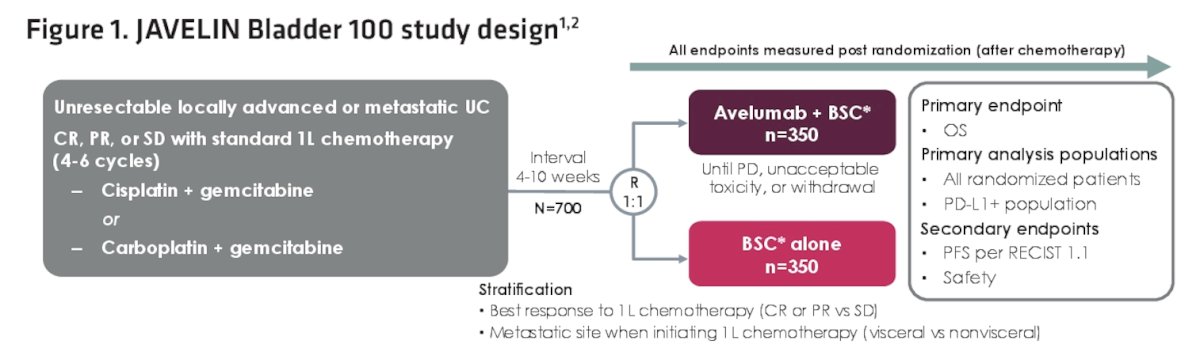
The primary endpoint was overall survival measured from randomization. Secondary endpoints included progression free survival measured from randomization and safety.
At randomization in the avelumab + best supportive care (n = 350) and best supportive care alone (n = 350) arms, 55 (15.7%) and 59 (16.9%) patients had documented controlled diabetes mellitus, and 295 and 291 patients did not have documented diabetes mellitus, respectively. Baseline characteristics in these subgroups are shown as follows:

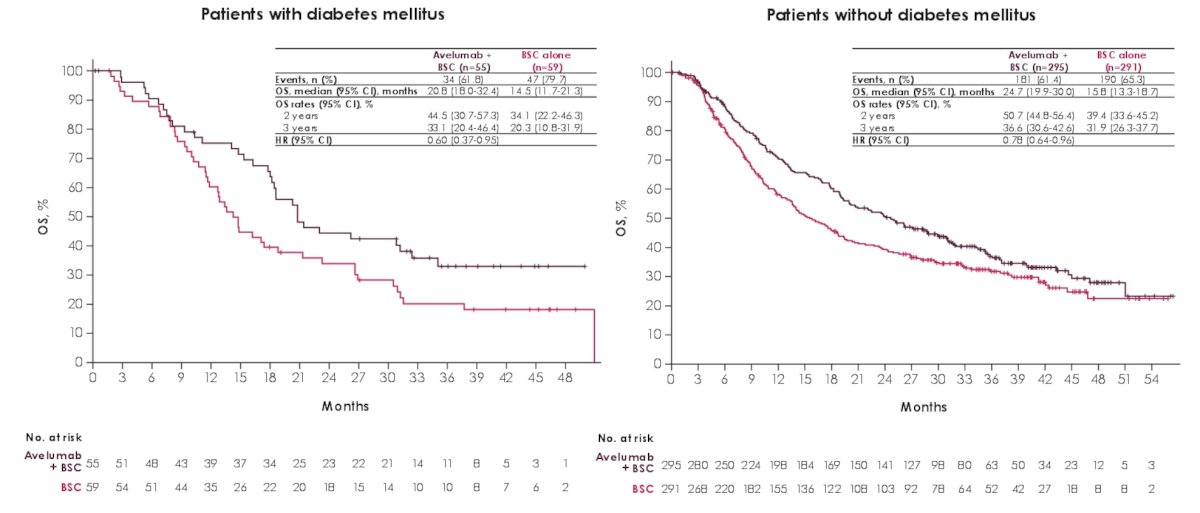
The median follow-up in both arms was ≥38.0 months (data cutoff: June 4, 2021). In patients with or without diabetes mellitus, overall survival was prolonged with avelumab + best supportive care versus best supportive care alone. The median overall survival in the avelumab + best supportive care versus best supportive care alone arms was 20.8 versus 14.5 months in patients with diabetes mellitus, and 24.7 versus 15.8 months in patients without diabetes mellitus:
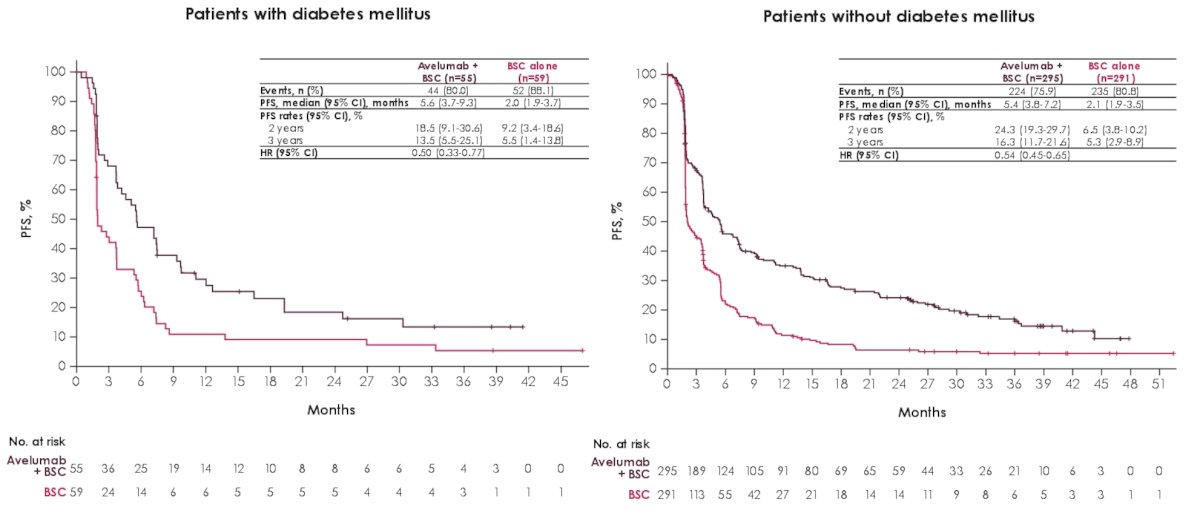
In patients with or without diabetes mellitus, progression free survival was prolonged with avelumab + best supportive care versus best supportive care alone. The median progression free survival in the avelumab + best supportive care versus best supportive care alone arms was 5.6 versus 2.0 months in patients with diabetes mellitus, and 5.4 versus 2.1 months in patients without diabetes mellitus:
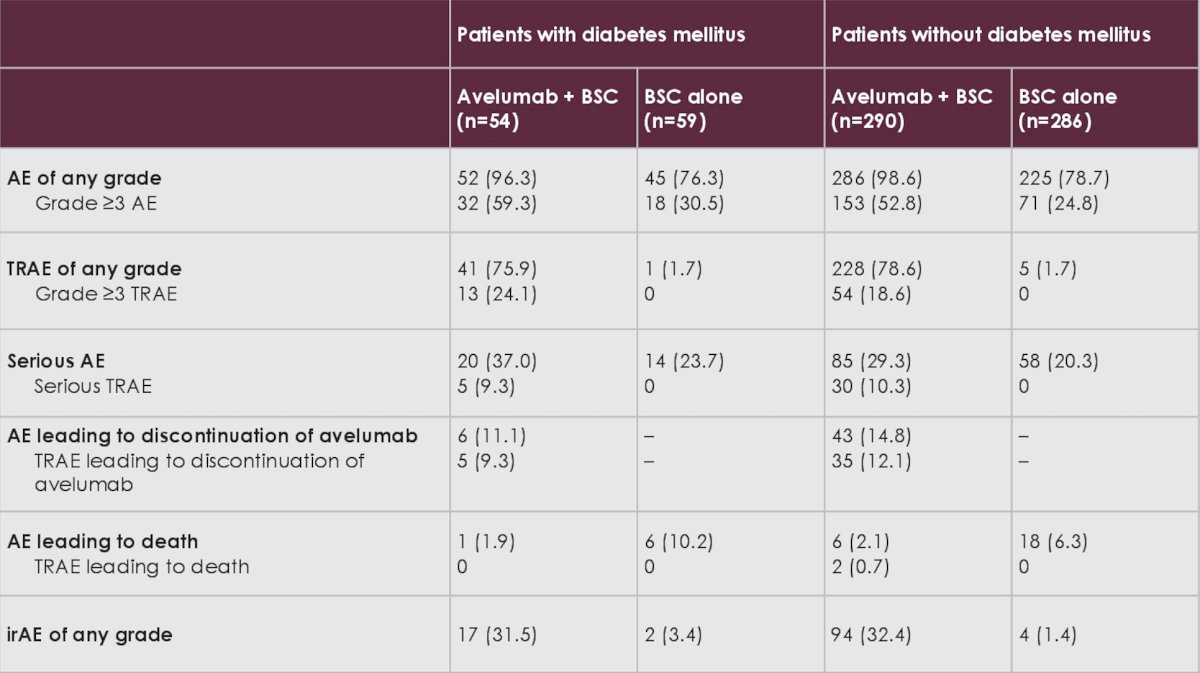
In the safety analysis set of avelumab-treated patients with (n = 54) or without (n = 290) diabetes mellitus, respectively, treatment-related adverse events of any grade occurred in 75.9% and 78.6% (grade ≥3 in 24.1% and 18.6%) and led to avelumab discontinuation in 9.3% and 12.1%, whereas immune-related adverse events of any grade occurred in 31.5% and 32.4%:
Limitations of this analysis include the exploratory nature of the analysis and the potential for missing diabetes mellitus diagnosis.
Dr. Gupta concluded her presentation discussing long-term outcomes from JAVELIN Bladder 100 assessing avelumab first-line maintenance in patients with advanced urothelial carcinoma with or without diabetes mellitus with the following take-home points:
- This study reported an exploratory subgroup analyses of long term efficacy and safety outcomes in patients with or without diabetes mellitus from the phase 3 JAVELIN Bladder 100 trial, which compared avelumab first line maintenance treatment + best supportive care versus best supportive care alone in patients with advanced urothelial carcinoma that had not progressed on first line platinum based chemotherapy
- In subgroups with or without diabetes mellitus, overall survival and progression free survival were prolonged with avelumab + best supportive care versus best supportive care alone
- The long term safety of avelumab first line maintenance was similar in patients with or without diabetes mellitus
- Overall, these results show that avelumab first line maintenance is associated with long term efficacy benefits and consistent safety in patients with advanced urothelial carcinoma with or without diabetes mellitus who are progression free after first line platinum based chemotherapy
Presented by: Shilpa Gupta, MD, Cleveland Clinic Taussig Cancer Institute, Cleveland, OH
Written by: Zachary Klaassen, MD, MSc – Urologic Oncologist, Associate Professor of Urology, Georgia Cancer Center, Wellstar MCG Health, @zklaassen_md on Twitter during the 2025 Genitourinary (GU) American Society of Clinical Oncology (ASCO) Annual Meeting, San Francisco, CA, Thurs, Feb 13 – Sat, Feb 15, 2025.
Related content: Avelumab’s Survival Impact in Diabetic vs Non-Diabetic Bladder Cancer Patients - Shilpa Gupta
References:
- Powles T, Park SH, Voog E, et al. Avelumab Maintenance Therapy for Advanced or Metastatic Urothelial Carcinoma. N Engl J Med 2020 Sept 24;383(13):1218-1230.