

(UroToday.com) The 2025 American Society of Clinical Oncology (ASCO) Genitourinary (GU) Annual Symposium held in San Francisco, CA was host to a urothelial carcinoma trials in progress poster session. Dr. Jianhui Chen presented a clinical trial evaluating the efficacy and safety of disitamab vedotin plus tislelizumab combined with re-TURBT in the treatment of HER-2-high expression (2+-3+) non-muscle invasive bladder cancer (NMIBC) at high- and very high-risk of disease progression.
HER2 expression (defined as IHC ≥1+) has been reported in approximately half of all patients across multiple tumor types, including urothelial carcinoma (UC), and may be associated with poor outcomes. Disitamab vedotin (DV; RC48-ADC) is an investigational antibody-drug conjugate (ADC) comprising a fully humanized HER2-directed monoclonal antibody, disitamab, conjugated to a monomethyl auristatin E (MMAE) via a protease-cleavable mc-vc linker. DV elicits antitumor activity through multimodal mechanisms of action, including MMAE-mediated direct cytotoxicity, bystander effect, and immunogenic cell death.
DV has shown encouraging activity with a manageable safety profile in a population of patients with HER2-expressing LA/mUC:
- As a single agent in a post-platinum setting (ORR: 50.5%; mPFS: 5.9 months; mOS: 14.2 months)1
- In combination with a PD-1 inhibitor in the 1st line setting (ORR in HER2 IHC 2/34, 83.3%; ORR in HER2 IHC 1+, 64.3%)2
Retrospective clinical data indicate that intravesical BCG therapy yields suboptimal outcomes in high- and very high-risk NMIBC patients exhibiting HER-2 overexpression (2+/3+), characterized by a substantial 1-year recurrence rate of 40–50% and a notably poor 5-year RFS rate of only 19%.3
However, the study investigators previously conducted a retrospective study observing 16 high- and very high-risk NMIBC patients with HER-2 expression (1-3+) from April 2022 to August 2024. In this study, 10 patients underwent TURBT followed by RC48 in combination with a PD-1 inhibitor and re-TURBT treatment (Group 1). Six patients only received RC-48 combined with a PD-1 inhibitor for 4-6 cycles after TURBT (Group 2). As of August 2024, the median follow-up time was 15 months (range: 4–29 months). The results showed that the 1-year EFS/DFS (Event-Free Survival/Disease-Free Survival) for Group 1 was 100%, and 88% for Group 2.
Current studies indicate that the combination of DV and PD-1 inhibitors can enhance the efficacy of systemic therapy in patients with HER2-positive urothelial carcinoma, with an acceptable safety profile. However, the evidence supporting its use in high- and very high-risk NMIBC remains limited. Therefore, this study aims to evaluate the efficacy and safety of the triplet regimen of disitamab vedotin, Tislelizumab (a PD-1 inhibitor), and re-TURBT in patients with HER2 IHC 2+ or 3+ high- and very high-risk NMIBC.
The study design is illustrated below:
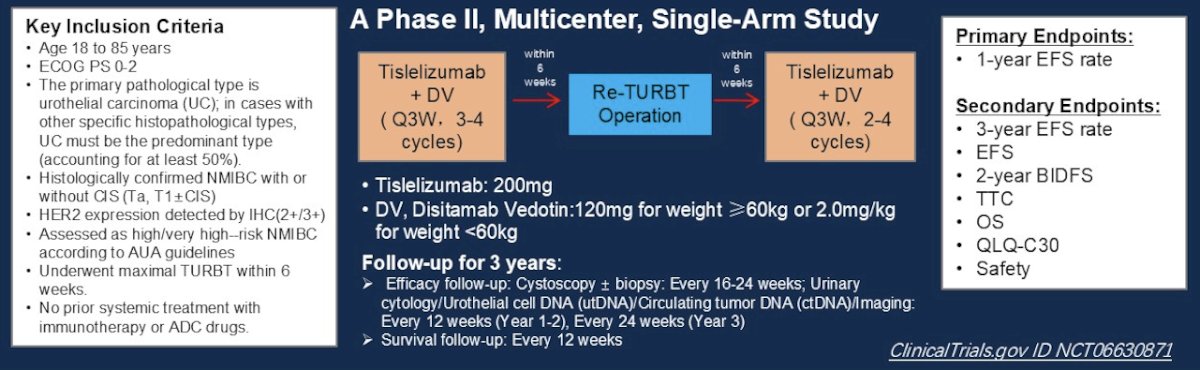
This study will include patients meeting the following eligibility criteria:
- AUA high- or very-high risk NMIBC (Urothelial carcinoma predominant type – i.e., ≥50%)
- HER2 expression detected by IHC (2+/3+)
- Underwent maximal TURBT within 6 weeks
- No prior systemic treatment with immunotherapy or ADC drugs
Eligible patients (n=10 ) will receive Tislelizumab (200 mg) + Disitamab Vedotin (120 mg for those weighing ≥60 Kg or 2 mg/Kg for weight <60 Kg) the day after the initial TURBT, with 3-4 cycles administered every 3 weeks thereafter. Patients will then undergo a second (i.e., re-staging) TURBT within 6 weeks, and after the surgery, they will continue with 2–4 additional courses of Tislelizumab + Disitamab Vedotin, every 3 weeks, until the end of the 3-year follow-up period.
The primary endpoint is the 1-year EFS rate. Secondary endpoints are:
- 3-year EFS rate
- EFS
- 2-year bladder-intact disease-free survival (BIDFS)
- Overall survival
- QLQ-C30
- Safety
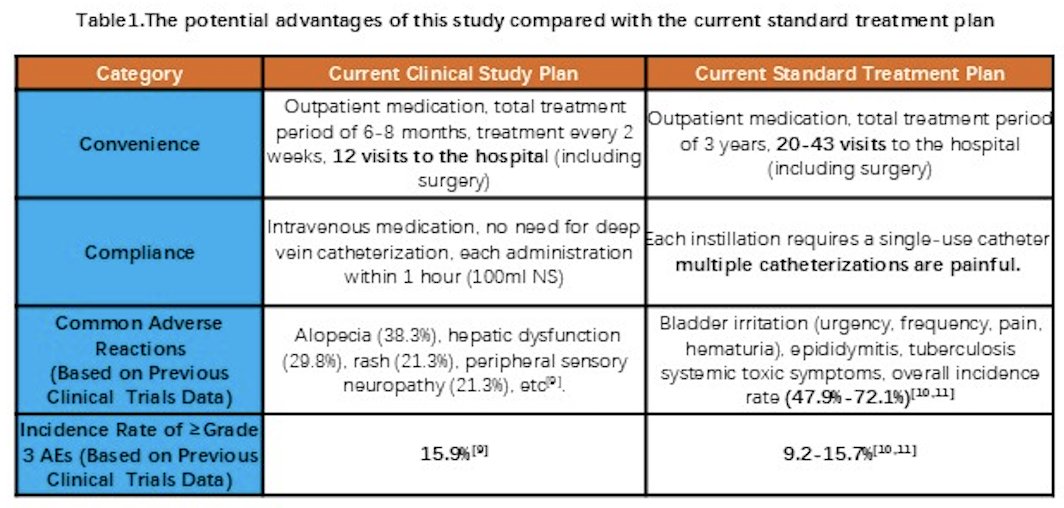
Dr. Chen noted that the potential advantages of this study, compared with currently available standards of care, include the following:
Presented by: Jianhui Chen, MD, Department of Urology, Fuji a Medical University Union Hospital, Fuzhou, China
Written by: Rashid K. Sayyid, MD, MSc – Robotic Urologic Oncology Fellow at The University of Southern California, @rksayyid on Twitter during the 2025 Genitourinary (GU) American Society of Clinical Oncology (ASCO) Annual Meeting, San Francisco, CA, Thurs, Feb 13 – Sat, Feb 15, 2025.
References:
- Sheng X. Efficacy and Safety of Disitamab Vedotin in Patients With Human Epidermal Growth Factor Receptor 2-Positive Locally Advanced or Metastatic Urothelial Carcinoma: A Combined Analysis of Two Phase II Clinical Trials. J Clin Oncol. 2023;JC02202912.
- Sheng X. Disitamab vedotin, a novel humanized anti-HER2 antibody-drug conjugate (ADC), combined with toripalimab in patients with locally advanced or metastatic urothelial carcinoma: An open-label phase 1b/2 study. ASCO 2023: Abstract 4566.
- Tan X. Eur Urol Oncol. 2024;7:760-9.