

(UroToday.com) The 2025 American Society of Clinical Oncology Genitourinary (ASCO GU) cancers symposium held in San Francisco, CA between February 13th and 15th 2025, was host to the Poster Session B: Urothelial Carcinoma. Dr. Matthew Galsky presented Abstract 793: Phase II study of oral APL-1202 plus tislelizumab or tislelizumab alone as neoadjuvant therapy in patients with muscle-invasive bladder cancer (MIBC).
APL-1202 (nitroxoline) is a reversible and orally available MetAP2 inhibitor with anti-angiogenic and anti-tumor activities and tislelizumab is a humanized IgG4 anti-PD-1 antibody. The interim results of the randomized phase II trial evaluating neoadjuvant tislelizumab with or without oral APL-1202 (nitroxoline), presented at ASCO GU last year, demonstrated promising pathological complete response (pCR) rates and met the prespecified criteria for study expansion. Specifically, the pCR rate was 39% in Group 1 (tislelizumab + APL-1202) compared to 21% in Group 2 (tislelizumab alone). Similarly, the pathological downstaging rate (<pT2N0) was 44% in Group 1 versus 21% in Group 2. Dr. Galsky and colleagues have now reported the final primary endpoint analysis of this trial.
This prospective, multicenter, randomized phase II trial (NCT04813107) enrolled patients with cT2-T4aN0M0 urothelial carcinoma of the bladder, based on local assessment, who were planned for radical cystectomy (RC) and were either ineligible for or refused cisplatin-based chemotherapy. Patients were randomly assigned to receive either APL-1202 plus tislelizumab or tislelizumab (T), with stratification based on PD-L1 expression. Neoadjuvant tislelizumab was administered every three weeks for three cycles, while APL-1202 was given orally three times daily.
The primary endpoint was the centrally assessed pathological complete response (pCR, pT0N0) rate, while key secondary endpoints included central pathological response (PaR, <ypT2N0) rate and safety.
A total of 103 patients were accrued and enrolled in the trial. Of these, 28 patients declined RC after neoadjuvant treatment, leaving 75 patients in the efficacy analysis set. RC was completed in 42 of 43 patients in the tislelizumab + APL-1202 group and in 31 of 32 patients in the tislelizumab-alone group. Notably, on retrospective central pathology review of baseline TURBT specimens, a significant subset of patients (33/75) were determined to be ineligible due to having <cT2 disease.
The primary endpoint of pCR was achieved in 33% of patients in the combination arm compared to 26% in the tislelizumab-alone arm. In an exploratory analysis of the retrospectively defined 'protocol-eligible' subset, the pCR rate was numerically higher, with 41% (9/22) in the tislelizumab + APL-1202 group versus 20% (4/20) in the tislelizumab-alone group.
Central pathological response (PaR) was observed in 44% of patients in the combination arm and 41% in the tislelizumab-alone arm.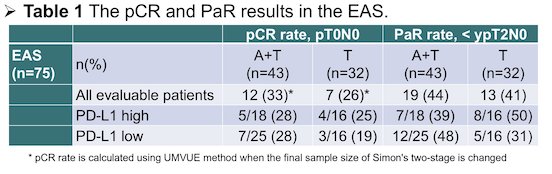
Treatment-related adverse events (TRAEs) occurred in 59% (35/59) of patients in the APL-1202 + tislelizumab arm and 44% (19/44) in the tislelizumab-alone arm. Notably, the majority (94%) of TRAEs were ≤ CTCAE grade 2.
Dr. Galsky concluded his poster with the following key takeaways:
- Neoadjuvant APL-1202 + tislelizumab was safe in cisplatin-ineligible patients undergoing radical cystectomy (RC).
- Assessing efficacy in MIBC is challenging due to a large subset of patients (33/75) retrospectively determined to have <cT2 disease and by a significant number of patients declining RC post-neoadjuvant treatment (28/103)
- A potential signal of increased activity with A+T was observed in PD-L1 "low" tumors (pCR 28% vs 19%), warranting further exploration of its immunomodulatory effects.
Presented by: Matthew Galsky, MD, Director of Genitourinary Medical Oncology at Tisch Cancer Institute/Mount Sinai School of Medicine, New York, United States of America.
Written by: Julian Chavarriaga, MD – Urologic Oncologist at Cancer Treatment and Research Center (CTIC) via Society of Urologic Oncology (SUO) Fellow at The University of Toronto. @chavarriagaj on Twitter during the 2025 Genitourinary (GU) American Society of Clinical Oncology (ASCO) Annual Meeting, San Francisco, CA, Thurs, Feb 13 – Sat, Feb 15, 2025.