

(UroToday.com) The 2024 American Society of Clinical Oncology Genitourinary (ASCO GU) cancers symposium held in San Francisco, CA between January 25th and 27th was host to a prostate cancer poster session. Dr. Neal Shore presented an analysis of the impact of a rash management guide on the incidence and severity of rashes with apalutamide using data from the Apa-RP study in high-risk, localized prostate cancer.
Apalutamide is an androgen receptor pathway inhibitor (ARPI) approved for patients with non-metastatic castration-resistant patients (SPARTAN)1 and metastatic castration-sensitive prostate cancer patients (TITAN).2 The safety profile of apalutamide was similar across both indications, with skin rash emerging as a common adverse event. In the subsequent phase II Apa-RP study, a rash management guide was implemented to help reduce dermatologic adverse events.3
In this analysis, Dr. Shore and colleagues presented the rash-related safety data from Apa-RP and descriptively compared it with data from SPARTAN and TITAN.
Apa-RP was a multicenter, open-label, single-arm phase II trial of adjuvant treatment with apalutamide plus ADT for treatment-naïve patients with high-risk localized prostate cancer who underwent radical prostatectomy (NCT04523207). This trial exclusively included a US population recruited from 28 large-group urologic practices. A standardized questionnaire was utilized during scheduled phone calls to help patients quickly identify the onset of rash, take preventive measures, and immediately seek necessary medical attention.
In Apa-RP, the pre-specified rash management guide outlined proactive steps for the medical management of rash, as well as educating patients on gentle skin care to reduce the onset and severity of rash events, which includes the use of light emollients and antiseptic-containing soap substitutes. Patients were advised to avoid harsh soaps, exposure to strong sun conditions, hot baths, showers, and saunas.
Rash incidence, severity, treatment, time to first onset, resolution, and time to resolution data were collected:
- Rash occurrence was monitored, and skin-related adverse events were defined by Common Terminology Criteria for Adverse Events (CTCAE) v5.0 grading scale
- Time to first onset of rash was defined as the number of days between the first dose of the study drug and the first rash
- Time to resolution was defined as the number of days from the date of first rash to complete resolution of all rash.
- Rash was considered resolved at resolution of all skin lesions.
Data from Apa-RP was descriptively compared to data from the North American populations of the global SPARTAN and TITAN studies.
All 108 patients enrolled in Apa-RP were treated with apalutamide 240 mg once daily for a maximum of twelve 28-day cycles. Of these 108 patients, 96 received injectable ADT and 12 received oral relugolix.
With regards to rash incidence and severity, fewer patients experienced any-grade rash in Apa-RP compared to those in the North American populations of SPARTAN and TITAN (21% versus 28% and 33%, respectively).
61% of rash events in Apa-RP were considered Grade 1, compared with 40% and 29% of the rash events in the North American populations of SPARTAN and TITAN.
The median time to first report of rash was shorter in Apa-RP at 79 days, versus 98 days and 84 days in SPARTAN and TITAN, respectively. In APA-RP, 96% of events resolved, compared to 94% and 57% in SPARTAN and TITAN. The median time to rash resolution was also shorter in Apa-RP at 46 days, versus SPARTAN (60 days) and TITAN (142 days).
The proportion of patients with any-grade rash who underwent dose reductions, treatment interruptions, or treatment discontinuations was lower in Apa-RP (4%, 26%, 0%), versus SPARTAN (10%, 24%, 6%), and TITAN (19%, 33%, 10%). The proportion of patients who developed rash and received systemic corticosteroids, topical corticosteroids, or oral antihistamines varied between the three studies.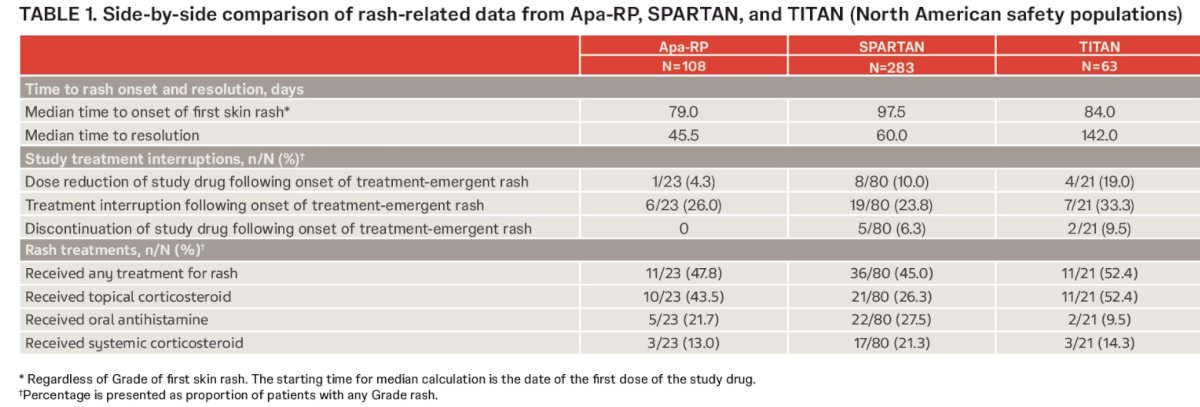
Dr. Shore concluded as follows:
- The Apa-RP rash management guide demonstrates a proactive and patient-empowered approach to monitoring and managing patients on apalutamide who develop skin rash.
- Patients in Apa-RP experienced lower overall incidence of rash, and for those who did experience a rash, there was reduced severity, a shortened time to resolution, and lower rates of dose reduction, and treatment interruption or discontinuation, compared to those in SPARTAN and TITAN.
- Improvements in rash management in Apa-RP suggest that early identification and intervention may help reduce the incidence, severity, and time to resolution of rash during treatment with apalutamide.
Presented by: Neal Shore, MD, FACS, Urologist, Director, CPI, Carolina Urologic Research Center, Atlantic Urology Clinics, Myrtle Beach, SC
Written by: Rashid Sayyid, MD, MSc – Society of Urologic Oncology (SUO) Clinical Fellow at The University of Toronto, @rksayyid on Twitter during the 2024 American Society of Clinical Oncology Genitourinary (ASCO GU) Cancers Symposium, San Francisco, CA, January 25th – January 27th, 2024
References:- Smith MR, Saad F, Chowdhury S, et al. Apalutamide treatment and metastasis-free survival in prostate cancer. N Engl J Med 2018;378(15):1408-1418.
- Chi KN, Agarwal N, Bjartell A, et al. Apalutamide for metastatic, castration-sensitive prostate cancer. N Engl J Med 2019 Jul 4;381(1):13-24.
- Brown G, Belkoff L, Hafron JM, et al. Coadministration of Apalutamide and Relugolix in Patients with Localized Prostate Cancer at High Risk for Metastases. Target Oncol. 2023;18(1):95-103.