

(UroToday.com) The 2024 GU ASCO annual meeting featured a urothelial carcinoma rapid oral abstract session, including a presentation by Dr. Antonio Cigliola discussing a comparative comprehensive genomic profiling study of urachal and non-urachal adenocarcinoma of the bladder. Urachal and non-urachal adenocarcinomas of the bladder are rare: 0.2% urachal adenocarcinoma, 0.5% - 2.0% non-urachal adenocarcinoma make up all bladder cancers. Although both urachal and non-urachal bladder adenocarcinoma share several histological similarities, they differ in site of origin and optimal treatment paradigms. They are both relatively resistant to conventional cisplatin-based chemotherapy and surgical resection is the only curative option for organ-confined stages. The goal of this study was to investigate the differences of genomic alterations between these tumor types, with the aim of identifying potential therapy targets.
A total of 133 urachal and 328 non-urachal adenocarcinomas were analyzed from a series of Formalin-Fixed Paraffin-Embedded tissues obtained from clinically advanced bladder tumors. Hybrid-capture-based comprehensive genomic profiling was performed to evaluate all classes of genomic alterations. Genomic ancestry and gene signatures, including the somatic-germline nature, were determined with algorithm-based analysis of sequencing data. Tumor mutational burden was determined based on at least 0.8 Mbp of sequenced DNA, and microsatellite instability (MSI) was assessed on at least 1500 loci.
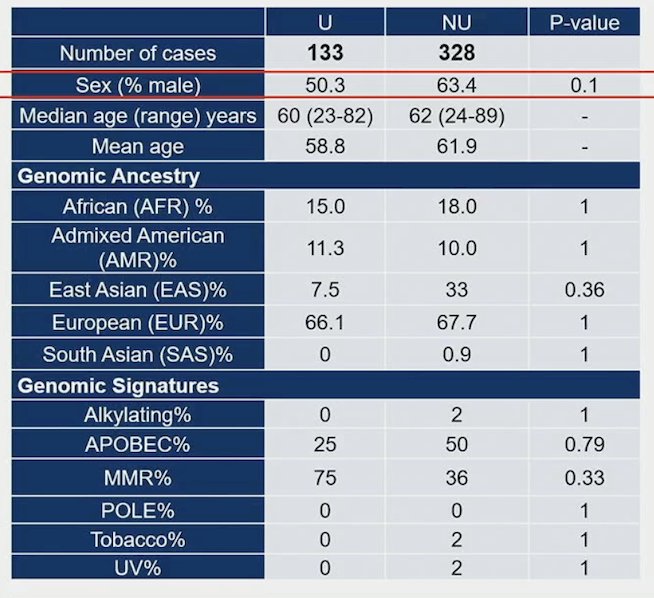
Sex distribution for urachal adenocarcinoma was similar (male 50.4%; female 49.6%), whereas more men were diagnosed with non-urachal adenocarcinoma (male 63.4%; female 36.6%). Median ages were similar between the two groups (60 vs 62 years for urachal and non-urachal, respectively):
The most frequent genomic alterations in both urachal and non-urachal cohorts included TP53 (86.5% vs 81.1%) and KRAS (34.6% vs 27.7%):

Genomic alterations characteristic of colorectal adenocarcinoma, such as SMAD4 and GNAS, were more common in urachal vs non-urachal (28.6% vs 16.5% for SMAD4, p = 0.069; 18% vs 8.8% for GNAS, p = 0.071). Conversely, mutations typical of urothelial carcinoma, including TERT and RB1, were prevalent in non-urachal adenocarcinoma (14.7% vs 0.77% for TERT, p < 0.01; 9.2% vs 2.3% for RB, p = 0.071). Notably, both urachal and non-urachal adenocarcinoma exhibited targetable genomic alterations in PIK3CA (7.5% vs 7.9%) and ERBB2 (6.8% vs 7.6%). Biomarkers associated with potential benefit from anti-PD(L)1 were infrequent. These tumors were generally MSI stable, with a low tumor mutational burden (2.61 vs 3.48 mutation/Mb for urachal and non-urachal, respectively) and did not frequently show PD-L1 expression even at a low cut-off of > 1% (5 cases in urachal vs 4 in non-urachal). Genomic ancestry distributions were similar, with European frequency being 66% in urachal and 68% in non-urachal patients. Genomic signatures were similar with both tumor types featuring a predominant mix of APOBEC (25% vs 50%) and MMR signatures (75% vs 36%).
Limitations of this study include the lack of clinical data annotation, retrospective and descriptive study design, lack of randomized control group, variability in therapies received, different surveillance and follow-up protocols, selection bias, and residual confounding.
Dr. Cigliola concluded his presentation discussing a comparative comprehensive genomic profiling study of urachal and non-urachal adenocarcinoma of the bladder with the following take-home points:
- Urachal and non-urachal adenocarcinoma revealed notable differences in genomic alterations, while PIK3CA and ERBB2 were identified as potential therapy targets in both groups
- Less frequent genomic alterations may also be useful to provide rationale for including of these entities in basket trials testing novel single combination therapeutic strategies
- Putative biomarkers of response to anti-PD(L)1 were uncommon
- This study highlights the potential of comprehensive genomic profiling to personalize the treatment of bladder adenocarcinoma and may inform clinical trial designs for these tumors
Presented by: Antonio Cigliola, MD, Medical Oncology Department, IRCCS San Raffaele Hospital, Milan, Italy
Written by: Zachary Klaassen, MD, MSc – Urologic Oncologist, Associate Professor of Urology, Georgia Cancer Center, Wellstar MCG Health, @zklaassen_md on Twitter during the 2024 American Society of Clinical Oncology Genitourinary (ASCO GU) Cancers Symposium, San Francisco, CA, January 25th – January 27th, 2024