

(UroToday.com) On the third day of the American Society for Clinical Oncology (ASCO) Genitourinary Cancer Symposium 2023, the Rapid Abstract Session focused on Renal Cell Cancer and Rare Tumors. In this context, Dr. Laurence Albiges presented interim results of the CaboPoint trial, a phase 2 study assessing cabozantinib for patients with advanced renal cell carcinoma (aRCC) following prior treatment with checkpoint inhibitor (CPI) therapy.
Over the past few years, the treatment landscape for patients with aRCC has been revolutionized. Combination therapy relying on a CPI backbone has become the standard of care. However, optimal second (and later) line treatment approaches remain to be better defined. One potential treatment approach is the use of cabozantinib, a multi-target TKI originally approved as a second line treatment after prior VEGF-targeted therapy.
The authors designed CaboPoint (ClinicalTrials.gov identifier: NCT03945773) as an ongoing Phase 2, multicenter, open-label study of cabozantinib in adults with unresectable, locally advanced, or metastatic clear cell RCC who have progressed after 1L CPI-based therapy. To be eligible, patients could not have received prior treatment with cabozantinib.
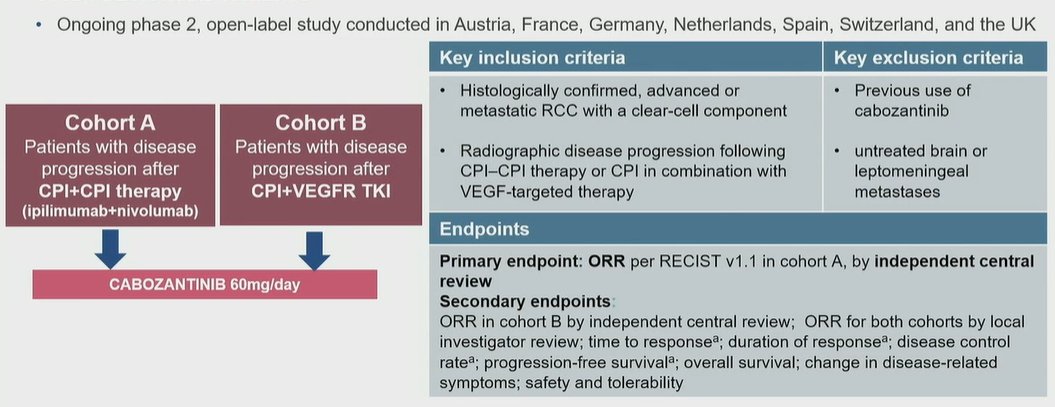
Once enrolled, patients received cabozantinib in two independent cohorts (cohort A [post nivolumab + ipilimumab] and cohort B [post CPI + vascular endothelial growth factor targeted therapy]). Both cohorts received cabozantinib (60 mg/day as starting dose) until study end (18 months after last patient’s enrollment). The primary endpoint was objective response rate (ORR) in Cohort A per RECIST 1.1 evaluated by independent central review. ORR by investigator review was evaluated as a secondary endpoint for both cohorts. In this abstract, the authors reported a pre-planned interim analysis of ORR based on investigator assessment in both cohorts that occurred when 80% of patients in cohort A reached at least 3 months of treatment.
As of the time of this interim analysis data cut-off, 88 patients had at least 3 months of follow up (60 in cohort A and 28 in cohort B). Baseline characteristics were similar across cohorts. The majority of patients had an Eastern Cooperative Oncology Group status of 0 (55.0% and 60.7% in cohort A and B, respectively) and an intermediate or poor International Metastatic RCC Database Consortium risk (intermediate: 46.3% and 40.7% for groups A and B, respectively; poor: 13.0% and 11.1% for groups A and B, respectively). The most common prior treatment in cohort B was pembrolizumab + axitinib (71.4%), followed by avelumab + axitinib (28.6%).
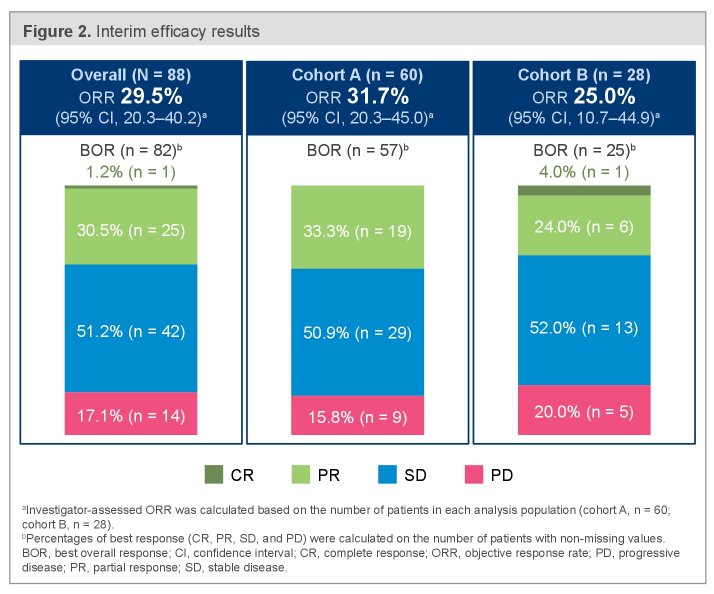
Overall, one patient experienced a complete response, and 25 experienced partial responses. Thus, as highlighted below, the authors found that the ORR was 29.5% (95% CI 20-40%) in the overall cohort, with some stratification between the groups: in cohort A, the ORR was 32% (95% CI 20-45%) while it was somewhat lower among patients in cohort B (ORR 25%, 95% 11-45%).
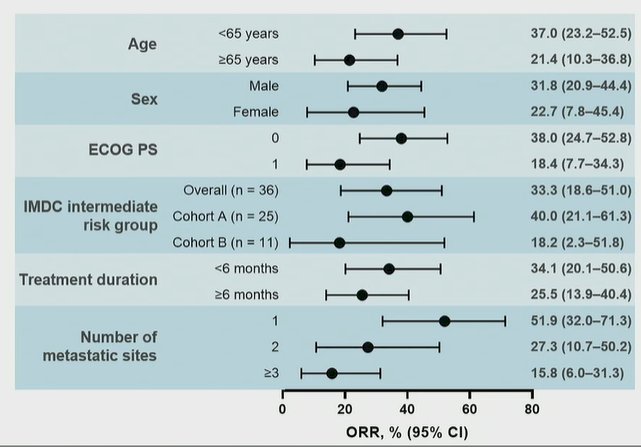
In subgroup analyses, she noted that efficacy of second-line cabozantinib was observed across multiple subgroups, irrespective of first-line treatment approach in those with intermediate-risk disease. However, Dr. Albiges noted that in patients in cohort A who received nivolumab and ipilimumab who had intermediate risk disease, the OOR was 40%. Additionally, there was strong objective response among patients with a short treatment duration (<6 months), consistent with progressive disease.
Thus, Dr. Albiges concluded that, as of this interim analysis, cabozantinib demonstrates preliminary efficacy with high response rates in patients with advanced RCC after progression on CPI-based combination therapy, irrespective of 1L regimen. This study remains ongoing the final analysis anticipated in September 2023.
Presented by: Laurence Albiges, MD, PhD; Medical Oncology, Gustave Roussy, Université Paris SaclayWritten by: Christopher J.D. Wallis, University of Toronto Twitter: @WallisCJD during the 2023 Genitourinary (GU) American Society of Clinical Oncology (ASCO) Annual Meeting, San Francisco, Thurs, Feb 16 – Sat, Feb 18, 2023.
Related Content:
CaboPoint Study: Cabozantinib After Checkpoint Inhibitor Therapy in Patients with Advanced Renal Cell Carcinoma - Laurence Albiges