

(UroToday.com) The 2023 GU ASCO annual meeting included a session on urothelial carcinoma, featuring a presentation by Dr. Kyle Rose discussing prediction of downstream recurrence using complimentary genomic, pathologic, and artificial intelligence analysis for low-grade noninvasive bladder cancer. Low-grade noninvasive bladder cancer is a relatively quiescent but heterogeneous malignancy, characterized by downstream recurrences requiring repeated transurethral resections and frequent surveillance. Investigations to elucidate drivers of recurrence have been sparse, but will help risk-stratify patients with low-grade noninvasive tumors and allow augmentation of follow up protocols.
Patients with low-grade noninvasive index tumors were stratified by those with no downstream recurrences (nonrecurrent) versus those with later recurrences (recurrent). RNA sequencing identified differentially expressed genes, deconvoluted for cell-type using xCell. Pathologic analysis was performed by a genitourinary pathologist, then a deep-learning artificial intelligence platform was leveraged to correlate recurrence risk and recurrence-free survival based on deep-learning algorithm of segmented nuclei.
This study had 29 index bladder tumors/patients, 17 (59%) of which had later recurrence. The median follow-up was 59.0 months (IQR 48.5-75.8), and the median number of recurrences following initial diagnosis was 4 (IQR 2-10) in the recurrence cohort:

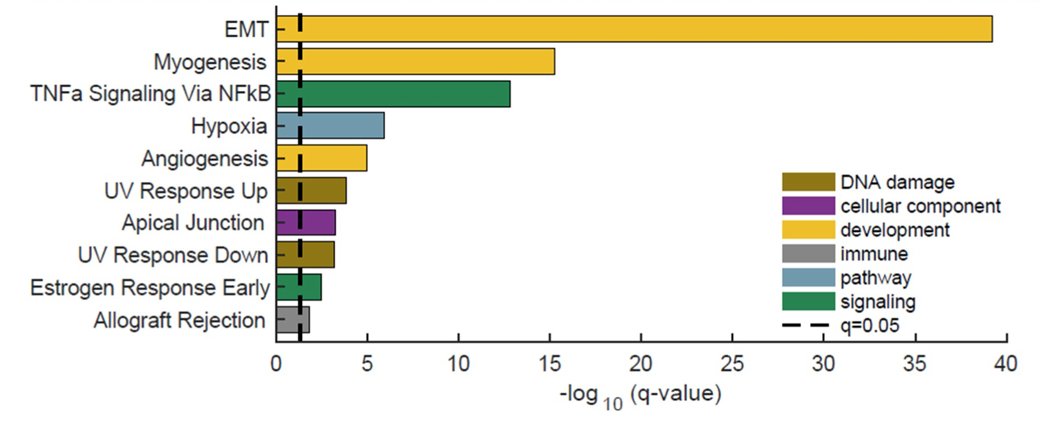
There were 238 differentially expressed genes recognized, with recurrent tumors expressing signatures for:
- Epithelial mesenchymal transition
- Myogenesis
- TNFα signaling via NFκB
- Angiogenesis
Recurrent tumors also demonstrated a higher tissue microenvironment, stroma, and cancer-associated fibroblast score:
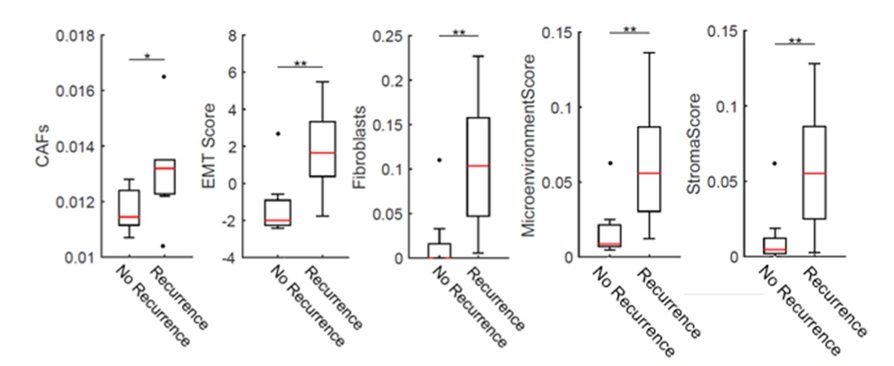
Pathologic tumor microenvironment analysis validated these findings, with recurrent tumors demonstrating a higher frequency of inverted growth pattern and a higher median stroma percentage. Finally, the artificial intelligence-derived signature was predictive of recurrence (AUC 0.81) and risk-stratified the cohort (HR 5.43, 95% CI 1.1-26.76) for predicting high versus low risk of recurrence. Patients in the high risk group had a 87.5% recurrence rate while those in the low risk group had a 28.5% recurrence rate (p<0.01):

Dr. Rose concluded his presentation discussing prediction of downstream recurrence using complimentary genomic, pathologic, and artificial intelligence analysis for low-grade noninvasive bladder cancer with the following take-home messages:
- Using a multi-disciplinary approach, this study identified key signatures in recurrent low-grade noninvasive bladder cancer
- Characterization of these factors is a critical first step in the risk-stratification of low-grade noninvasive bladder cancer, and may allow risk-stratification of surveillance protocols and identification of possible targets for chemoprevention trials
Presented by: Kyle M. Rose, MD, Moffitt Cancer Center, Tampa, FL
Co-Authors: Aram Vosoughi, Gustavo Borjas, Heather L Huelster, Philippe E. Spiess, Anders E. Berglund, Wade J. Sexton, Anirudh Joshi, Nagi B. Kumar, Roger Li
Written by: Zachary Klaassen, MD, MSc – Urologic Oncologist, Assistant Professor of Urology, Georgia Cancer Center, Augusta University/Medical College of Georgia, @zklaassen_md on Twitter during the 2023 Genitourinary (GU) American Society of Clinical Oncology (ASCO) Annual Meeting, San Francisco, Thurs, Feb 16 – Sat, Feb 18, 2023.