

(UroToday.com) The 2022 GU ASCO Annual meeting included a prostate cancer session featuring work from Dr. Masatoshi Hotta and colleagues presenting results assessing kinetics of PSMA PET uptake in prostate cancer lesions after radiation therapy. External body radiation therapy (EBRT) is essential in the management of localized and metastatic prostate cancer. PSMA PET/CT can provide higher diagnostic performance than conventional imaging, and has a high impact on treatment strategy. Furthermore, the kinetics of PSMA PET uptake in prostate cancer lesions after radiation therapy (RT) is unknown. Thus, the aim of this study was to assess the patterns of PSMA PET uptake in irradiated lesions using serial PSMA PET/CT scans.
This was a single-center retrospective study that included patients with prostate cancer who underwent one PSMA PET/CT scan before RT and at least one other scan after RT between November 2016 and July 2021. One reader (Dr. Hotta) analyzed the target lesions uptake by visual criteria (uptake above background) and semi-quantitative analysis. Lesions with and without residual uptake were compared for:
- Time-interval after RT
- Lesion tissue type (prostate, prostate bed, lymph node, and bone)
- RT type (stereotactic body RT, intensity-modulated RT, three-dimensional conformal RT, and proton therapy)
- Baseline uptake intensity (SUVmax)
- PSMA-derived tumor volume (PSMA-TV)
Lesions with residual uptake were followed-up. Diagnosis of recurrence was made by biopsy or subsequent PSMA PET/CT where increased PSMA uptake from the previous scan was considered a recurrence.
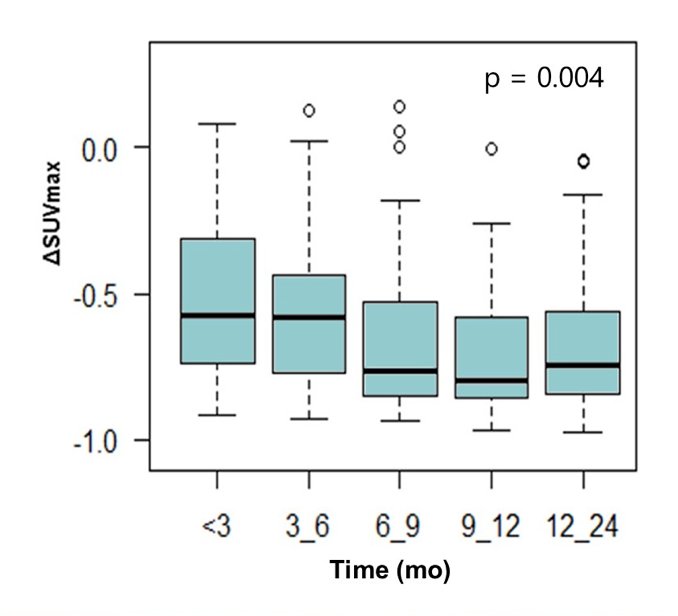
A total of 108 patients with available clinical and imaging data on 257 irradiated lesions (lymph node: n = 126; bone: n = 98; prostate: n = 25; prostate bed: n = 8) were included. The median time from end of RT to follow-up PET was 10.6 (range: 0.4-51.7) months and the residual uptake after RT was observed in 35.0% of the irradiated lesions. The mean decrease in SUVmax on the follow-up PET performed at < 3, 3-6, 6-9, and 9-12 months post-RT were 41.4%, 53.8%, 65.6%, and 69.7% (p = 0.004), respectively, suggesting that the lesions disappears over time:
Residual uptake was more commonly seen in the prostate (68.0% vs bone 40.8% vs prostate bed 25.0% vs lymph node 24.8%, p < 0001), and associated with higher baseline uptake and lesion size: (residual uptake positive vs negative: SUVmax 9.5 vs 6.4, p < 0.001; PSMA-TV 1.7 vs 1.0 ml, p = 0.002).
In multivariate logistic regression analysis, shorter time after RT (OR 0.93, 95% CI 0.89-0.97), higher baseline SUVmax (OR 1.07, 95% CI 1.03-1.11), and target lesions in the prostate (vs lymph node: OR 6.84, 95% CI 2.19-21.30) were independently associated with residual uptake. Among the lesions with residual uptake, 28/90 (31.1%) lesions were subsequently evaluated by biopsy and/or follow-up PSMA PET, and 6/28 (21.4%) lesions were eventually diagnosed as recurrence. Risk factors of recurrence were a residual uptake observed after a long time-interval from the end of RT (recurrence vs non-recurrence: 15.8 vs 3.7 months, p = 0.002) and a prostate lesion (prostate 50.0%; bone 12.5%; lymph node 0.0%, p = 0.044). When using a cutoff value of > 8.6 months after RT, the presence of residual uptake was diagnostic of recurrence with a sensitivity of 0.83 and specificity of 0.86 (AUC: 0.92).
Dr. Hotta concluded this presentation by assessing kinetics of PSMA PET uptake in prostate cancer lesions after radiation therapy with the following take-home messages:
- Lesion uptake decreases gradually after RT and reaches its lowest level at 9-12 months
- The PSMA PET signal in prostate lesions remains longer than bone and lymph node
- A longer persistent uptake (> 8.6 months), particularly in the prostate, should suggest a risk of potential local progression
Presented by: Masatoshi Hotta, MD, PhD, University of California Los Angeles, Los Angeles, CA
Co-Authors: Kathleen Nguyen, Pan Thin, Wesley R Armstrong, Andrei Gafita, Matthias R. Benz, Johannes Czernin, Amar Upadhyaya Kishan, Nicholas George Nickols, Jeremie Calais
Written by: Zachary Klaassen, MD, MSc – Urologic Oncologist, Assistant Professor of Urology, Georgia Cancer Center, Augusta University/Medical College of Georgia, @zklaassen_md on Twitter during the 2022 American Society of Clinical Oncology Genitourinary (ASCO GU) Cancers Symposium, Thursday Feb 17 – Saturday Feb 19, 2022