

(UroToday.com) The 2022 GU ASCO Annual meeting included a prostate cancer session highlighting work from Dr. Daniel Nemirovsky and colleagues presenting results of their study tailoring 4Kscore thresholds to multiparametric MRI (mpMRI) results. The 4Kscore was developed and validated agnostic to prostate mpMRI findings, with current clinical paradigms utilizing a value of 7.5% to delineate the potential for high-grade disease. A growing body of evidence suggests improved diagnostic utility when used in conjunction with mpMRI results. The incorporation of mpMRI PIRADS scores may have the potential to enhance the diagnostic accuracy of 4Kscore, especially for non-definitive lesions. The aim of this study was to examine the optimal 4Kscore threshold in PIRADS 3/4 lesions to maximize test utility and help guide clinical decision-making.
This was a single-institution review of all patients with recorded 4Kscore, prostate MRI with dominant PIRADS 3/4 lesions, and final biopsy pathology from 2016-2020. Clinically significant prostate cancer was defined as Gleason score ≥3+4 on final biopsy. Receiver operating characteristic curves were generated, and the primary data point was chosen to maximize sensitivity and specificity.
There were 88 patients with dominant PIRADS 3 (n = 40) or PIRADS 4 (n = 48) lesions identified. For patients with PIRADS 3 lesions, area under the curve (AUC) was 0.81 (p < 0.0039) with optimal 4Kscore threshold to detect clinically significant prostate cancer as 18.5% (sensitivity = 70.0%, specificity = 80.0%). Negative predictive value (NPV) at 4Kscore of 18.5% in PIRADS 3 lesions was 0.93. In patients with dominant PIRADS 4 lesions, AUC was 0.77 (p < 0.002), and optimal threshold to detect clinically significant prostate cancer was 21.5% (sensitivity = 70.6%, specificity = 76.7%). The NPV at 4Kscore of 21.5% in PIRADS 4 lesions was 0.82. Receiver operating curves demonstrating 4Kscore’s ability to identify clinically significant prostate cancer in patients with PIRADS 3 and PIRADS 4 lesions is as follows:
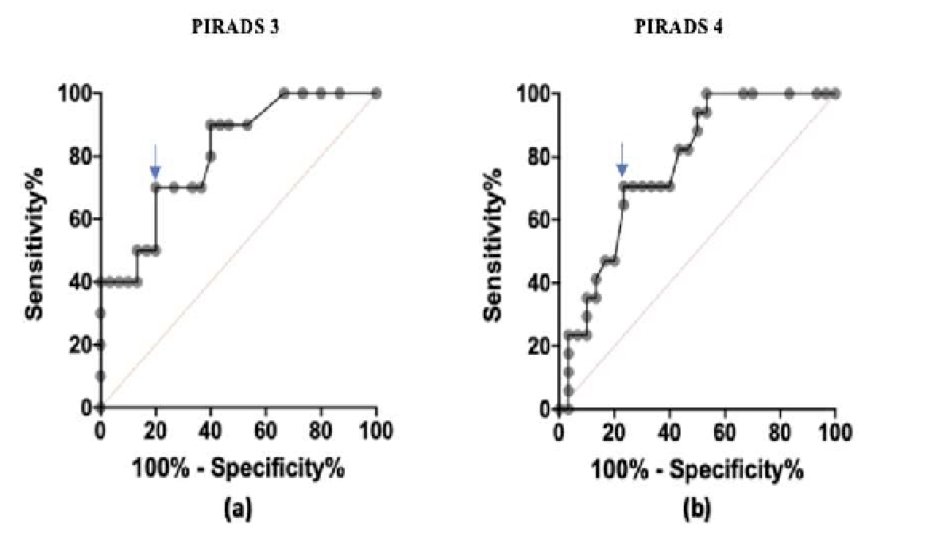
Dr. Nemirovsky concluded his presentation presenting results of their study tailoring 4Kscore thresholds to mpMRI results with the following take home messages:
- Stratification of mpMRI PIRADS 3/4 lesions suggests that utilization of more permissive 4Kscore thresholds can improve prediction of clinically significant prostate cancer without sacrificing NPV, especially for PIRADS 3 lesions
- These findings may enhance risk-adapted prostate cancer screening, reduce unnecessary prostate biopsies, and optimize clinical management
Presented By: Daniel R. Nemirovsky, MD, George Washington University School of Medicine and Health Sciences, Washington, DC
Co-Authors: Akshay G Reddy, Benjamin McSweeney, Charles Klose, Joyce Chen, Matthew Atienza, Shawn Haji-Momenian, Danish Imtiaz, Michael Joseph Whalen
Affiliations: George Washington University School of Medicine and Health Sciences, Washington, DC, East Carolina University, Greenville, NC, California Northstate University, Elk Grove, CA
Written By: Zachary Klaassen, MD, MSc – Urologic Oncologist, Assistant Professor of Urology, Georgia Cancer Center, Augusta University/Medical College of Georgia, @zklaassen_md on Twitter during the 2022 American Society of Clinical Oncology Genitourinary (ASCO GU) Cancers Symposium, Thursday Feb 17 – Saturday Feb 19, 2022