

(UroToday.com) On the first day of the American Society for Clinical Oncology (ASCO) Genitourinary Cancer Symposium 2022, Poster Session A focussed on the care of patients with prostate cancer. Dr. Shore presented a poster outline MiCheck as a prostate blood test to identify aggressive prostate cancer. There remains a great clinical need for a more accurate diagnostic test to identify patients for prostate biopsy. MiCheck is a Luminex based test for aggressive prostate cancer. The work presented at today’s meeting describes additional analytical validation and model development using the MiCheck-01 clinical samples to facilitate widespread deployment. A novel algorithm, termed MiCheck Prostate, was developed to differentiate aggressive prostate cancer (Gleason 3+4 or above) from non-aggressive (GS3+3) or no cancer patients.
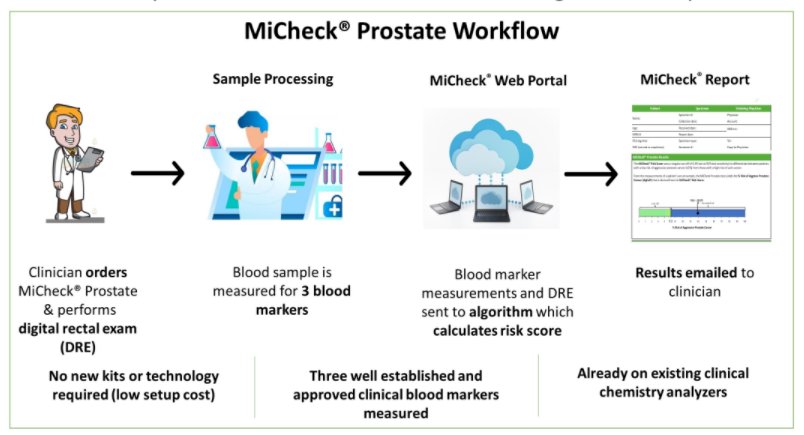
The authors measured serum protein biomarkers among 317 samples from the MiCheck-01 clinical trial using either Luminex Multiplex kits, Abbott ARCHITECT or Beckmann Coulter systems. They then used logistic regression models to maximize the detection of aggressive prostate cancer. A second, independent cohort of 79 samples from Maquarie University Hospital in Australia were collected and the combined sample set was used for further algorithm development and validation.
The MiCheck-01 samples were later all measured on a standard Abbott ARCHITECT system using commercial ARCHITECT IVD tests. The best cross-validated model was developed and the results compared to those obtained from the mixed analyte platforms using ROC curve analysis.
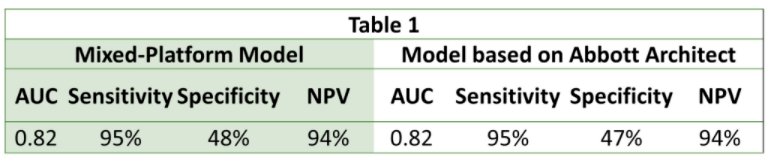
Following the development of the logistic regression models, the authors identified three serum protein markers and one clinical factor which form MiCheck Prostate algorithm The algorithm gave an AUC of 0.82, with a 48% specificity at a 95% sensitivity cutpoint, with a negative predictive value of 94% for GS3+4 and higher cancers. When measured on ARCHITECT immunoassays, good correlations of each analyte across different measurement platforms were observed (Pearson’s R > 0.9).
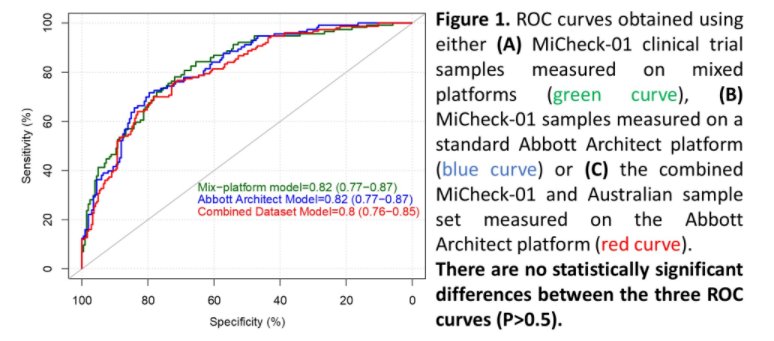
Further, whether a mix platform model, the Abbott Architect model, or a combined dataset model was employed, the ROC curves were essentially identical demonstrating model consistency.
Presented by: Neal D. Shore FACS, MD, Carolina Urologic Research Center, Myrtle Beach, SC