

(UroToday.com) On the first day of the American Society for Clinical Oncology (ASCO) Genitourinary Cancer Symposium 2022, Poster Session A focused on the care of patients with prostate cancer. Dr. de Kouchkovsky presented a poster examining clinical and molecular characteristics of patients with metastatic castration-resistant prostate cancer (mCRPC) who have low prostate-specific membrane antigen (PSMA) expression. Low PSMA uptake is seen in up to 30% of patients with mCRPC and is associated with adverse outcomes and a poor prognosis. However, little is known about other transcriptional and clinical features associated with low PSMA (FOLH1) gene expression in mCRPC.
The authors performed a retrospective analysis of mCRPC biopsy samples with RNA-seq data. They compared normalized FOLH1 expression across histologic subtypes and sites of disease and tested for associations between FOLH1 expression, selected androgen receptor (AR) target genes, master regulators of neuroendocrine differentiation, and previously validated AR activity and treatment-associated small cell neuroendocrine carcinoma (t-SCNC) transcriptional signature scores using Pearson correlations. Further, they examined associations between FOLH1 and both PSA50 response to subsequent AR-targeted therapy and overall survival (OS) using logistic regression and Cox proportional hazard models, respectively.
Among 97 patient samples identified, 18% harbored t-SCNC histology. 43 (45%) of patients had visceral metastases at the time of biopsy, and 40 (41%) received subsequent AR-targeted therapy.
The median FOLH1 expression was lower in patients with visceral metastases, compared to those without visceral metastases (14.7 vs 15.6, p = 0.02) but was not significantly different between those with t-SCNC histology on biopsy compared to adenocarcinoma (14.3 vs 15.4, p = 0.13). FOLH1 expression was positively correlated with AR transcriptional activity and AR target genes, and negatively correlated with master regulators of neuroendocrine differentiation and t-SCNC transcriptional signature scores.
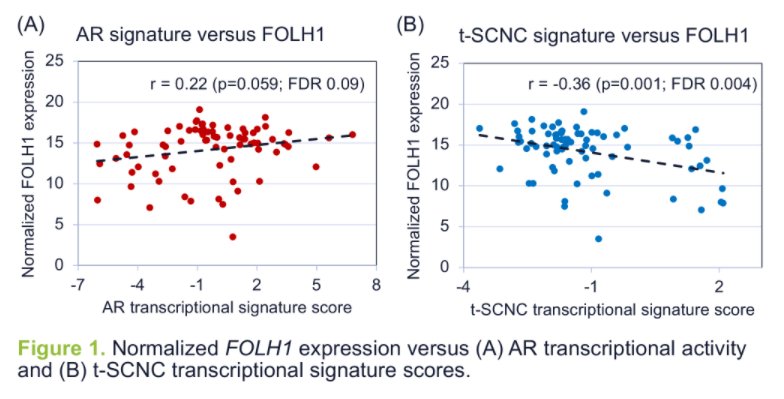
Low FOLH1 expression was not predictive of PSA50 response to subsequent AR-targeted therapy (OR 0.97, p = 0.8), but was associated with shorter OS on univariate analysis (HR 1.09, 95% CI 1.02-1.16, p=0.01).
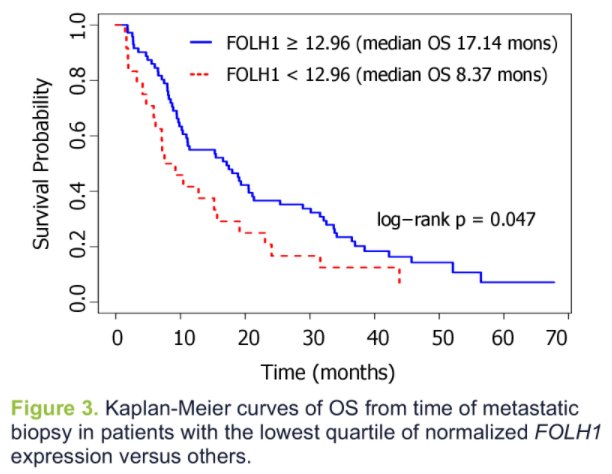
In post-hoc analysis, patients in the lowest quartile of FOLH1 expression had significantly worse overall survival (median 8.4 months vs 17.1 months, log-rank p = 0.047).
Thus, the authors conclude that this retrospective analysis of patients with mCRPC demonstrates that low FOLH1 expression was associated with transcriptional features of t-SCNC, decreased AR activity, and shorter OS. While these findings are hypothesis-generating, they require further prospective validation.
Presented By: Ivan de Kouchkovsky MD, University of California San Francisco, Helen Diller Family Comprehensive Cancer Center, San Francisco, CA