

(UroToday.com) On the first day of the American Society for Clinical Oncology (ASCO) Genitourinary Cancer Symposium 2022, Poster Session A focussed on the care of patients with prostate cancer. Dr. Rana McKay presented results from the COMRADE trial assessing the combination of olaparib and radium-223 in men with metastatic castration-resistant prostate cancer (mCRPC) with bone metastases. Each of these agents is approved for patients with mCRPC. However, preclinical models have suggested potential synergy as PARP inhibitors have shown efficacy as radiosensitizing agents which may promote the efficacy of radium-223, an α-emitting radioisotope that induces DNA double-strand breaks leading to cell death.
To test this hypothesis, the authors designed an open-label, multi-center, phase 1/2 study (NCT03317392) trial to test the safety and efficacy of radium-223 and olaparib. They recruited men with mCRPC who had at least 2 bone metastases without visceral metastases or lymphadenopathy > 4 cm. There was no limit on prior therapy. At baseline, all patients underwent biopsy and archival tissue was collected when available. The phase 1 portion of the study employed a 3+3 dose escalation design with fixed-dose radium-223 (55 kBq/kg IV every 4 weeks x 6) and escalating doses of olaparib. The dose level 1 (DL1) for was olaparib 200 mg PO BID while DL2 was 300 mg PO BID.
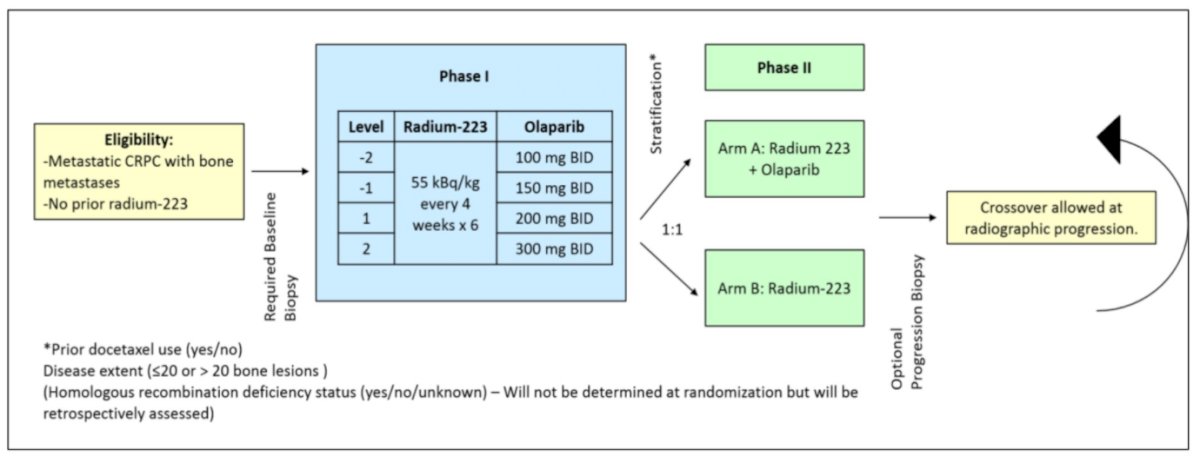
In phase 1, the primary objective was to determine the recommended phase 2 dose (RP2D) for the randomized portion of the study. Additionally, the authors assessed secondary objectives including radiographic progression-free survival (rPFS) (PCWG3 criteria), PSA response (50% decline from baseline), and alkaline phosphatase response (30% decline from baseline). They further determined patient’s homologous recombination repair (HRR) gene status using Oncopanel tissue profiling.
In the phase 1 portion of this study, 12 patients were enrolled with a median age of 68 (range 59-81) years. Patients had received a median of 2 prior lines of CRPC therapies (range 1-5), including 3 (25%) who had received prior chemotherapy and 12 (100%) who had received a prior novel hormone therapy.
Based on the dose-escalation protocol, the authors determined that the RP2D of olaparib was 200 mg BID when combined with radium-223. No dose limiting toxicities were observed at either DL1 or DL2. However, 5 of 6 patients enrolled at DL2 required dose reduction.
Assessing secondary objectives, the authors found that the PSA response and alkaline phosphatase response rates were 16.7% (n=2) and 67% (n=8), respectively.
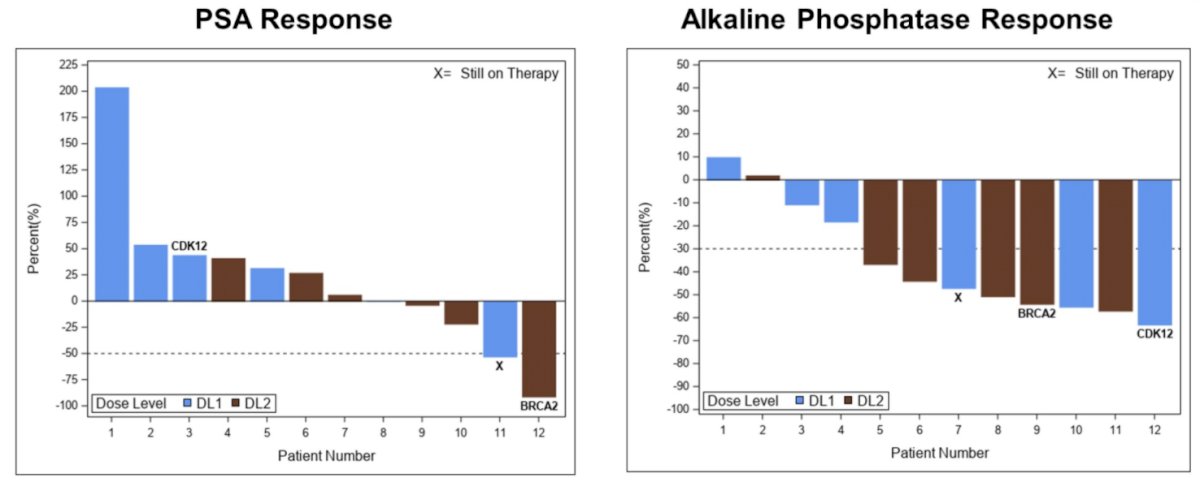
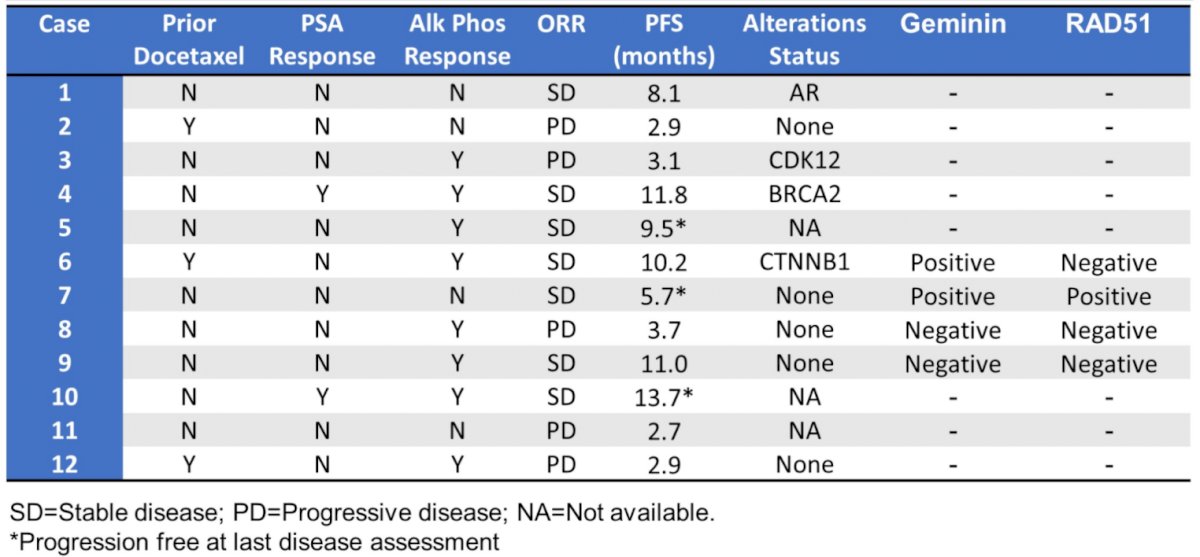
Over a median follow-up of 6.5 (range 2.8, 11.8) months, the 6-month rPFS was 57% (95% CI 25% to 80%) and 12 month overall survival was 56% (95% CI 24% to 79%).
Of 12 included patients, 9 had available tissue for Oncopanel testing (7 from baseline metastasis biopsy and 2 from archival prostate tissue). Two of these nine patients were identified to have pathogenic HRR gene alterations: 1 patient with a BRCA2 mutation who had an rPFS of 11.63 months and 1 patient with CDK12 mutation who had an rPFS of 2.60 months.
Presented by: Rana R. McKay MD, University of California San Diego, La Jolla, CA