

(UroToday.com) On the second day of the American Society for Clinical Oncology (ASCO) Genitourinary Cancer Symposium 2022 focused on urothelial carcinoma, in Poster Session B, Dr. Rafael Morales-Barrera presented a secondary analysis of the KEYNOTE-361 trial examining the association between tumor mutational burden (TMB) and PD-L1 expression with response to first-line pembrolizumab and chemotherapy, compared to chemotherapy alone, in patients with advanced urothelial carcinoma (UC). In the overall population, independent of PD-L1 status, the 3-arm, open-label, phase 3 KEYNOTE-361 study (NCT02853305) did not meet its primary endpoint, failing to find a benefit to the combination of pembrolizumab and chemotherapy, compared to chemotherapy. Thus, a secondary analysis of pembrolizumab versus chemotherapy was exploratory. However, in a pantumor setting, TMB is predictive of response to pembrolizumab monotherapy. However, the predictive role of TMB in advanced UC is uncertain. Thus, the authors performed a secondary analysis exploring the association of TMB status and PD-L1 combined positive score (CPS) with clinical outcomes in KEYNOTE-361.
Within the context of the KEYNOTE-361 trial, the authors included patients with evaluable TMB or PD-L1 data. TMB was assessed using whole exome sequencing and PD-L1 was assessed using CPS (PD-L1 IHC 22C3 pharmDx). Within each treatment group, the authors examined associations between TMB and PD-L1 scores and clinical outcomes including ORR, PFS, and OS using logistic regression (ORR) and Cox proportional hazards regression (PFS; OS). The authors used a prespecified α of 0.05 without multiplicity adjustment. Further, the authors assess the magnitude of treatment effects (clinical utility) using prespecified cut-offs of 175 mut/exome (TMB) and CPS 10 (PD-L1).
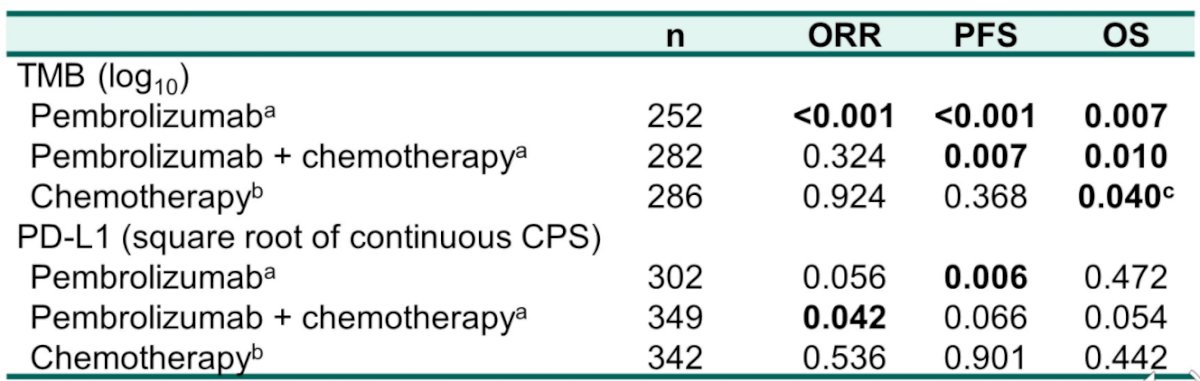
Among the 993 patients included in KEYNOTE-361, 820 (82.6%) had evaluable TMB data of whom 252 received pembrolizumab, 282 received pembrolizumab and chemotherapy, and 286 received chemotherapy alone. TMB (log10) was significantly positively associated with ORR, PFS, and OS for pembrolizumab (P < 0.001, < 0.001, and 0.007, respectively) and PFS and OS for pembrolizumab and chemotherapy (P= 0.007 and 0.010, respectively).
TMB was a relatively poor predictor of tumor response with an area under the receiver operating characteristics (AUROC) curve (95% CI) of 0.64 (0.56-0.71) for pembrolizumab monotherapy, 0.53 (0.46-0.60) for pembrolizumab and chemotherapy, and 0.52 (0.45-0.59) for chemotherapy alone.
All 993 patients had available data on PD-L1 expression status. PD-L1 was significantly positively associated with PFS for pembrolizumab (P= 0.006) and ORR for pembrolizumab and chemotherapy (P= 0.042) but not chemotherapy.
Based on the analysis of the KEYNOTE-361 cohort, the authors demonstrated strong associations between TMB and all 3 clinical outcomes (ORR, PFS, and OS) among patients treated with pembrolizumab monotherapy, with weaker associations observed among patients treated with the combination of pembrolizumab and chemotherapy. In contrast, PD-L1 expression was not consistently associated with clinical outcomes for patients treated with pembrolizumab, either in monotherapy or combination.
Presented by: Rafael Morales-Barrera, MD, Vall d’Hebron Institute of Oncology, Vall d’Hebron University Hospital, Universitat Autònoma de Barcelona