

(UroToday.com) The 2022 GU ASCO Annual meeting included a urothelial carcinoma trials in progress session featuring the KEYNOTE-676 cohort B trial, presented by Dr. Ashish Kamat, a randomized, comparator-controlled study evaluating efficacy and safety of pembrolizumab plus BCG in patients with high-risk nonmuscle-invasive bladder cancer (HR NMIBC). Standard treatment for HR NMIBC is TURBT followed by intravesical BCG induction and maintenance therapy. Despite a high rate of complete response, up to 50% of patients experience recurrence or become unresponsive to BCG and are at increased risk for progression to muscle invasive disease. Cohort A of the phase 2 KEYNOTE-057 study1 showed that pembrolizumab monotherapy provided effective antitumor activity and acceptable safety in patients with BCG-unresponsive HR NMIBC with carcinoma in situ (CIS). Pembrolizumab in combination with BCG at earlier stages of HR NMIBC might provide benefits superior to that of BCG monotherapy. Results from a phase 1 study of pembrolizumab + BCG showed acceptable safety and a rate of no evidence of disease of 69% at 3 months after BCG treatment in patients with high-grade NMIBC who had persistent or recurrent disease after intravesical therapy with BCG. The open-label, comparator-controlled, phase 3 KEYNOTE-676 study (NCT03711032) will be conducted to investigate the efficacy and safety of pembrolizumab + BCG versus BCG monotherapy in patients with HR NMIBC. Cohort A will enroll patients with persistent or recurrent HR NMIBC after BCG induction. Cohort B is a new, randomly assigned cohort that will help evaluate pembrolizumab + BCG in BCG treatment–naive patients who either never received BCG treatment or received BCG treatment > 2 years before enrollment.
Cohort B of KEYNOTE-676 will enroll approximately 975 patients with blinded independent central review–confirmed HR NMIBC (T1, high-grade Ta CIS) and Eastern Cooperative Oncology Group performance status score 0-2 who underwent cystoscopy/transurethral resection of bladder tumor ≤12 weeks before randomization and had not received BCG within the past 2 years. Patients will be randomly assigned 1:1:1 to receive pembrolizumab 400 mg intravenously (IV) every 6 weeks (Q6W) + BCG reduced maintenance (≤6 months), pembrolizumab 400 mg IV Q6W + BCG full maintenance (≤18 months), or BCG monotherapy (BCG full maintenance). The trial schema for KEYNOTE-676 cohort B is as follows:
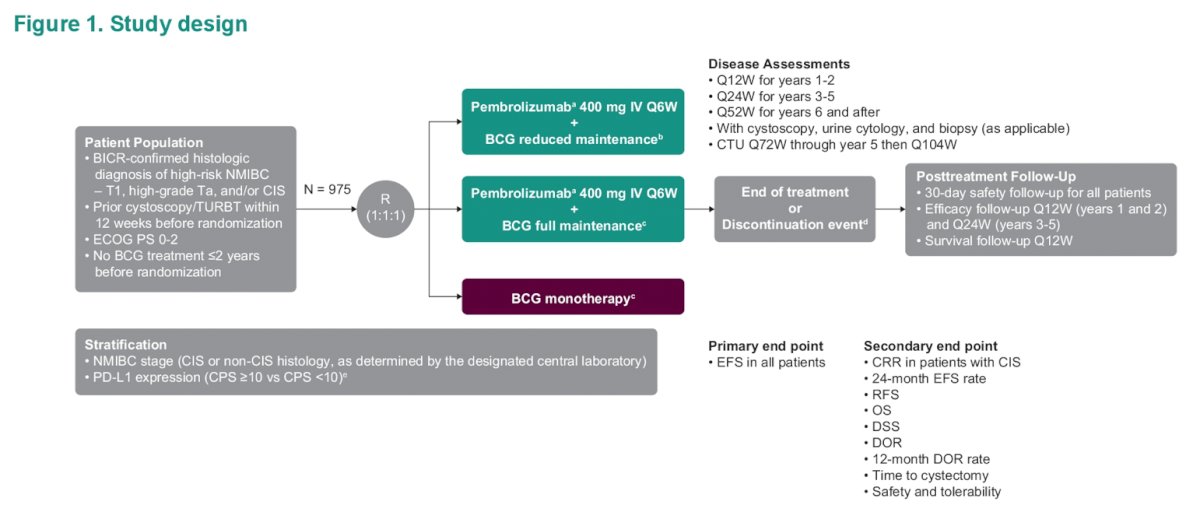
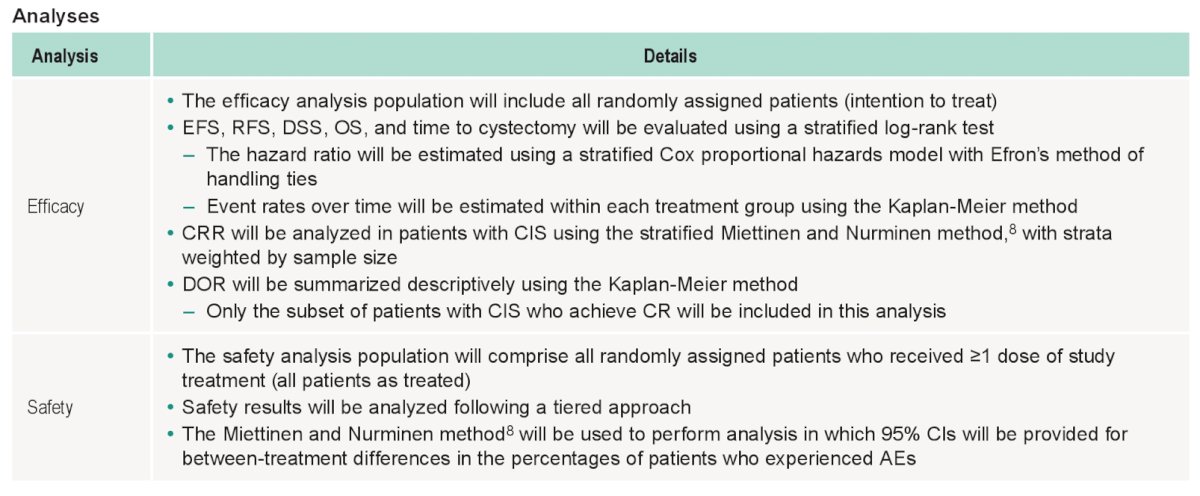
Stratification factors include NMIBC stage (CIS or no CIS) and PD-L1 expression (combined positive score ≥10 or combined positive score < 10), determined by a central laboratory. Disease status will be assessed by use of cystoscopy, urine cytology, and biopsy (as applicable) every 12 weeks (Q12W) through year 2, then every 24 weeks through year 5; imaging with CT urography will occur every 72 weeks. Adverse events will be monitored throughout the study and up to 30 days after cessation of study treatment (90 days for serious adverse events). The primary endpoint is event-free survival (EFS), defined as the time from random assignment to the first occurrence of high-grade Ta or CIS, any T1 disease of the bladder, high-risk disease (high-grade Ta, CIS, or >=T1) of the urethra, or upper tract, or locally advanced/metastatic disease determined by blinded independent central review, or death from any cause. Secondary endpoints include complete response rate by blinded independent central review, duration of response, 12-month duration of response rate (CIS only), 24-month EFS rate, disease-specific survival, time to cystectomy, overall survival, and safety. The analysis plan, stratified by efficacy and safety, is as follows:
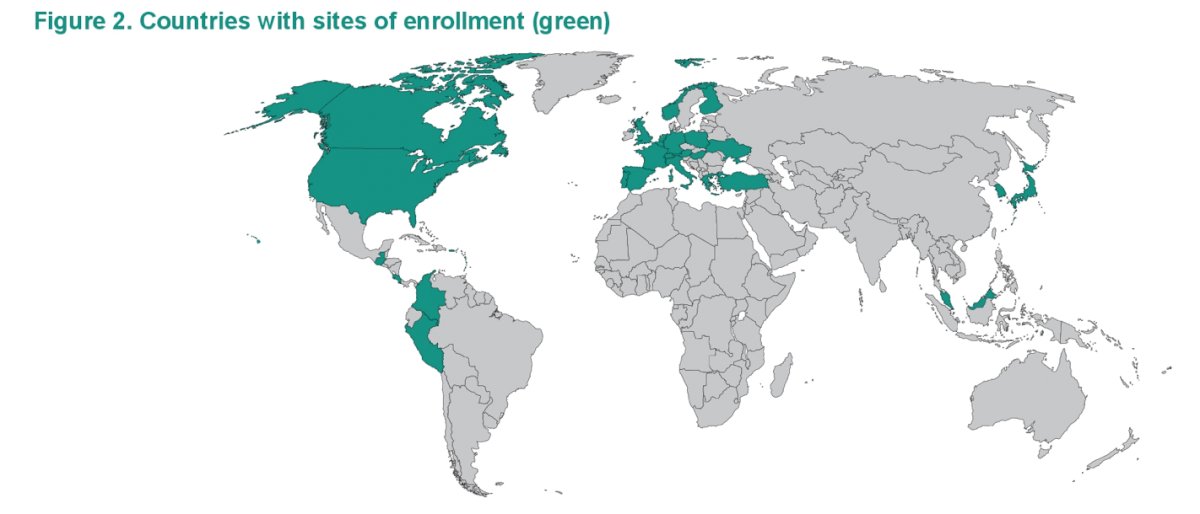
The study is enrolling or planning to enroll at sites in Asia, Australia, Europe, North America, and South America:
Presented by: Ashish M. Kamat, MD, The University of Texas MD Anderson Cancer Center, Houston, TX
Co-Authors: Shahrokh Shariat, Gary D. Steinberg, Shaheen Riadh Alanee, Hiroyuki Nishiyama, Kijoeng Nam, Ekta Kapadia, Neal D. Shore, Noah M. Hahn
Written by: Zachary Klaassen, MD, MSc – Urologic Oncologist, Assistant Professor of Urology, Georgia Cancer Center, Augusta University/Medical College of Georgia, @zklaassen_md on Twitter during the 2022 American Society of Clinical Oncology Genitourinary (ASCO GU) Cancers Symposium, Thursday Feb 17 – Saturday Feb 19, 2022
References: