

(UroToday.com) The 2026 American Society of Clinical Oncology (ASCO) Annual Meeting was host to a prostate, testicular, and penile cancers poster session. Dr. Alison Zhang presented preliminary data from ProTACT, a first-in-human phase 1 study evaluating the safety, tolerability, and anti-tumor activity of [225Ac]Ac-FL-020, a PSMA-targeted radioconjugate, in patients with metastatic castrate-resistant prostate cancer (mCRPC).
PSMA-targeted, beta-emitting radioligand therapy has emerged as an effective treatment option for mCRPC patients in the post-androgen receptor pathway inhibitor (ARPI) setting. However, alpha-emitting radioconjugates may offer enhanced tumor cell killing because of their high linear energy transfer and short tissue penetration range. Despite promising activity observed with prior actinium-225 PSMA therapies, treatment-related xerostomia and off-target toxicity have remained important clinical limitations. [225Ac]Ac-FL-020 was developed using proprietary UniRDC™ linker-chelator technology designed to optimize biodistribution, improve tumor uptake, and reduce radiation exposure to radiosensitive organs such as the salivary glands, potentially improving the therapeutic window of alpha-targeted therapy.
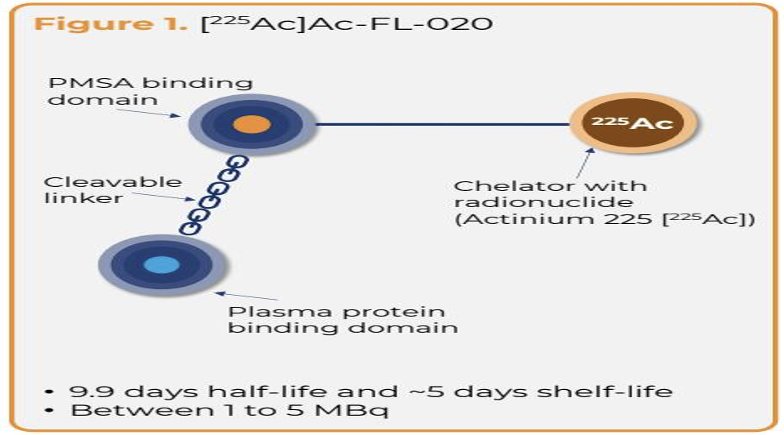

ProTACT (FL-020-001; NCT06492122) is an open-label, multicenter phase I study evaluating the safety, tolerability, and preliminary anti-tumor activity of [225Ac]Ac-FL-020 in patients with advanced PSMA-positive mCRPC. The trial consists of a Bayesian dose-escalation phase followed by a dose-expansion component. Eligible patients were required to have histologically confirmed mCRPC, evidence of disease progression, and at least one PSMA PET-positive lesion with uptake greater than liver background. Prior ARPI or CYP17 inhibitor therapy and ≥1 prior taxane-based chemotherapy regimen were required, unless declined by the patient. Prior lutetium-177 therapy was permitted, while patients with extensive PSMA-negative disease were excluded.
![ProTACT (FL-020-001; NCT06492122) is an open-label, multicenter phase I study evaluating the safety, tolerability, and preliminary anti-tumor activity of [225Ac]Ac-FL-020 in patients with advanced PSMA-positive mCRPC. The trial consists of a Bayesian dose-escalation phase followed by a dose-expansion component. Eligible patients were required to have histologically confirmed mCRPC, evidence of disease progression, and at least one PSMA PET-positive lesion with uptake greater than liver background. Prior ARPI or CYP17 inhibitor therapy and ≥1 prior taxane-based chemotherapy regimen were required, unless declined by the patient. Prior lutetium-177 therapy was permitted, while patients with extensive PSMA-negative disease were excluded.](/images/com-doc-importer/271-asco-2026/asco-2026-protact-preliminary-data-from-a-first-in-human-phase-1-study-evaluating-the-safety-tolerability-and-anti-tumor-activity-of-225ac-ac-fl-020-a-psma-targeted-radioconjugate-in-patients-with-mcrpc/image-2.jpg)
Dose escalation evaluated intravenous [225Ac]Ac-FL-020 administered every 6 weeks for up to 6 cycles across escalating dose levels ranging from 1 to 10 MBq. Initial cohorts enrolled 1–3 patients for the lower dose levels and 3–6 patients for higher dose cohorts, with the primary objective of identifying the maximum tolerated dose and/or recommended phase II dose (RP2D). Once the RP2D is established, an additional 18 patients will be enrolled in the expansion phase to further evaluate safety and early efficacy signals.
As of January 2, 2026, 15 eligible patients had received [225Ac]Ac-FL-020, with dose escalation reaching a maximum administered dose of 5 MBq per cycle. No dose-limiting toxicities had been observed at the time of reporting.
The most common adverse events were:
- Fatigue in 10 patients
- Nausea and dry mouth in 7 patients each
- Constipation and anemia in 4 patients each
Grade ≥3 adverse events were reported in 6 patients overall, although each grade ≥3 event occurred in only a single patient. Importantly, the two hematologic grade 3 toxicities considered clinically notable were attributed to progressive bone marrow infiltration rather than treatment itself:
- One patient treated at 1 MBq developed grade 3 anemia
- One patient treated at 5 MBq developed grade 3 anemia and grade 3 thrombocytopenia
Both events were considered related to disease progression and unrelated to [225Ac]Ac-FL-020.
At the data cutoff, 11 patients remained on treatment, while 4 had discontinued therapy prematurely:
- 3 because of disease progression
- 1 because of grade 2 dry mouth
An additional 6 patients experienced grade 1 dry mouth. Notably, no renal toxicities or declines in renal function were observed.
Although efficacy assessment remains preliminary, early anti-tumor activity signals were observed. As of January 6, 2026:
- One of three patients treated at 3 MBq achieved a >80% decline in PSA after 3 cycles
- Two of six patients treated at 5 MBq achieved >50% PSA reductions after only 1 cycle
The investigators concluded that these early findings support the feasibility and tolerability of [225Ac]Ac-FL-020 in heavily pretreated patients with mCRPC, with encouraging preliminary PSA responses observed during dose escalation. Dose escalation remains ongoing, and the RP2D has not yet been reached.
These early data suggest that next-generation actinium-225 PSMA radioconjugates may achieve meaningful anti-tumor activity while potentially mitigating some of the toxicities that have limited the broader application of alpha-emitting therapies, particularly severe xerostomia and renal toxicity. Although follow-up remains short and patient numbers are limited, the absence of dose-limiting toxicities through 5 MBq and the early PSA responses observed in this heavily pretreated population support continued clinical development of [225Ac]Ac-FL-020 as a potentially promising next-generation PSMA-targeted alpha therapy platform.
Presented by: Alison Y. Zhang, Consultant Genitourinary Medical Oncologist and the Bladder Cancer Lead at Macquarie University Hospital and the Chris O’Brien Lifehouse in Sydney, Australia
Written by: Rashid K. Sayyid, MD, MSc, Assistant Professor, Urologic Oncologist, Department of Urology at The University of Arizona and Banner University Medical Center, Tucson, AZ – @rksayyid on X during the American Society of Clinical Oncology Genitourinary (ASCO) Annual Meeting held in Chicago, IL between May 29th and June 1st, 2026