

(UroToday.com) The 2026 ASCO annual meeting featured a prostate cancer trials in progress session and a presentation by Dr. Luke Nordquist discussing AMPLIFY, a phase 3 study of 64Cu-SAR-bisPSMA PET in participants with biochemical recurrence of prostate cancer. Prostate cancer is the second most prevalent cancer in men globally, and there is a need for improved prostate cancer imaging, reflected in a biochemical recurrence rate of 20 to 40% after initial definitive therapy.
Despite advances in technology, many patients will fail to have their recurrence accurately localized by imaging, especially at low PSA levels. Imaging modalities that are widely available and can accurately detect, monitor, and restage residual/recurrent loco-regional and metastatic disease are therefore highly desirable. PSMA is a type II transmembrane glycoprotein that is strongly overexpressed in prostate cancer, making it an ideal target for imaging and therapy. 64Cu-SAR-bisPSMA may offer several advantages over the currently approved PSMA PET agents for prostate cancer due to the bivalent structure of SAR-bisPSMA and longer half-life of 64Cu (t1/2 = 12.7 hours), compared to the approved monovalent PSMA agents utilizing 18F and 68Ga (t1/2 < 2 hours):
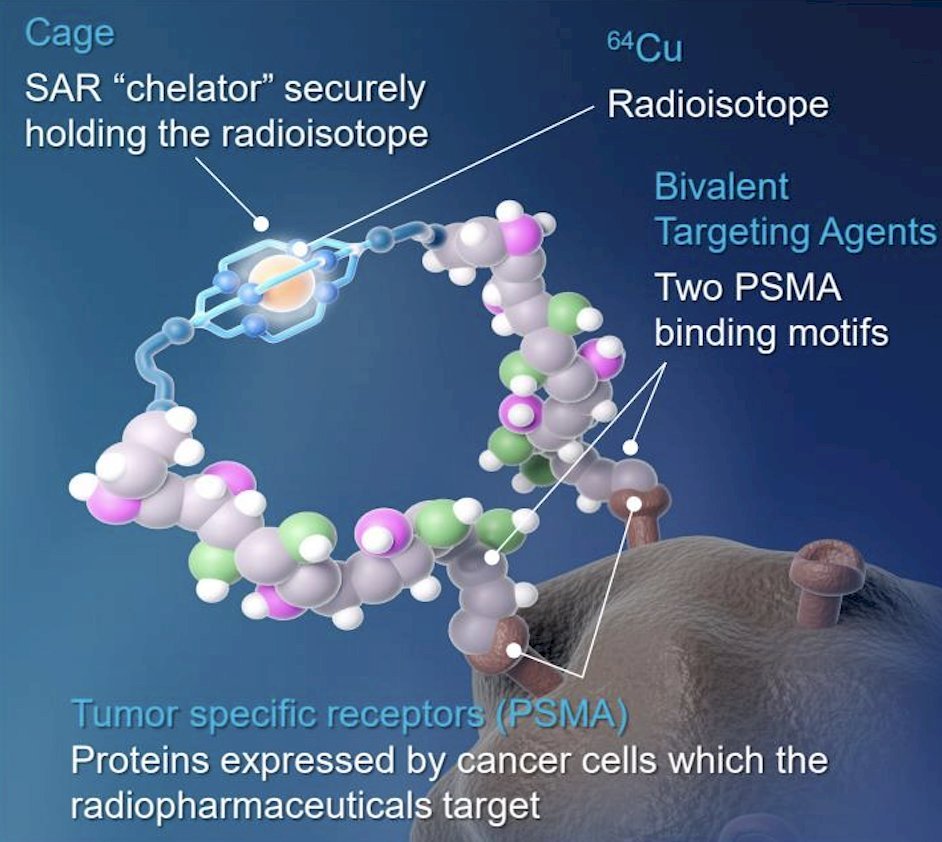
Evidence has demonstrated prolonged tumor retention and 2-3x higher tumor uptake with detection of additional prostate cancer lesions using 64Cu-SAR-bisPSMA compared to approved PSMA PET agents.
AMPLIFY (NCT06970847) is a multi-center, single-arm, open-label phase 3 diagnostic performance study of 64Cu-SAR-bisPSMA PET/CT in participants with a history of prostate adenocarcinoma and rising or detectable PSA after initial definitive treatment. The primary objective is to investigate the ability of 64Cu-SAR-bisPSMA PET/CT to detect recurrence of prostate cancer, with co-primary endpoints of participant-level correct detection rate and region-level positive predictive value assessed independently for Day 1 and Day 2. Key secondary objectives include assessment of safety, participant-level positive predictive value, and participant-level detection rate. A total of 220 patients will be enrolled, and all participants are required to have baseline conventional imaging. Eligible patients will receive a single administration of 64Cu-SAR-bisPSMA (200 MBq) followed by a PET/CT scan on Day 1 (1-4 hours post-dose) and on Day 2 (24 ± 6 hours post-dose). Participants will then continue into the follow-up period to verify the 64Cu-SAR-bisPSMA PET/CT findings. The Day 1 and Day 2 scans will be interpreted individually by a qualified local reader and 3 independent, blinded, central readers for the presence of abnormal 64Cu-SAR-bisPSMA uptake. 64Cu-SAR-bisPSMA PET/CT results on Day 1 and Day 2 will then be assessed against a composite reference standard by a central expert panel:

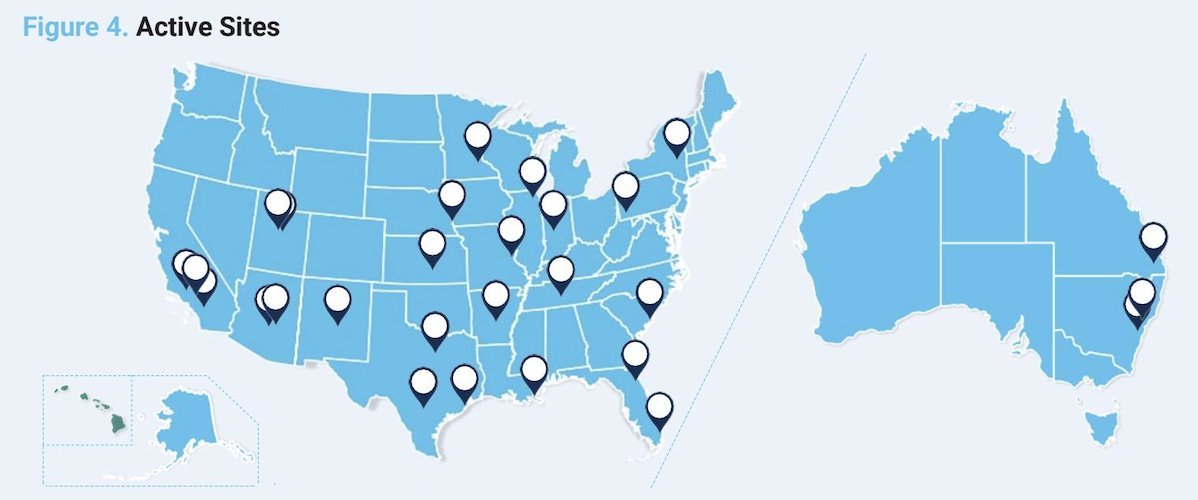
The study is open for recruitment in the United States and Australia:
Presented by: Luke Nordquist, MD, FACP, Genitourinary Medical Oncologist, CEO, XCancer, Omaha, NE
Written by: Zachary Klaassen, MD, MSc – Urologic Oncologist, Associate Professor of Urology, Georgia Cancer Center, Wellstar MCG Health, @zklaassen_md on Twitter during the American Society of Clinical Oncology Genitourinary (ASCO) Annual Meeting held in Chicago, IL between May 29th and June 1st, 2026