

(UroToday.com) The 2026 ASCO annual meeting featured a prostate cancer session and a presentation by Dr. Mitchell Singstock discussing real-world genetic testing patterns in prostate cancer assessed via artificial intelligence. Germline and somatic genomic testing in prostate cancer guide both targeted therapy selection and identification of heritable cancer risk.
Although the NCCN guidelines define testing eligibility based on disease risk and stage, real-world testing remains suboptimal. Population-level data indicate that only one-third of men with metastatic prostate cancer undergo genomic testing. As part of a larger effort to improve testing rates, Dr. Singstock and colleagues evaluated three consecutive years of prostate cancer care to quantify testing utilization and assessed artificial intelligence performance for risk stratification and testing eligibility.
This was a retrospective chart review of patients with advanced prostate cancer treated at a large multi-site community oncology practice between 2023 and 2025. Clinical data were manually reviewed to assign disease stage, NCCN risk stratification, and eligibility for germline and somatic testing. In 2023, a rules-based artificial intelligence algorithm applied explicit NCCN guideline logic (v1.2023). In 2024 and 2025, an untrained general-purpose artificial intelligence model (ChatGPT 5.2) was provided with the NCCN guideline text (v1.2024 and v1.2025) and tasked with inferring risk category and testing eligibility. Primary outcomes included observed annual germline and somatic testing rates and artificial intelligence concordance with manual review. Temporal trends in germline and somatic testing adoption were assessed using the Cochran-Armitage trend test.
Across 2023–2025, NCCN-indicated germline and somatic testing were inconsistently performed, with significantly increasing rates from 2023 to 2025 (Cochran–Armitage trend test, germline p < 0.001, somatic p < 0.001):
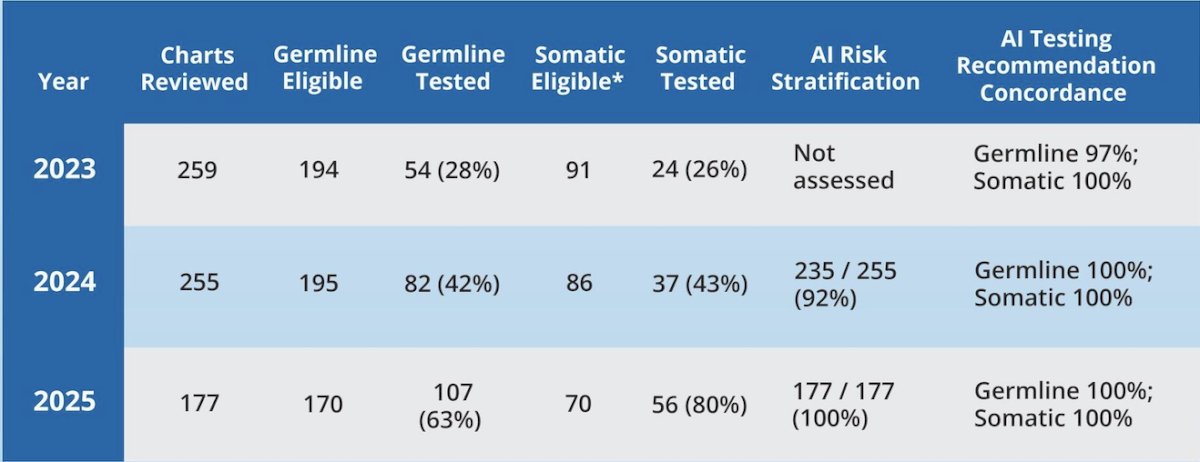
Testing outside of NCCN guidelines was ordered by clinicians in 10 (4%), 22 (9%), and 31 (18%) patients each year, respectively.
Dr. Singstock concluded his presentation discussing real-world genetic testing patterns in prostate cancer assessed via artificial intelligence with the following take-home points:
- In a large community oncology setting, NCCN-indicated germline and somatic testing for prostate cancer was frequently underutilized, despite significant improvement over time
- Ongoing analyses seek to clarify which interventions contributed to increased testing rates and whether testing performed outside NCCN guidelines reflects broader clinical awareness of indications not consistently captured in structured data
- Artificial intelligence-based guideline interpretation of NCCN guidelines demonstrated consistently high concordance with manual review and may offer a scalable approach to systematically identify patients eligible for genetic testing using structured data
Presented by: Mitchell Singstock, MD, University of Utah, Salt Lake City, UT
Written by: Zachary Klaassen, MD, MSc – Urologic Oncologist, Associate Professor of Urology, Georgia Cancer Center, Wellstar MCG Health, @zklaassen_md on Twitter during the American Society of Clinical Oncology Genitourinary (ASCO) Annual Meeting held in Chicago, IL between May 29th and June 1st, 2026