

(UroToday.com) The 2026 ASCO annual meeting featured a prostate cancer session and a presentation by Dr. Boon Hao Hong discussing the clinical and biological associations between multimodal artificial intelligence (MMAI) and the 22-gene genomic classifier in localized prostate cancer. MMAI and genomic classifier are clinically validated prognostic tools for localized prostate cancer, and are incorporated into NCCN guidelines as treatment decision aids. However, their clinical and biological relationships remain unclear, especially in Asian populations where comparative studies are limited.
Patients with newly diagnosed localized prostate cancer from a single institution in Singapore were enrolled into a prospective protocol (NCT04340024) and underwent image-guided radiotherapy with or without hormonal therapy. All subjects had paired genomic classifier and MMAI scores. However, colored marker annotations were present on the H&E slides, which could negatively impact MMAI performance. Associations between genomic classifier and MMAI scores with metastasis-free survival were evaluated using Cox proportional hazards models. Pearson's correlation was used to assess associations between risk scores and cancer hallmark pathways:
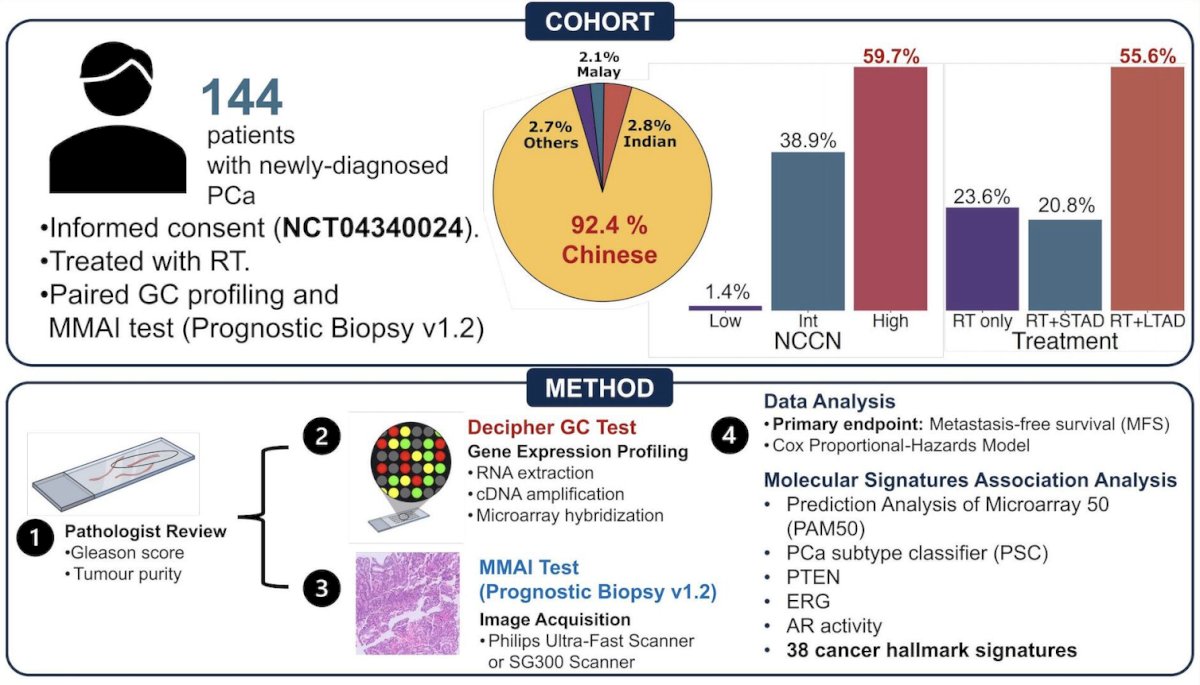
There were 144 men included, comprising 142 (99%) with NCCN intermediate to high-risk, and 2 (1%) with low-risk disease. The median follow-up duration was 78.5 (IQR: 68.2–95.3) months. MMAI and genomic classifier scores were correlated (R = 0.56):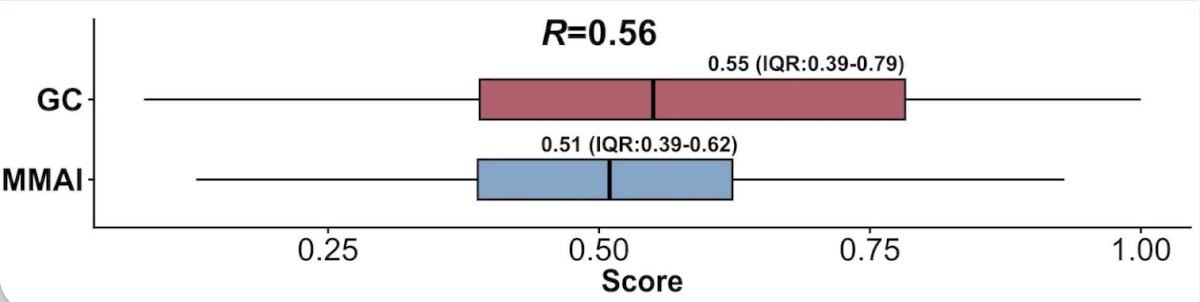
However, MMAI and genomic classifier scores differed in risk stratification: 12/144 (8%), 54/144 (38%), and 78/144 (54%) were MMAI low-, intermediate-, and high-risk, respectively, compared with 51/144 (35%), 32/144 (22%), and 61/144 (43%) by genomic classifier in the same order.:
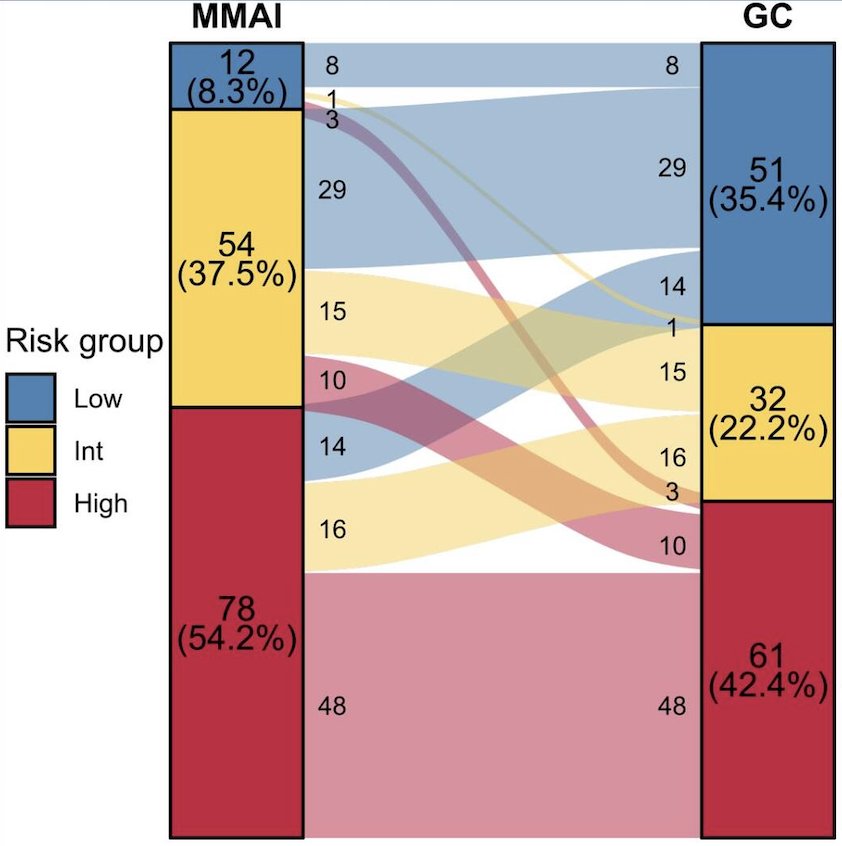
The investigators observed the largest discordance in the genomic classifier low-risk subgroup (n = 51), where 29/51 (57%) and 14/51 (28%) were classified as MMAI intermediate- and high-risk, respectively. Of note, 16/32 (50%) of genomic classifier intermediate-risk men were classified as MMAI high-risk. Nonetheless, both tests were prognostic for metastasis-free survival (MMAI: HR of 2.6 [95% CI 1.0–6.4], p = 0.035; genomic classifier: HR of 3.4 [95% CI:1.5–7.6], p = 0.002), although the difference in HR should be interpreted with caution, as it is attributable to a limited sample size with longer follow-up:
![The investigators observed the largest discordance in the genomic classifier low-risk subgroup (n = 51), where 29/51 (57%) and 14/51 (28%) were classified as MMAI intermediate- and high-risk, respectively. Of note, 16/32 (50%) of genomic classifier intermediate-risk men were classified as MMAI high-risk. Nonetheless, both tests were prognostic for metastasis-free survival (MMAI: HR of 2.6 [95% CI 1.0–6.4], p = 0.035; genomic classifier: HR of 3.4 [95% CI:1.5–7.6], p = 0.002), although the difference in HR should be interpreted with caution, as it is attributable to a limited sample size with longer follow-up:](/images/com-doc-importer/271-asco-2026/asco-2026-assessing-the-clinical-and-biological-associations-between-mmai-and-22-gene-gc-in-localized-prostate-cancer/image-3.jpg)
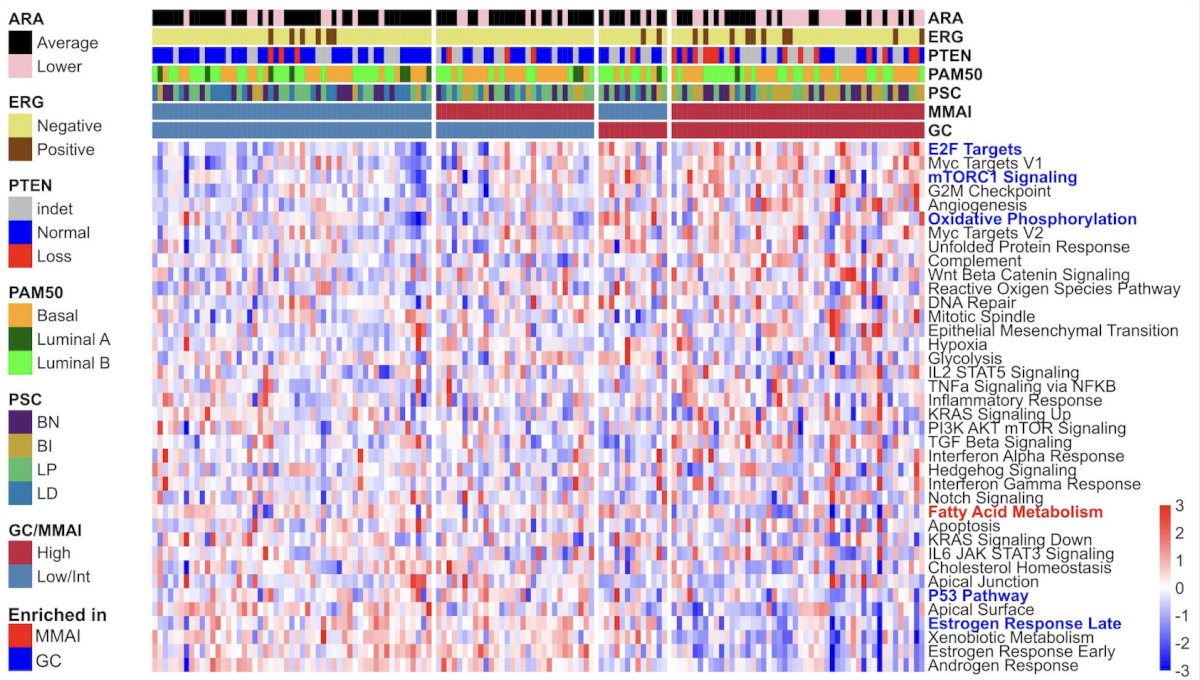
Next, they investigated the molecular pathway enrichment of the genomic classifier and the MMAI high-risk groups. Proportions of known prostate cancer molecular subtypes were comparable between the respective genomic classifier and MMAI risk-groups: Genomic classifier high versus MMAI high:
- PAM50 Basal 51% versus 58%, p = 0.419
- Luminal B 46% versus 39%, p = 0.377
- PTEN loss 25% versus 22%, p = 0.698
- AR lower activity 49% versus 44%, p = 0.512
Genomic classifier high versus genomic classifier low/intermediate tumors, however, showed positive enrichment in E2F, oxidative phosphorylation, and mTORC1 pathways; negative enrichment in P53 and estrogen pathways. MMAI high was only negatively enriched for fatty acid metabolism:
Dr. Hong concluded this presentation discussing the clinical and biological associations between MMAI and 22-gene genomic classifier in localized prostate cancer with the following take-home points:
- While MMAI and genomic classifier provide differing risk categorization, both tests were significantly associated with metastasis-free survival in men with localized prostate cancer who underwent radiotherapy
- Known prostate cancer-associated transcriptomic subtypes were comparable between the respective MMAI and genomic classifier risk groups
- Genomic classifier groups showed broader pathway differences, while MMAI-high was mainly associated with lower fatty acid metabolism
Presented by: Boon Hao Hong, Research Data Scientist, National Cancer Centre Singapore, Singapore
Written by: Zachary Klaassen, MD, MSc – Urologic Oncologist, Associate Professor of Urology, Georgia Cancer Center, Wellstar MCG Health, @zklaassen_md on Twitter during the American Society of Clinical Oncology Genitourinary (ASCO) Annual Meeting held in Chicago, IL between May 29th and June 1st, 2026