

(UroToday.com) The 2026 American Society of Clinical Oncology (ASCO) Annual Meeting was host to a prostate, testicular, and penile cancers poster session. Dr. Robert Dreicer presented ProTACT, an ongoing, first-in-human phase I dose-escalation and expansion study evaluating the safety, tolerability, biodistribution, dosimetry, and preliminary antitumor activity of [²²⁵Ac]Ac-FL-020, a novel prostate-specific membrane antigen (PSMA)-targeted alpha radioligand therapy, in patients with metastatic castration-resistant prostate cancer (mCRPC).
PSMA remains one of the most important therapeutic targets in advanced prostate cancer and has transformed the treatment landscape through the development of radioligand therapies. While beta-emitting agents such as lutetium-177–PSMA have demonstrated significant clinical benefit, many patients ultimately develop resistance or disease progression, creating interest in next-generation alpha-emitting radiopharmaceuticals. Alpha emitters deliver high-energy radiation over a very short tissue range, potentially enhancing tumor cell killing while limiting damage to surrounding normal tissues.
[²²⁵Ac]Ac-FL-020 is a novel PSMA-targeted alpha radioconjugate designed to selectively deliver actinium-225 to PSMA-expressing prostate cancer cells. Imaging and biodistribution data have demonstrated successful tumor targeting with [²²⁵Ac]Ac-FL-020. Representative scans illustrate uptake within metastatic lesions, supporting selective localization of the radioconjugate to PSMA-expressing disease sites. Dosimetry analyses suggest favorable biodistribution characteristics, with accumulation in tumor tissue and expected uptake in physiologic PSMA-expressing organs.
Preliminary efficacy analyses demonstrated evidence of biologic activity, including PSA declines in a subset of treated patients. Waterfall plots presented in the poster showed varying degrees of PSA reduction across dose levels, suggesting potential antitumor activity even in a heavily pretreated mCRPC population.
Time-to-event analyses and swimmer plot data further demonstrated durable treatment exposure in several patients, with some individuals remaining on therapy for extended periods. These findings provide early evidence of clinical activity and support continued dose optimization.
From a safety perspective, treatment-related adverse events were generally manageable and consistent with expectations for PSMA-targeted alpha radioligand therapy. Ongoing follow-up will further define the safety profile and establish the recommended dose for future studies.
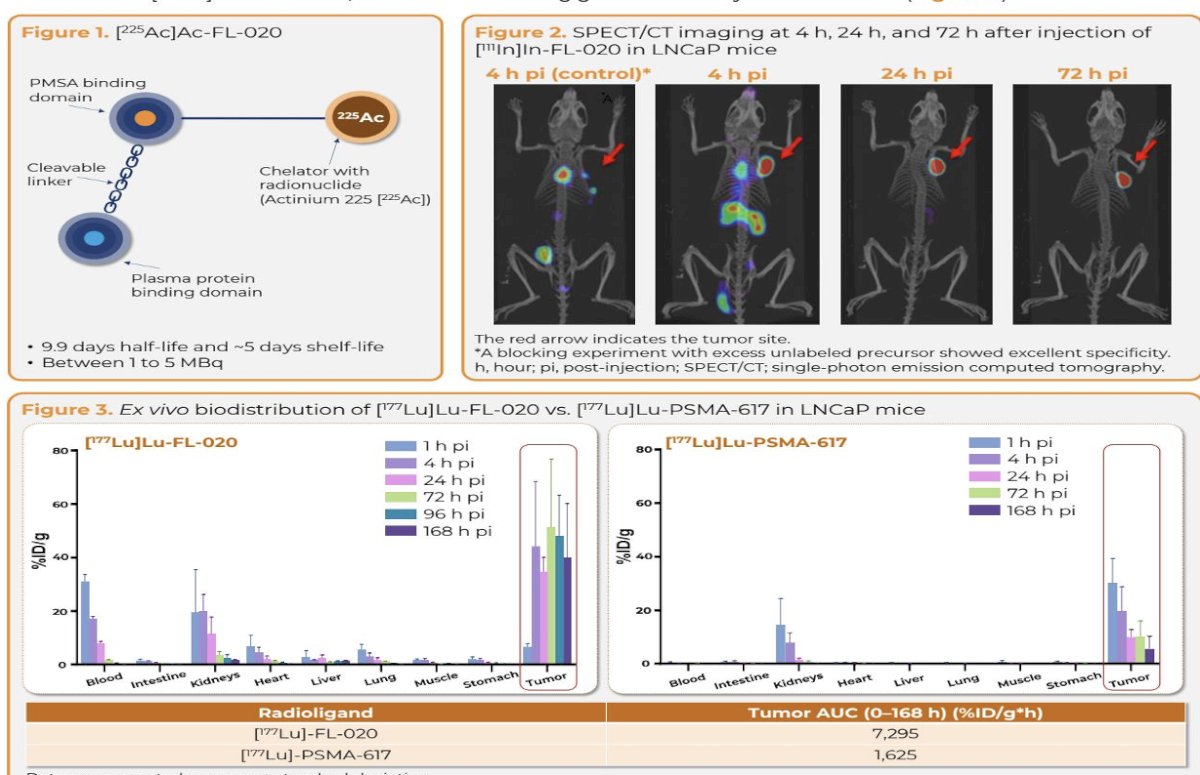
The ProTACT study was developed to characterize the safety profile, pharmacokinetics, biodistribution, dosimetry, and early efficacy signals of this agent in patients with advanced mCRPC. ProTACT is a first-in-human, multicenter, phase I study consisting of dose-escalation and dose-expansion cohorts. Patients with mCRPC receive escalating dose levels of [²²⁵Ac]Ac-FL-020 to identify a recommended phase II dose while evaluating treatment-related adverse events and preliminary antitumor activity.![The ProTACT study was developed to characterize the safety profile, pharmacokinetics, biodistribution, dosimetry, and early efficacy signals of this agent in patients with advanced mCRPC. ProTACT is a first-in-human, multicenter, phase I study consisting of dose-escalation and dose-expansion cohorts. Patients with mCRPC receive escalating dose levels of [²²⁵Ac]Ac-FL-020 to identify a recommended phase II dose while evaluating treatment-related adverse events and preliminary antitumor activity.](/images/com-doc-importer/271-asco-2026/asco-2026-protact-a-first-in-human-phase-1-dose-escalation-and-expansion-study-evaluating-the-safety-tolerability-and-anti-tumor-activity-of-225ac-ac-fl-020-a-psma-targeted-radioconjugate-in-patients-with-mcrpc/image-1.jpg)
Eligible patients have metastatic castration-resistant prostate cancer with progressive disease despite standard therapies. The study population includes heavily pretreated patients who have received prior androgen receptor pathway inhibitors and other approved therapies for advanced disease.
The primary objectives of the study are to evaluate:
- Safety and tolerability of [²²⁵Ac]Ac-FL-020
- Dose-limiting toxicities and adverse events
- Pharmacokinetics and biodistribution
- Radiation dosimetry
Secondary and exploratory objectives include:
- Prostate-specific antigen (PSA) responses
- Radiographic antitumor activity
- Duration of response and disease control
- Identification of an optimal dose and schedule for future development
At the time of presentation, patient enrollment and follow-up were ongoing. Investigators noted that the study continues to evaluate multiple dose levels to better characterize the therapeutic window of [²²⁵Ac]Ac-FL-020 and determine the optimal balance between efficacy and tolerability.
Overall, the ProTACT study provides early clinical evidence supporting the development of [²²⁵Ac]Ac-FL-020 as a novel PSMA-targeted alpha radioligand therapy for mCRPC. The favorable tumor targeting, manageable safety profile, and preliminary signs of antitumor activity observed in this first-in-human experience support continued clinical investigation and further exploration of alpha-emitting radiopharmaceuticals in advanced prostate cancer.
Presented by: Robert Dreicer, MD, MS, MACP, FASCO, Head, Medical Oncology Section, Deputy Director University of Virginia Comprehensive Cancer Center, Associate Director for Clinical Research, Co-Director Paul Mellon Urologic Oncology Center, Professor of Medicine and Urology, University of Virginia School of Medicine, Charlottesville, VA, USA
Written by: Rashid K. Sayyid, MD, MSc, Assistant Professor, Urologic Oncologist, Department of Urology at The University of Arizona and Banner University Medical Center, Tucson, AZ – @rksayyid on X during the American Society of Clinical Oncology Genitourinary (ASCO) Annual Meeting held in Chicago, IL between May 29th and June 1st, 2026