

(UroToday.com) The 2026 ASCO annual meeting featured a prostate cancer trials in progress session and a presentation by Dr. Tanya Dorff discussing XALience, a phase 3, open-label, multicenter, randomized study of xaluritamig + abiraterone versus investigator's choice in patients with chemotherapy-naïve metastatic castration resistant prostate cancer (mCRPC). Prostate cancer remains a major global health challenge with 1.47 million new cases reported annually worldwide, ranking it as the fourth most common cancer globally and the second leading cause of cancer death among men.
Following progression on androgen-receptor pathway inhibitor (ARPI), treatment options include taxane-based chemotherapy and ARPI switch, however modest efficacy and notable side effects highlight the unmet need for better treatment options. Xaluritamig is a humanized bispecific T-cell engager targeting six-transmembrane epithelial antigen of prostate 1 (STEAP1) and CD3, resulting in T-cell-mediated cytotoxicity and cancer cell death:
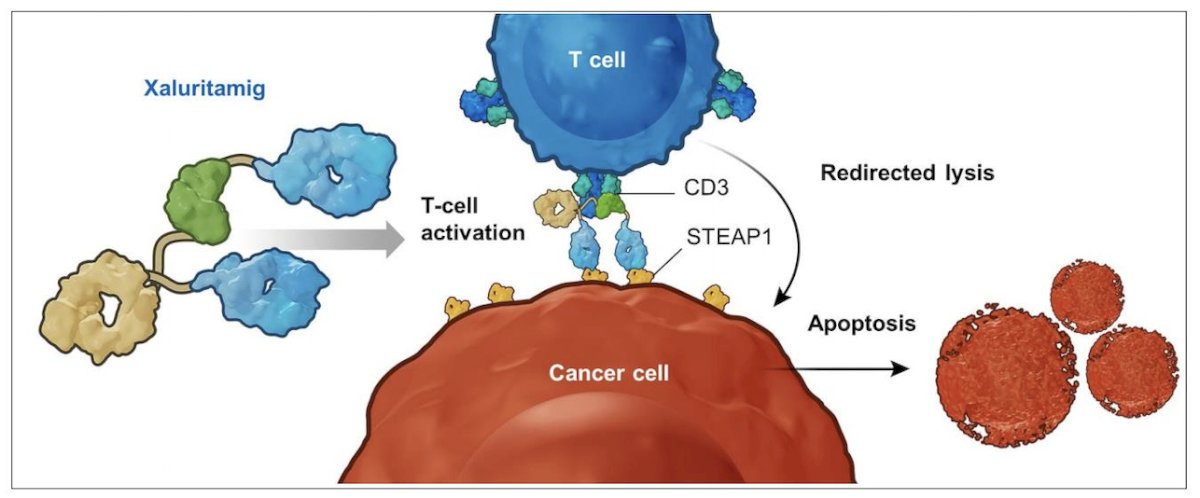
In the first human study, xaluritamig demonstrated potent antitumor activity with a manageable safety profile in patients with mCRPC [1]. Preliminary data from this first-in-human study of xaluritamig in combination with abiraterone in chemotherapy-naïve patients with mCRPC3 support the initiation of a phase 3 study of xaluritamig + abiraterone with the aim of improving survival in this population.
XALience is a randomized, multicenter, open-label, phase 3 study of xaluritamig + abiraterone versus investigator’s choice in patients with chemotherapy-naïve mCRPC. Approximately 750 eligible patients ≥18 years old with histologically confirmed chemotherapy-naïve mCRPC, evidence of disease progression on prior enzalutamide, apalutamide, or darolutamide, ECOG performance status of 0-1, and adequate organ function and who may have previously received ≤6 cycles of docetaxel in the metastatic hormone-sensitive prostate cancer (mHSPC) setting will be randomized 1:1 to receive xaluritamig + abiraterone or investigator’s choice of docetaxel, cabazitaxel, or abiraterone. Patients will be stratified by prior docetaxel exposure in mHSPC, presence of liver metastases, prior treatment with PSMA radioligand therapy, and planned intention-to-treat with the investigator’s choice: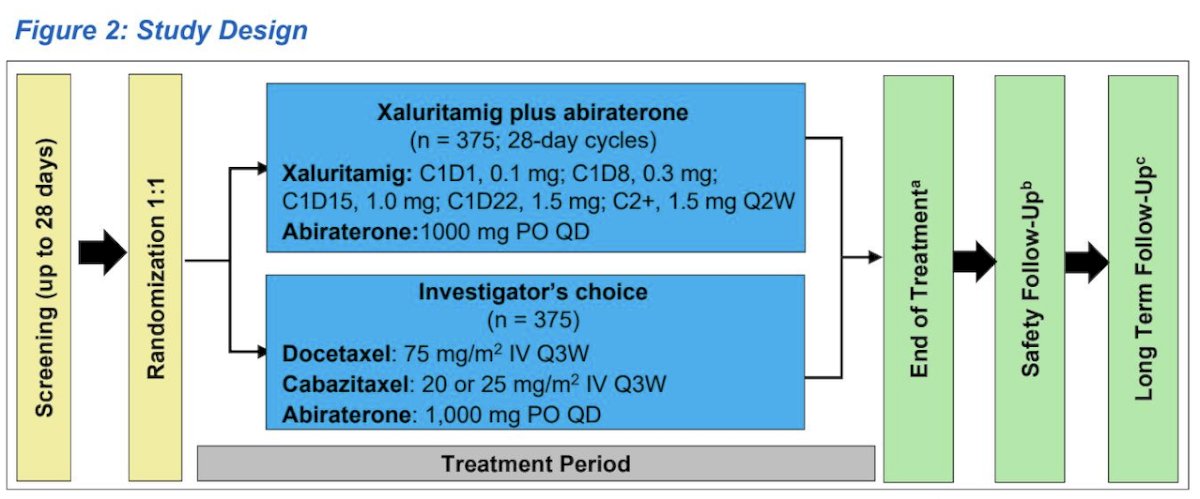
This study consists of a 28-day screening period, treatment until radiographic progression based on PCWG3 guidelines, a safety follow-up period, and a long-term follow-up period. To mitigate the risk of cytokine release syndrome, xaluritamig will be initiated at weekly step-up dosing over four doses up to the target dose during cycle 1, followed by target dose administration every 2 weeks from cycle 2 day 1 onwards. The primary endpoint is overall survival, which will be analyzed using a stratified log-rank test at a one-sided 2.5% significance level. The key secondary endpoint is investigator-assessed radiographic progression-free survival per PCWG3. Other secondary endpoints include radiographic and PSA response, safety, tolerability, health-related quality of life, patient-reported outcomes, pharmacokinetics, and immunogenicity.
The participating countries include: Australia, Austria, Belgium, Brazil, Canada, France, Germany, Greece, Italy, Japan, the Netherlands, Portugal, the Republic of Korea, Singapore, Spain, Switzerland, Taiwan, the United Kingdom, and the United States. Participant enrollment started in November 2025.
Presented by: Tanya Dorff, MD, Medical Oncologist, Professor of Medicine, Vice Chair of Clinical Affairs, Department of Medical Oncology & Therapeutics Research, Division Chief of the Genitourinary Disease Program, City of Hope, Duarte, CA
Written by: Zachary Klaassen, MD, MSc – Urologic Oncologist, Associate Professor of Urology, Georgia Cancer Center, Wellstar MCG Health, @zklaassen_md on Twitter during the American Society of Clinical Oncology Genitourinary (ASCO) Annual Meeting held in Chicago, IL between May 29th and June 1st, 2026
References:
- Kelly WK, Danila DC, Lin CC, et al. Xaluritamig, a STEAP1 x CD3 XmAb 2+1 Immune Therapy for Metastatic Castration-Resistant Prostate Cancer: Results from a Dose Exploration in a First-in-Human Study. Cancer Discov. 2024 Jan 12;14(1):76-89.