

(UroToday.com) The 2026 American Society of Clinical Oncology (ASCO) Annual Meeting hosted a prostate, testicular, and penile cancers poster session. Dr. Kim Chi presented LK2-comPAS (NCT07191443), an ongoing randomized phase III study evaluating the efficacy and safety of pasritamig, a DLL3-targeted therapy, in combination with standard-of-care treatment for patients with metastatic castration-resistant prostate cancer (mCRPC).
Metastatic castration-resistant prostate cancer remains associated with poor clinical outcomes despite recent therapeutic advances. Molecular characterization studies have identified delta-like ligand 3 (DLL3) as a promising therapeutic target in prostate cancer. DLL3 expression is highly specific to tumor cells, with minimal expression in normal tissues, and has been associated with neuroendocrine differentiation, treatment resistance, and aggressive disease biology. Importantly, DLL3 expression has been observed across a spectrum of prostate cancer phenotypes, including adenocarcinoma and neuroendocrine prostate cancer.
Pasritamig is a first-in-class DLL3-targeted bispecific T-cell engager designed to redirect T cells toward DLL3-expressing tumor cells. Early-phase clinical studies have demonstrated encouraging antitumor activity and manageable safety in patients with heavily pretreated prostate cancer, supporting further investigation in earlier disease settings.
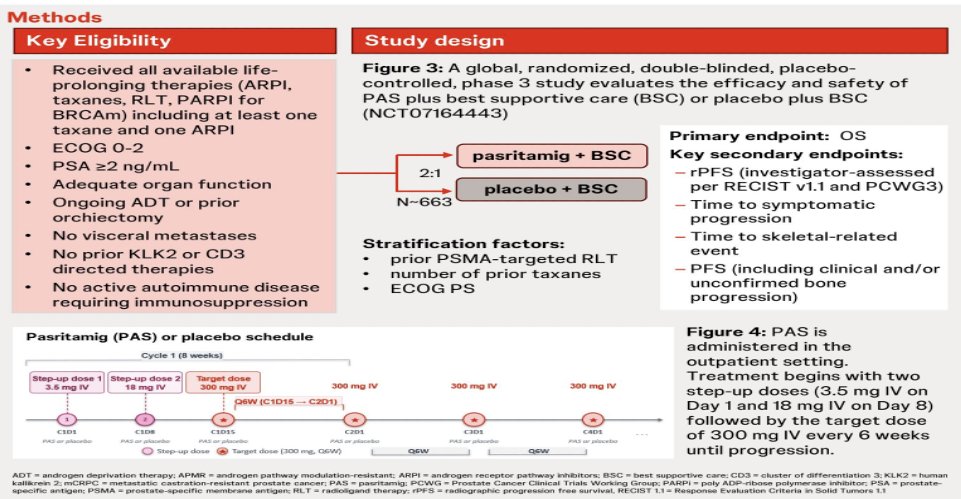
LK2-comPAS is a global, multicenter, randomized, double-blind, placebo-controlled phase III study evaluating pasritamig plus standard of care (SOC) versus placebo plus SOC in patients with mCRPC. A total of 630 patients will be randomized in a 1:1 fashion to:
- Pasritamig + SOC (n=315)
- Placebo + SOC (n=315)
Randomization is stratified according to:
- Prior treatment with taxane chemotherapy (yes versus no)
- Presence of liver metastases (yes versus no)
- Prior treatment with an androgen receptor pathway inhibitor (ARPI)
Eligible patients must have:
- Measurable or evaluable metastatic disease
- ECOG performance status 0–1
- Ongoing androgen deprivation therapy
- Progressive mCRPC
- No prior treatment with DLL3-directed therapy
Key exclusion criteria include:
- Active or uncontrolled central nervous system metastases
- Significant cardiovascular disease
- Active autoimmune disease requiring systemic therapy
- Prior exposure to DLL3-targeted agents
The dual primary endpoints of the trial are:
- Overall survival (OS) by blinded independent central review (BICR)
- Radiographic progression-free survival (rPFS) by BICR
Secondary endpoints include:
- Time to symptomatic progression
- Time to metastasis-related pain events
- Objective response rate (ORR)
- Duration of response (DOR)
- Safety and tolerability
- Patient-reported outcomes
The study incorporates serial blood-based biomarker assessments throughout treatment, including circulating tumor DNA analyses, to further characterize treatment response and mechanisms of resistance. Tumor tissue will also be evaluated for DLL3 expression and associated biomarkers.
A key translational component of LK2-comPAS is the assessment of DLL3 prevalence across prostate cancer disease states. The poster highlights that DLL3 expression has been observed in both adenocarcinoma and neuroendocrine prostate cancer and may increase with disease progression and treatment resistance, providing strong biological rationale for targeting this pathway.
At the time of presentation, LK2-comPAS was actively recruiting globally across North America, South America, Europe, Asia, and Australia. Participating countries include the United States, Canada, Brazil, Spain, France, Italy, Australia, and several additional international sites.
The investigators concluded that LK2-comPAS will determine whether the addition of pasritamig to standard-of-care therapy can improve clinical outcomes in patients with mCRPC. Given the unmet need for novel therapeutic targets beyond androgen receptor signaling and the tumor-specific expression pattern of DLL3, this study represents an important effort to evaluate a first-in-class immunotherapeutic approach in advanced prostate cancer.¹
Presented by: Kim N. Chi, MD, Vice President & Chief Medical Officer, British Columbia Cancer Agency, Vancouver Cancer Centre, Vancouver, Canada
Written by: Rashid K. Sayyid, MD, MSc, Assistant Professor, Urologic Oncologist, Department of Urology at The University of Arizona and Banner University Medical Center, Tucson, AZ – @rksayyid on X during the American Society of Clinical Oncology Genitourinary (ASCO) Annual Meeting held in Chicago, IL between May 29th and June 1st, 2026