

(UroToday.com) The 2026 American Society of Clinical Oncology (ASCO) Annual Meeting was host to a prostate, testicular, and penile cancers poster session. Dr. Nicholas James presented the study protocol for ADHERE, a randomized controlled trial evaluating a digital exercise intervention with virtual supervised group exercise sessions compared to standard of care for patients receiving ADT for prostate cancer.
Prostate cancer is the most commonly diagnosed cancer among men in the United Kingdom, with over 55,000 new diagnoses annually. While ADT remains a cornerstone of treatment across multiple disease states, it is associated with substantial adverse effects, including loss of muscle mass and function, increased fatigue, reduced physical activity, and diminished quality of life. Exercise has consistently been shown to mitigate many of these treatment-related toxicities, improving physical function, cardiovascular health, fatigue, and overall quality of life. Despite these benefits, physical activity levels among men receiving ADT remain low, and adherence to exercise programs is often suboptimal. Although supervised exercise interventions can improve outcomes, barriers such as access, cost, and long-term sustainability limit widespread implementation. Consequently, there is a need for innovative approaches that can support exercise participation and long-term behavior change in this patient population.
The ADHERE trial was designed to evaluate the feasibility, acceptability, and uptake of a combined digital and supervised exercise intervention among men receiving ADT. Investigators also aim to assess maintenance of physical activity following the intervention, evaluate the effects of the program on physical function, body composition, and quality of life, and explore participant experiences and facilitators to participation.
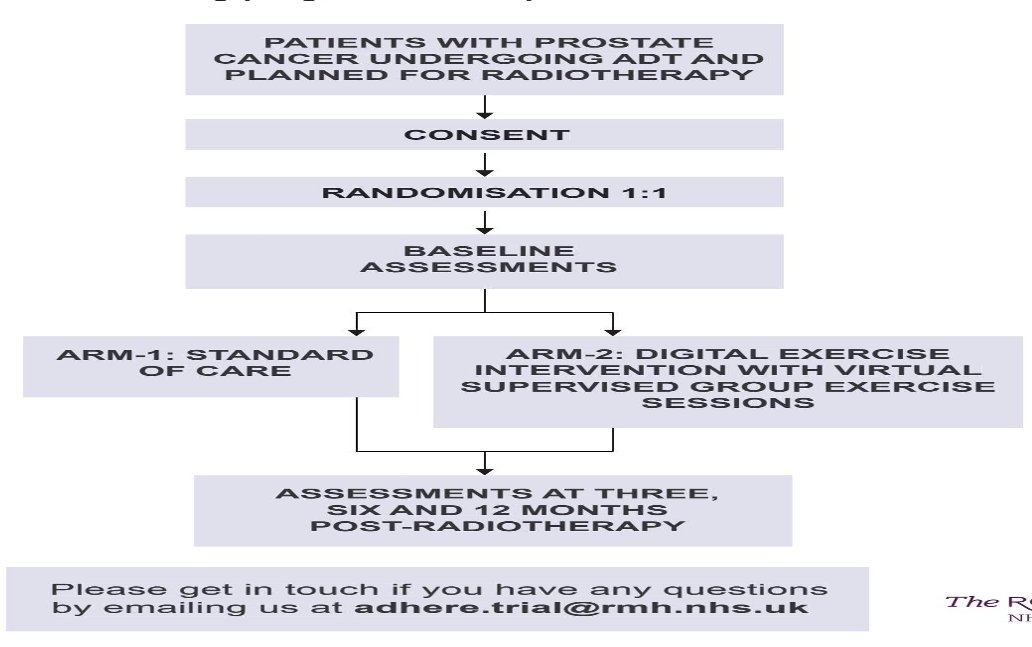
ADHERE is a single-center, phase III randomized controlled trial. Participants undergo a baseline assessment followed by 1:1 randomization to one of two treatment groups:
- Arm 1: Standard of care
- Arm 2: Digital exercise intervention with virtual supervised group exercise sessions
Participants undergo follow-up assessments at 3 months and 6 months after randomization.
Eligible patients must have:
- Histologically confirmed prostate adenocarcinoma
- Received ADT within the preceding 6 months
- Planned ADT duration of at least 6 months
- Ability to communicate in English
- Access to the internet and a device capable of videoconferencing
Key exclusion criteria include:
- Previous participation in a formal exercise intervention study
- Medical contraindications to exercise
- Receipt of short-term ADT (<6 months) in the adjuvant setting
- Inability to provide informed consent
The primary endpoint is the feasibility and acceptability of the intervention, assessed by the proportion of eligible men recruited and retained, as well as adherence to the exercise program.
Secondary endpoints include:
- Physical activity levels
- Physical function
- Body composition
- Quality of life
- Participant-reported experiences and barriers to exercise participation
The trial aims to recruit 58 participants and will employ both quantitative and qualitative methodologies. Quantitative outcomes will be analyzed using intention-to-treat principles, while qualitative interviews will provide insight into participant experiences and factors influencing engagement with exercise during ADT.
Overall, ADHERE addresses an important supportive care challenge in prostate cancer management. By combining digital health technology with virtually supervised group exercise, the study seeks to improve accessibility and long-term adherence to exercise among men receiving ADT. If successful, this model may provide a scalable and sustainable strategy to reduce treatment-related toxicities and improve quality of life for patients undergoing androgen deprivation therapy.
Presented by: Nicholas James, MBBS, PhD, Professor of Prostate and Bladder Cancer Research at The Institute of Cancer Research and The Royal Marsden NHS Foundation Trust, London, UK
Written by: Rashid K. Sayyid, MD, MSc, Assistant Professor, Urologic Oncologist, Department of Urology at The University of Arizona and Banner University Medical Center, Tucson, AZ – @rksayyid on X during the American Society of Clinical Oncology Genitourinary (ASCO) Annual Meeting held in Chicago, IL between May 29th and June 1st, 2026