

(UroToday.com) The 2026 American Society of Clinical Oncology Genitourinary (ASCO) Annual Meeting held in Chicago, IL between Fri, May 29 – Tues, Jun 2, 2026., was host to Prostate, Testicular, and Penile Cancer – Posters Session. Dr. Neeraj Agarwal presented Abstract 5087: Evaluation of concomitant medications in advanced prostate cancer patients receiving apalutamide: TITAN and SPARTAN post-hoc analysis.
Dr. Agarwal highlighted that apalutamide is an androgen receptor pathway inhibitor approved in combination with ADT for patients with metastatic castration-sensitive prostate cancer and nonmetastatic castration-resistant prostate cancer based on the TITAN and SPARTAN trials. (1,2) However, because apalutamide induces CYP3A4/2C19 and P-glycoprotein pathways, concerns remain regarding potential drug-drug interactions with commonly prescribed medications frequently used in this patient population.
Dr. Agarwal reviewed findings from the TITAN and SPARTAN phase III trials evaluating apalutamide in advanced prostate cancer. In TITAN, 1,052 patients with metastatic castration-sensitive prostate cancer were randomized to receive apalutamide plus ADT or placebo plus ADT, with apalutamide significantly improving both overall survival and radiographic progression-free survival while maintaining a similar safety profile and preserved health-related quality of life.1 In SPARTAN, 1,207 patients with nonmetastatic castration-resistant prostate cancer receiving ongoing ADT were randomized to apalutamide or placebo, and treatment with apalutamide significantly reduced the risk of distant metastasis or death, improved overall survival, and remained well tolerated.2
These post hoc analyses from TITAN and SPARTAN specifically evaluated treatment-emergent adverse events potentially influenced by drug-drug interactions when apalutamide was administered alongside commonly prescribed concomitant medications. The analyses focused on eight frequently used medication classes with known interaction potential, including anticoagulants, antidiabetics, antihypertensives, corticosteroids, gabapentinoids, macrolides, proton pump inhibitors, and statins. Incidence rates of treatment-emergent adverse events were descriptively compared between treatment arms.
Because treatment duration was substantially longer in the apalutamide plus ADT arms compared with placebo plus ADT, exceeding placebo exposure by approximately 12 to 26 months across the two studies, the investigators utilized exposure-adjusted incidence rates per 100 patient-years to account for imbalances in time at risk between study groups.
Dr. Agarwal noted that concomitant medication use was common across both studies and reflected real-world clinical practice. (1,2) Patients receiving 1 or more of the 8 most commonly used concomitant medication classes had baseline characteristics generally consistent with the overall TITAN and SPARTAN safety populations as shown below: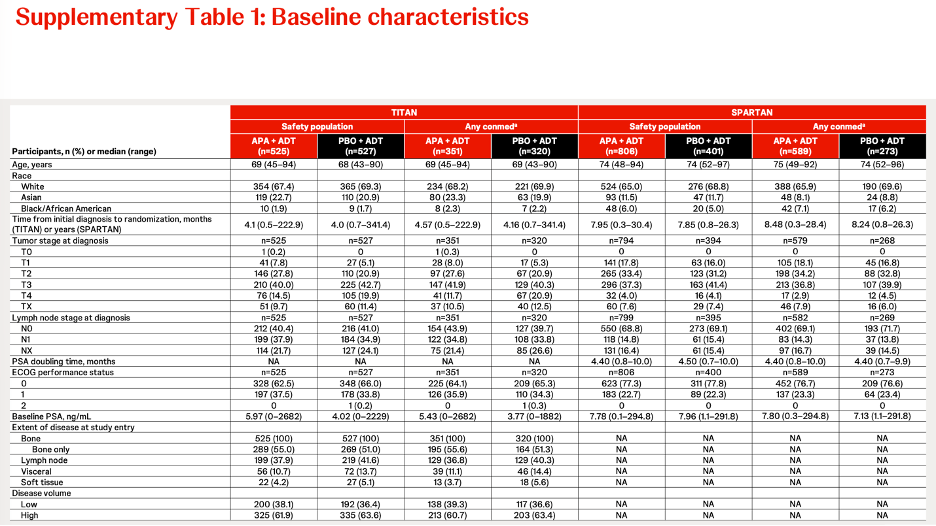
In TITAN, exposure-adjusted rates of any-grade TEAEs per 100 patient-years among patients receiving any concomitant medication were lower with apalutamide plus ADT compared with placebo plus ADT (76.5 vs 116.5), although grade 3–4 TEAE rates remained numerically similar (13.2 vs 20.3). Similar patterns favoring apalutamide were observed across antihypertensives, macrolides, antidiabetics, anticoagulants, corticosteroids, gabapentinoids, and statins. However, proton pump inhibitors demonstrated slightly higher any-grade TEAE rates with apalutamide (2.5 vs 0.9 events per 100 patient-years).
Similarly, in SPARTAN, patients receiving any concomitant medication had lower exposure-adjusted rates of any-grade TEAEs with apalutamide plus ADT versus placebo plus ADT (105.8 vs 160.3 events per 100 patient-years), while grade 3–4 TEAEs occurred at rates of 19.0 versus 28.2, respectively. Across most medication classes, including antihypertensives, antidiabetics, macrolides, corticosteroids, anticoagulants, statins, and proton pump inhibitors, exposure-adjusted TEAE rates were numerically lower in the apalutamide arm, although grade 3–4 anticoagulant-associated TEAEs were higher with placebo in SPARTAN (10.6 vs 4.0 events per 100 patient-years).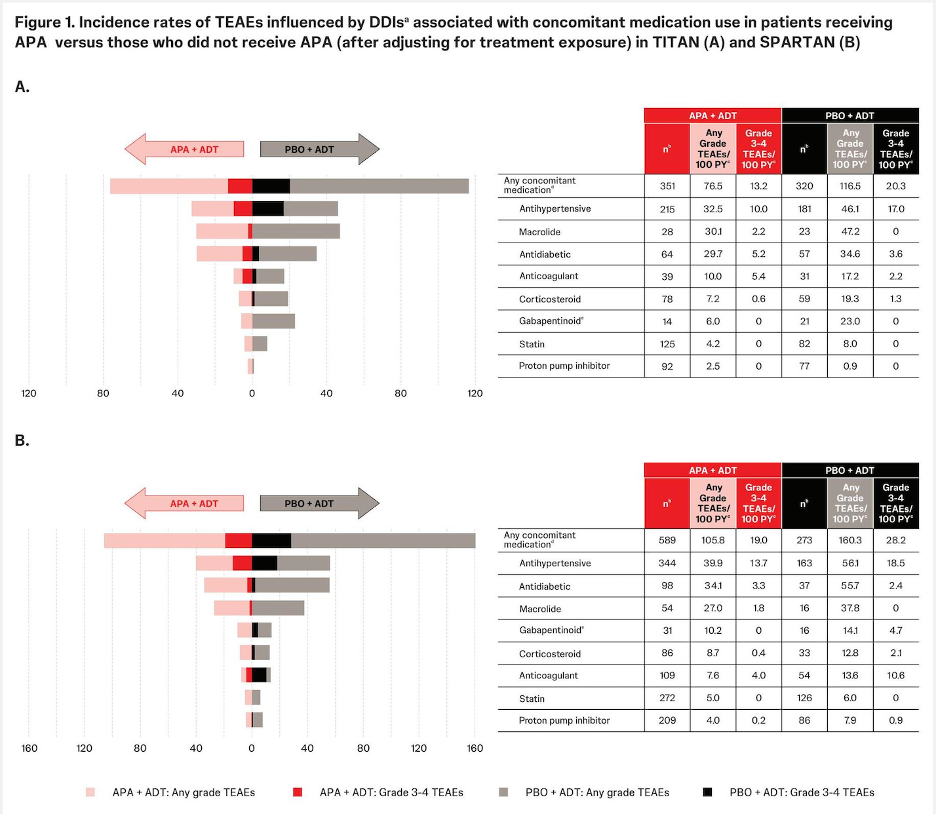
Antihypertensive agents represented the most frequently used concomitant medication class in TITAN. Among patients receiving antihypertensives, exposure-adjusted rates of any-grade TEAEs were numerically lower with apalutamide plus ADT compared with placebo plus ADT (32.5 vs 46.1 events per 100 patient-years), with similar findings observed for grade 3–4 TEAEs (10.0 vs 17.0). As shown in the table below, vascular disorders, including hypertension, represented the most common adverse events in both treatment arms, while rates of hypotension, orthostatic hypotension, dizziness, peripheral swelling, and cardiac disorders remained low overall.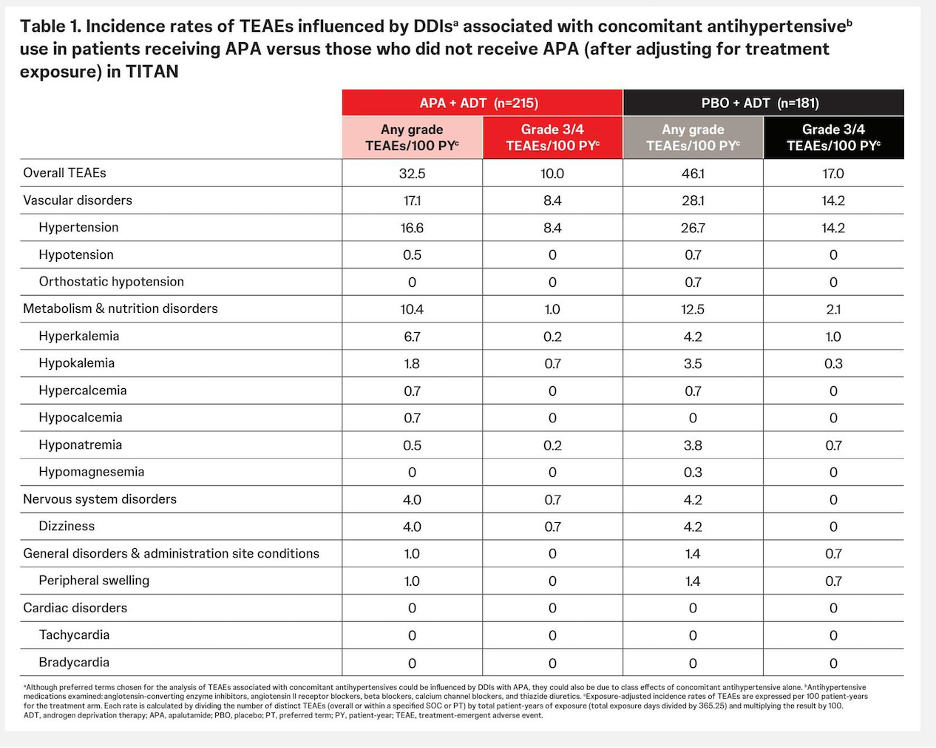
Dr. Agarwal concluded his presentation with the following key remarks:
- In exploratory post hoc analyses from TITAN and SPARTAN, concomitant use of commonly prescribed medications was frequent, reflecting the degree of polypharmacy commonly encountered in real-world patients with advanced prostate cancer
- Across eight commonly used concomitant medication classes, incidence rates of treatment-emergent events potentially influenced by drug-drug interactions were generally comparable between patients receiving apalutamide and those not receiving apalutamide
- These findings suggest that, under standard clinical monitoring, coadministration of apalutamide with commonly prescribed concomitant medications did not result in a clinically meaningful increase in treatment-emergent adverse event burden
- Apalutamide and other ARPIs are known to carry drug-drug interaction potential, highlighting the continued importance of medication reconciliation and routine monitoring in clinical practice
Presented by: Neeraj Agarwal, MD, FASCO, Professor, Presidential Endowed Chair of Cancer Research, Director, GU Program and the Center of Investigational Therapeutics (CIT), Huntsman Cancer Institute, University of Utah, Salt Lake City, UT
Written by: Julian Chavarriaga, MD, Clinical Assistant Professor, Urologic Oncologist, Department of Urology at Penn State Health @chavarriagaj on X during the American Society of Clinical Oncology Genitourinary (ASCO) Annual Meeting held in Chicago, IL between May 29th and June 1st, 2026
References:- Chi KN, Chowdhury S, Bjartell A, Chung BH, Pereira de Santana Gomes AJ, Given R, Juárez A, Merseburger AS, Özgüroğlu M, Uemura H, Ye D, Brookman-May S, Mundle SD, McCarthy SA, Larsen JS, Sun W, Bevans KB, Zhang K, Bandyopadhyay N, Agarwal N. Apalutamide in Patients With Metastatic Castration-Sensitive Prostate Cancer: Final Survival Analysis of the Randomized, Double-Blind, Phase III TITAN Study. J Clin Oncol. 2021 Jul 10;39(20):2294-2303. doi: 10.1200/JCO.20.03488. Epub 2021 Apr 29. PMID: 33914595.
- Smith MR, Saad F, Chowdhury S, Oudard S, Hadaschik BA, Graff JN, Olmos D, Mainwaring PN, Lee JY, Uemura H, Lopez-Gitlitz A, Trudel GC, Espina BM, Shu Y, Park YC, Rackoff WR, Yu MK, Small EJ; SPARTAN Investigators. Apalutamide Treatment and Metastasis-free Survival in Prostate Cancer. N Engl J Med. 2018 Apr 12;378(15):1408-1418. doi: 10.1056/NEJMoa1715546. Epub 2018 Feb 8. PMID: 29420164.