

(UroToday.com) The 2026 American Society of Clinical Oncology Genitourinary (ASCO) Annual Meeting held in Chicago, IL between Fri, May 29 – Tues, Jun 2, 2026, was host to Prostate, Testicular, and Penile Cancer – Posters Session. Alexandra Larkin presented Abstract 5095: Classification tree phenotypes for early treatment-limiting toxicity after ARPI initiation in mHSPC from the IRONMAN registry.
Dr. Larkin highlighted that although androgen receptor pathway inhibitors have significantly improved survival outcomes in metastatic hormone-sensitive prostate cancer (mHSPC), early treatment-limiting toxicities remain clinically relevant and may impact treatment persistence and quality of life. Using data from the IRONMAN registry, the investigators sought to develop a simple and clinically interpretable classification tree capable of stratifying patients according to risk of early adverse outcomes following ARPI initiation.The primary analytic cohort included 583 patients with at least 12 months of follow-up or an adverse outcome event within 365 days, defined as either a first serious adverse event or ARPI discontinuation due to toxicity or other non-progression-related reasons. Candidate peri-initiation predictors included demographic variables, laboratory parameters, treatments, and concomitant medications, as well as patient-reported outcomes. Stepwise logistic regression was used for variable reduction prior to recursive partitioning analysis. Terminal nodes generated through the decision-tree model were subsequently collapsed into low-, intermediate-, and high-risk strata. Exploratory Kaplan-Meier analyses then applied these tree-derived risk cutoffs to the broader eligible cohort of 758 patients. The cohort summary is presented below:

Dr. Larkin noted that 122 of 583 patients (20.9%) experienced an adverse outcome within the first year, including 85 serious adverse events and 37 ARPI discontinuations, of which 28 were attributed to toxicity. Adverse outcome-free survival did not significantly differ according to the specific ARPI agent utilized, allowing all ARPIs to be pooled for analysis.
The final recursive-partitioning classification tree retained nine clinically relevant predictors, including EORTC global health rating, hemoglobin, pain score, lactate dehydrogenase (LDH), age, docetaxel exposure, opioid agonist use, and systemic steroid use.
The model demonstrated an in-sample AUC of 0.76 (95% CI 0.71–0.81), while cross-validated AUC was 0.60 (95% CI 0.55–0.65). Patients were ultimately grouped into low-, intermediate-, and high-risk phenotypes with clearly distinct risks of adverse outcomes at 1 year.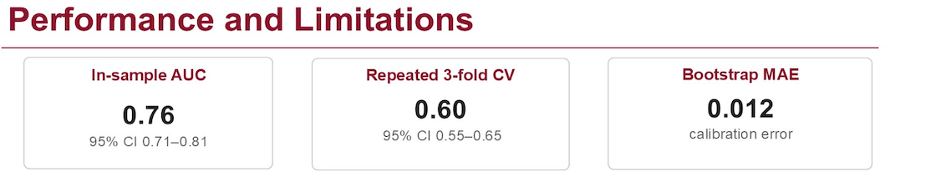
Among the 583 patients analyzed, 72% were categorized as low risk, with a 1-year adverse outcome risk of 10.7% (95% CI 7.7–13.6). Intermediate-risk patients comprised 14% of the cohort and demonstrated a 1-year adverse outcome risk of 26.3% (95% CI 16.6–35.9). The remaining 14% were classified as high risk, with a markedly elevated 1-year adverse outcome risk of 69.1% (95% CI 59.1–79.2).
Dr. Larkin emphasized that high-risk phenotypes were characterized by poorer baseline health status, symptomatic disease burden, anemia, and/or elevated LDH, as well as a treatment-intensity phenotype involving triplet therapy combined with opioid and steroid use.
Dr. Larkin concluded her presentation with the following take-home messages:
- A simple classification tree identified clinically interpretable phenotypes associated with early adverse outcomes following ARPI initiation in mHSPC
- Approximately 21% of patients experienced a serious adverse event or treatment discontinuation within the first year of therapy
- The model stratified patients into low-, intermediate-, and high-risk groups with markedly different 1-year adverse outcome risks
- High-risk phenotypes were associated with poor baseline health status, symptomatic disease, anemia, elevated LDH, and more intensive systemic treatment
- These decision rules may help support patient counseling, toxicity monitoring, and shared decision-making in routine clinical practice
Presented by: Alexandra Larkin, MPH, Clinical Research Coordinator III at The University of Chicago, Chicago, IL.
Written by: Julian Chavarriaga, MD, Clinical Assistant Professor, Urologic Oncologist, Department of Urology at Penn State Health @chavarriagaj on X during the American Society of Clinical Oncology Genitourinary (ASCO) Annual Meeting held in Chicago, IL between May 29th and June 1st, 2026