

(UroToday.com) The 2026 American Society of Clinical Oncology Genitourinary (ASCO) Annual Meeting held in Chicago, IL between Fri, May 29 – Tues, Jun 2, 2026, was host to Prostate, Testicular, and Penile Cancer – Posters Session. Dr. Christelle McFarland presented Abstract 5071: Real-world use of olaparib in US veterans with mCRPC: Treatment patterns and outcomes.
Dr. McFarland highlighted that olaparib has demonstrated meaningful clinical benefit in patients with metastatic castration-resistant prostate cancer harboring homologous recombination repair gene alterations, as previously established in the PROfound trial.1 However, real-world data evaluating olaparib utilization patterns and outcomes in broader, more diverse patient populations remain limited. Given the size and diversity of the Veteran’s Health Administration (VHA) healthcare system, this analysis sought to characterize treatment sequencing and clinical outcomes among veterans with mCRPC treated with olaparib in routine clinical practice.
The investigators identified all VHA patients with mCRPC who received olaparib between May 2020 and December 2023 and performed a retrospective chart review capturing clinical data from May 2018 through June 2025. Demographics, biomarker testing patterns, treatment sequencing, time to next therapy (TTNT), and overall survival (OS) were evaluated.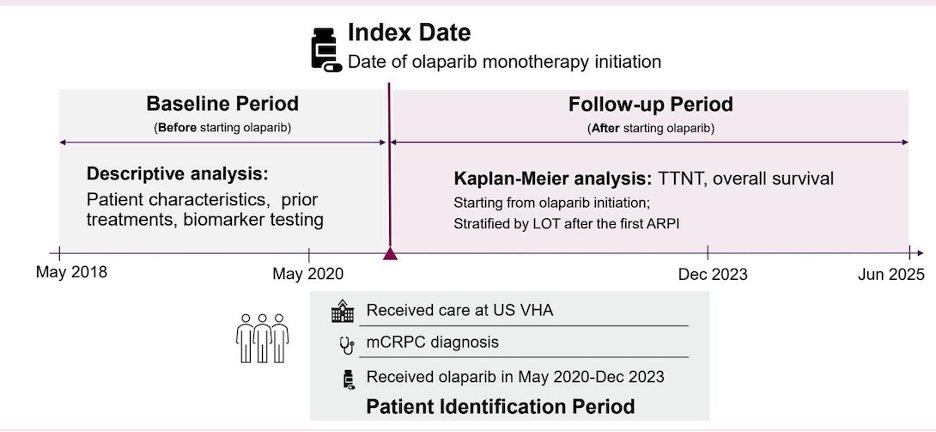
A total of 477 patients with mCRPC received olaparib within the VHA system. Median age at olaparib initiation was 75 years, notably older than the population enrolled in the PROfound trial. The cohort was predominantly non-Hispanic White (69%), with substantial representation of Black/African American (20%) and Hispanic/Latino (6%) patients.
Dr. McFarland noted that among 437 patients with known homologous recombination repair alterations, BRCA2 mutations were the most common, identified in 175 patients (40%), followed by ATM alterations in 130 patients (30%), CDK12 alterations in 59 patients (13.5%), and BRCA1 alterations in 37 patients (8.5%).
Dr. McFarland highlighted evolving treatment patterns following FDA approval of olaparib. Among the 461 patients who received an androgen receptor pathway inhibitor prior to olaparib, many initiated olaparib monotherapy in later lines of therapy after progression on their first ARPI, including 24% in the first-line setting, 35% in the second-line setting, and 41% in the third-line setting or beyond. Median time to next treatment decreased with later-line olaparib use, from 9 months in the first-line setting to 5 months in the fourth-line or later setting. Similarly, median overall survival declined across later lines of therapy, ranging from 17 months in the first-line setting to 8 months among patients treated in the fourth-line or later setting.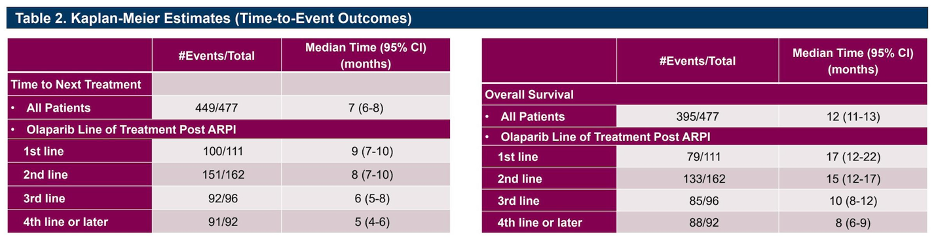
The median interval from HRR testing to olaparib initiation was 5 months. Median TTNT following olaparib initiation was 7 months, while median OS was 12 months. Importantly, earlier use of olaparib following first novel hormonal agent exposure appeared to be associated with improved survival outcomes, with median OS reaching 17 months in patients receiving olaparib earlier in the disease course compared with 8 months among those treated in the fourth-line setting or later.
Several important study limitations were acknowledged. The analysis reflected treatment patterns during the early post-FDA approval era for olaparib (May 2020 through December 2023), and these patterns may continue to evolve over time with broader adoption of PARP inhibitors and changing treatment paradigms. Additionally, the study was conducted within a single healthcare system, the Veterans Health Administration, which may limit generalizability beyond the veteran population. Finally, the lack of a prospective control group limited the ability to perform direct comparative analyses.
Dr. McFarland concluded her presentation with the following key messages:
- Real-world use of olaparib within the VHA demonstrated favorable outcomes despite an older and more heavily pretreated patient population
- The VHA cohort included substantially greater representation of Black/African American and Hispanic/Latino patients compared with pivotal clinical trials
- Most patients received olaparib in late-line treatment settings, often after multiple prior therapies
- Earlier integration of olaparib following the first novel hormonal agent exposure was associated with numerically longer overall survival
- These findings support the effectiveness of olaparib in routine clinical practice and provide important insights into treatment sequencing patterns in mCRPC
Presented by: Christelle McFarland, MD, Project Scientist at Institute for Medical Research, Raleigh, North Carolina, United States
Written by: Julian Chavarriaga, MD, Clinical Assistant Professor, Urologic Oncologist, Department of Urology at Penn State Health @chavarriagaj on X during the American Society of Clinical Oncology Genitourinary (ASCO) Annual Meeting held in Chicago, IL between May 29th and June 1st, 2026
Reference: