

(UroToday.com) The 2026 American Society of Clinical Oncology Genitourinary (ASCO) Annual Meeting held in Chicago, IL between Fri, May 29 – Tues, Jun 2, 2026, was host to Prostate, Testicular, and Penile Cancer – Posters Session. Dr. Praful Ravi presented Abstract 5102: Quantitative results from PSMAtrack: A prospective study evaluating change in PSMA-PET during initial systemic therapy for mHSPC.
Dr. Ravi highlighted that achieving a PSA <0.2 ng/mL after 6 months of treatment with ADT plus an androgen receptor pathway inhibitor (ARPI), with or without docetaxel, is strongly prognostic in metastatic hormone-sensitive prostate cancer (mHSPC). (1) However, less is known about the biologic significance of persistent disease detected on PSMA-PET imaging despite biochemical response. This prospective pilot study evaluated whether quantitative PSMA-PET parameters after 6 months of therapy correlate with PSA response in patients with mHSPC.
This single-institution study enrolled patients with mHSPC initiating ADT plus ARPI ± docetaxel. F18-flotufolastat PSMA-PET imaging was performed at baseline within 21 days of ADT initiation and repeated after 6 months of systemic therapy. Quantitative PSMA-PET parameters included total tumor volume (TTV), SUVmax, and SUVmean.
Patients were excluded if they had received radiation therapy to primary or metastatic sites prior to the 6-month PET scan. PSMA-avid disease was defined as PSMA uptake greater than blood pool in a pattern consistent with prostate cancer, with quantitative analysis performed using MIM (GE Healthcare) and aPROMISE (Exini) software. The primary objective was to determine the proportion of patients with residual disease on PSMA-PET at 6 months, with an exploratory objective comparing 6-month PET parameters between patients achieving PSA <0.2 ng/mL versus ≥0.2 ng/mL.
Among 21 enrolled patients, 20 had evaluable baseline and 6-month PSMA-PET scans. Median age was 72 years (range 60–95), median baseline PSA was 55 ng/mL (range 2.2–3,696), and 65% of patients had high-volume disease per CHAARTED criteria. Twelve patients (60%) received ADT plus ARPI, while 8 (40%) received triplet therapy with docetaxel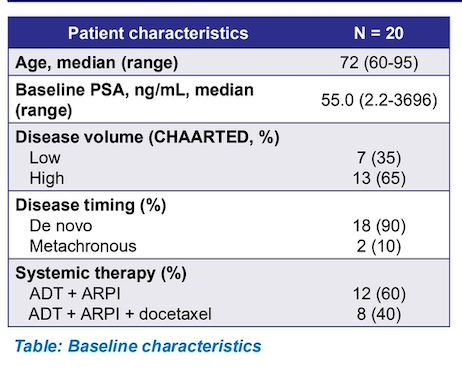
At 6 months, median PSA was 0.29 ng/mL (range <0.02–177), and 9 patients (45%) achieved a PSA ≤0.2 ng/mL. Despite treatment, all 20 patients demonstrated persistent PSMA-avid disease on qualitative review at 6 months, with 85% showing residual disease outside the prostate. Additionally, 2 patients (10%) developed new lesions on follow-up PSMA-PET imaging.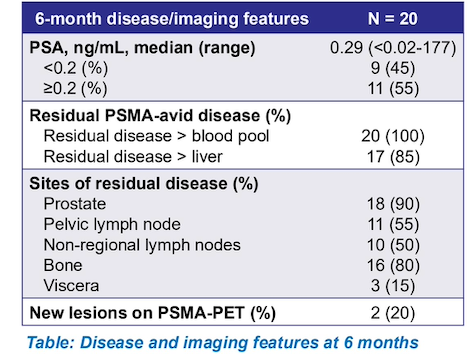
Dr. Ravi presented an example of a 6-month PSMA PET/CT improvement in nodal disease and residual disease with a PSA <0.02 as shown below: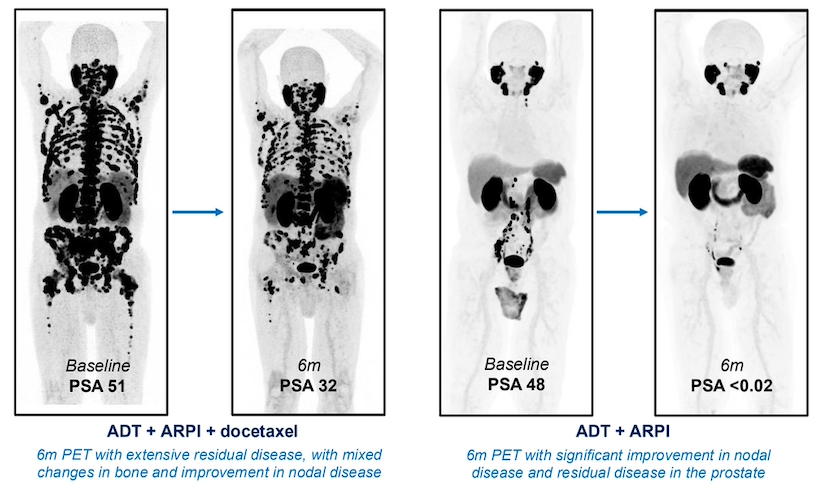
Importantly, patients achieving a 6-month PSA ≤0.2 ng/mL demonstrated significantly lower median TTV and SUVmax values compared with those with PSA >0.2 ng/mL. Median TTV was 7.7 mL (range 0.4–79.9) versus 147 mL (range 5.9–3440), respectively (p<0.01). Similarly, median SUVmax was 8.7 (range 4.8–39.2) versus 47.4 (range 11.7–162) (p<0.01), whereas SUVmean was not significantly different between groups (5.3 vs 6.4; p=0.14).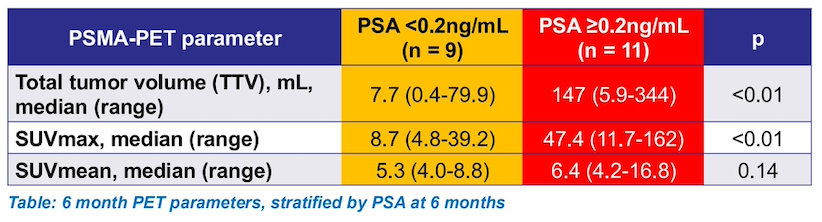
Dr. Ravi further noted that baseline TTV strongly correlated with 6-month PSA levels (r=0.74, p<0.01). PSA and TTV also demonstrated strong correlations both at baseline (r=0.68, p=0.001) and at 6 months (r=0.81, p<0.01), as well as for changes over time from baseline to 6 months (r=0.67, p=0.001).
Dr. Ravi concluded his presentation with the following key messages:
- Persistent PSMA-avid disease remained detectable in all patients after 6 months of ADT plus ARPI ± docetaxel, regardless of PSA response
- Patients with PSA >0.2 ng/mL at 6 months demonstrated significantly higher TTV and SUVmax values on PSMA-PET imaging
- TTV showed a strong correlation with PSA both at baseline and after 6 months of therapy
- Quantitative PSMA-PET imaging may help identify patients with suboptimal early response despite standard systemic therapy
- A six-month PSMA-PET assessment could potentially inform future consolidative treatment strategies in mHSPC
Presented by: Praful Ravi, MB, BChir, MRCP, Medical Oncologist, Assistant Professor of Medicine, Medical Director of GU Theranostics, Dana Farber Cancer Institute, Harvard Medical School, Boston, MA
Written by: Julian Chavarriaga, MD, Clinical Assistant Professor, Urologic Oncologist, Department of Urology at Penn State Health @chavarriagaj on X during the American Society of Clinical Oncology Genitourinary (ASCO) Annual Meeting held in Chicago, IL between May 29th and June 1st, 2026
Reference:- Ong M, et al. Prognostic significance of PSA>0.2 after 6-12 months treatment for metastatic hormone-sensitive prostate cancer (mHSPC) intensified by androgen-receptor pathway inhibitors (ARPI): A multinational real-world analysis of the IRONMAN registry.. J Clin Oncol 43, 5002-5002(2025). DOI:10.1200/JCO.2025.43.16_suppl.5002