

(UroToday.com) The 2026 American Society of Clinical Oncology Genitourinary (ASCO) Annual Meeting, held in Chicago, IL, will host the Prostate, Testicular, and Penile Cancer – Posters Session. Dr. Soumyajit Roy will present Abstract 5082: Independent validation of a model to predict early favorable PSA response (NADIR model) in enzalutamide-treated patients of the ARCHES trial.
Dr. Roy highlighted that their group previously developed and independently validated the NADIR model, a multivariable logistic regression model designed to predict early favorable PSA response in patients with metastatic hormone-sensitive prostate cancer treated with androgen receptor pathway inhibitors. Validated in LATITUDE, TITAN, ARASENS, and ENZAMET.1 Specifically, the model predicts achievement of a PSA ≤0.2 ng/mL within six months of treatment initiation, an endpoint associated with improved long-term outcomes. In this study, the investigators sought to independently validate the NADIR model using enzalutamide-treated patients from the phase 3 ARCHES trial.2
ARCHES was a randomized phase 3 trial comparing ADT alone versus ADT plus enzalutamide in patients with mHSPC.2 The locked NADIR model was applied to patients receiving enzalutamide, and model performance was evaluated using area under the receiver operating characteristic curve (AUC), index of prediction accuracy (IPA), sensitivity, specificity, positive predictive value (PPV), negative predictive value (NPV), and likelihood ratios. Additionally, overall survival outcomes were assessed according to tertiles of predicted PSA response probability generated by the model.
Among 1,125 evaluable patients in the validation cohort, 559 received enzalutamide. Approximately 64% of patients achieved a PSA ≤0.2 ng/mL within six months of treatment initiation.
The NADIR model demonstrated strong discriminatory performance, with:
- AUC of 0.80 (95% CI 0.76–0.83)
- IPA of 23%
Dr. Roy also presented a sensitivity analysis limited to patients who initiated ADT within ≤2 months prior to study inclusion. Importantly, model performance remained robust in this restricted cohort, with an AUC of 0.79 (95% CI 0.75–0.83) and an index of prediction accuracy of 23%, closely mirroring the primary analysis results. These findings support the stability and reproducibility of the model across clinically relevant sensitivity analyses.
When patients were stratified according to tertiles of predicted PSA response probability, early favorable PSA response rates were:
- 92% in the upper tertile
- 64% in the middle tertile
- 37% in the lower tertile

Importantly, predicted response probability was also associated with overall survival outcomes. Compared with patients in the upper tertile, those in the middle tertile had significantly worse OS (HR 1.97, 95% CI 1.33–2.91), while patients in the lower tertile experienced the poorest outcomes (HR 2.18, 95% CI 1.48–3.21).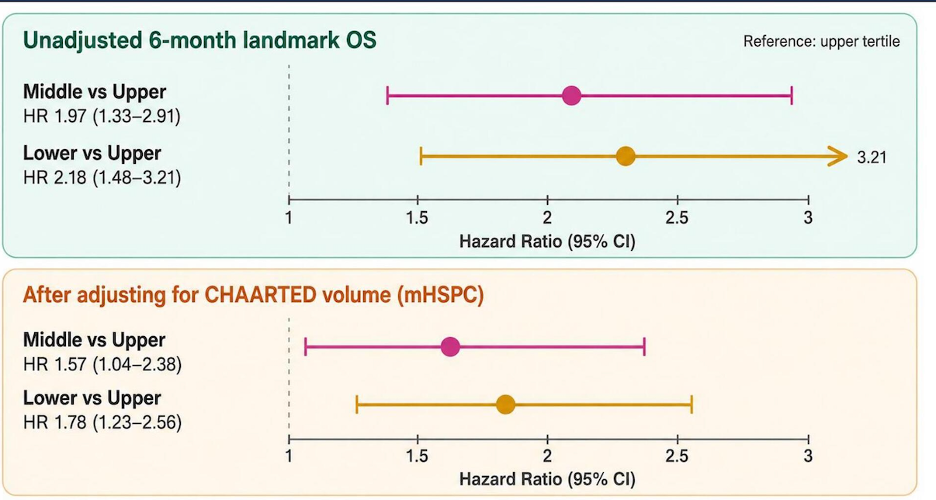
Among patients who received less than three months of ADT prior to ARPI initiation, the model maintained strong performance, with an AUC of 0.79 and IPA of 22%.
Dr. Roy concluded his presentation with the following key messages:
- The NADIR model demonstrated strong discriminatory performance in an independent validation cohort from the ARCHES trial
- The model effectively stratified enzalutamide-treated patients according to the likelihood of achieving an early favorable PSA response
- Predicted PSA response probability was strongly associated with overall survival outcomes
- Patients within lower predicted-response tertiles experienced significantly worse survival outcomes
Presented by: Soumyajit Roy, MD, Assistant Professor, Department of Radiation Oncology, University Hospitals Cleveland Medical Center, Case Western Reserve University School of Medicine, Cleveland, OH
Written by: Julian Chavarriaga, MD, Clinical Assistant Professor, Urologic Oncologist, Department of Urology at Penn State Health @chavarriagaj on X during the American Society of Clinical Oncology Genitourinary (ASCO) Annual Meeting held in Chicago, IL between May 29th and June 1st, 2026
References:
- Roy S, Sun Y, Hussain M, Chi KN, Fizazi K, Davis ID, Halabi S, Agarwal N, Chowdhury S, Tombal B, Morgan SC, Malone S, Barata PC, Ong M, Wallis CJD, Berlin A, Swami U, Kishan AU, Jia AY, Zaorsky NG, Garcia JA, Mendiratta P, Brown JR, Subhash VV, Stockler MR, Thomas H, McKay RR, Small EJ, Shore ND, Saad F, Sweeney CJ, Spratt DE. Early favorable prostate-specific antigen response prediction in metastatic hormone sensitive prostate cancer. Nat Commun. 2025 Dec 17;17(1):667. doi: 10.1038/s41467-025-67298-z. PMID: 41402322; PMCID: PMC12819402.
- Armstrong AJ, Szmulewitz RZ, Petrylak DP, Holzbeierlein J, Villers A, Azad A, Alcaraz A, Alekseev B, Iguchi T, Shore ND, Rosbrook B, Sugg J, Baron B, Chen L, Stenzl A. ARCHES: A Randomized, Phase III Study of Androgen Deprivation Therapy With Enzalutamide or Placebo in Men With Metastatic Hormone-Sensitive Prostate Cancer. J Clin Oncol. 2019 Nov 10;37(32):2974-2986. doi: 10.1200/JCO.19.00799. Epub 2019 Jul 22. PMID: 31329516; PMCID: PMC6839905.