

(UroToday.com) The 2026 American Society of Clinical Oncology Genitourinary (ASCO) Annual Meeting held in Chicago, IL, will host the Prostate, Testicular, and Penile Cancer – Posters Session. Dr. Arnulf Stenzl will present Abstract 5092: Efficacy and safety of enzalutamide in patients with mHSPC and cardiometabolic comorbidities and/or related concomitant medications: ARCHES post hoc.
Prior analyses from the phase 3 ARCHES trial demonstrated significant improvements in radiographic progression-free survival and overall survival with enzalutamide plus ADT compared with placebo plus ADT in patients with metastatic hormone-sensitive prostate cancer (mHSPC).1 Given the high prevalence of cardiometabolic diseases (CMDs) in this patient population, this analysis specifically evaluated the efficacy and safety of enzalutamide among patients with underlying CMDs receiving related concomitant medications.
The investigators evaluated two CMD populations within ARCHES: a full CMD cohort, which included patients with CMDs or receiving CMD-related medications, and a confirmed CMD cohort, which required both a documented CMD diagnosis and the use of concomitant CMD-related medications. Cardiometabolic conditions included hypertension, cardiac disorders, dyslipidemia, and diabetes mellitus.
CMD diagnoses were identified using medical history records and included hypertension, cardiac disorders, dyslipidemia, and diabetes mellitus. In parallel, CMD-related concomitant medications were categorized using ATC Level 2 classifications and included antidiabetics, vasoprotective agents, cardiac medications, lipid-modifying agents, antithrombotics, and antihypertensives. He noted that confirmed diagnoses derived from concomitant medication domains were sometimes incomplete or unvalidated and therefore were primarily utilized for sensitivity analyses.
The primary endpoint of the analysis remained radiographic progression-free survival, with a data cutoff of October 14, 2018. Secondary endpoints included overall survival, subgroup analyses according to concomitant medication categories, and safety outcomes in the full cardiometabolic comorbidity population. Exploratory analyses additionally evaluated rPFS and OS within confirmed CMD populations, as well as 5-year overall survival outcomes stratified by medication subgroup exposure.
Dr. Stenzl explained that Kaplan-Meier methodology was used for time-to-event analyses, while treatment group comparisons were performed using Cox proportional hazards models relative to placebo plus ADT. Overall survival analyses additionally incorporated adjustment for treatment crossover using a rank-preserving failure time model. Sensitivity analyses for rPFS and OS were conducted in the confirmed CMD population, and he noted that no multiplicity adjustments were performed, making all reported p-values nominal.
Among the 1,150 patients enrolled in ARCHES, 938 patients (82%) met criteria for the full CMD cohort, while 756 patients (66%) comprised the confirmed CMD population. Baseline characteristics were well balanced between treatment arms. Median age was approximately 70 years, about two-thirds of patients had Gleason score ≥8 disease, and high-volume disease was present in over 60% of patients.
Cardiometabolic comorbidities were highly prevalent, including hypertension (~68%), cardiac disorders (~33%), dyslipidemia (~31–34%), and diabetes mellitus (~22–23%). Nearly all patients were receiving concomitant medications, including CMD-related therapies. Median treatment duration was notably longer with ENZA + ADT versus placebo + ADT (40.6 vs 13.9 months).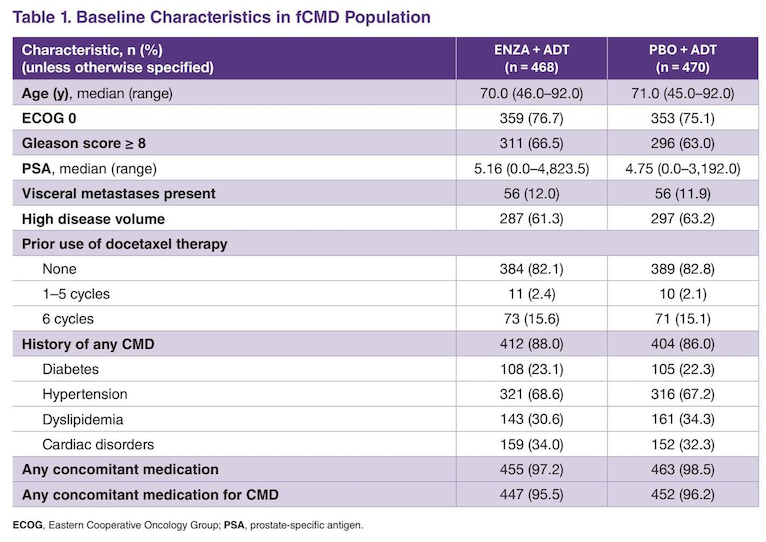
In the full cardiometabolic comorbidity (fCMD) population, ENZA + ADT significantly improved radiographic progression-free survival compared with placebo + ADT (HR 0.39; 95% CI 0.29–0.51; p<0.0001), with consistent findings observed in the confirmed CMD population (HR 0.41; 95% CI 0.30–0.56; p<0.0001). Benefits were maintained across concomitant medication subgroups and regardless of the number of cardiometabolic comorbidities present.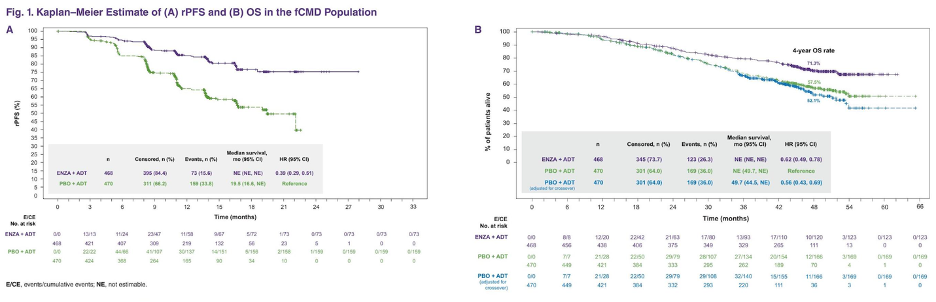
Similar improvements were also observed for overall survival in the fCMD population (HR 0.62; 95% CI 0.49–0.78; p<0.001), including after crossover adjustment (HR 0.56; 95% CI 0.43–0.69). Consistent overall survival benefits were also observed in the confirmed CMD population (HR 0.62; 95% CI 0.48–0.80; p=0.0002), across most concomitant medication subgroups (as shown below), and regardless of CMD burden. Furthermore, ENZA + ADT improved 5-year overall survival in the fCMD population (HR 0.65; 95% CI 0.53–0.81; p<0.001), with benefits remaining consistent after crossover adjustment and across most CMD and medication subgroups.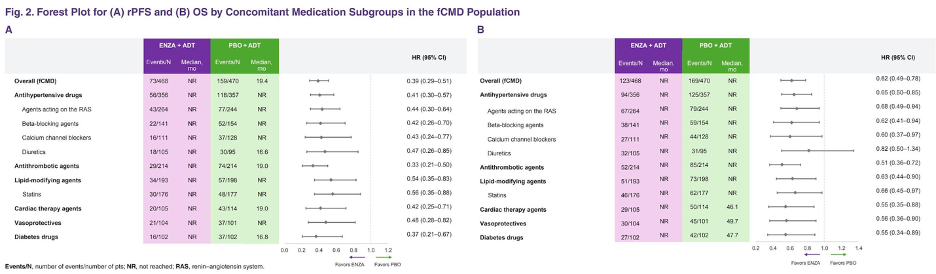
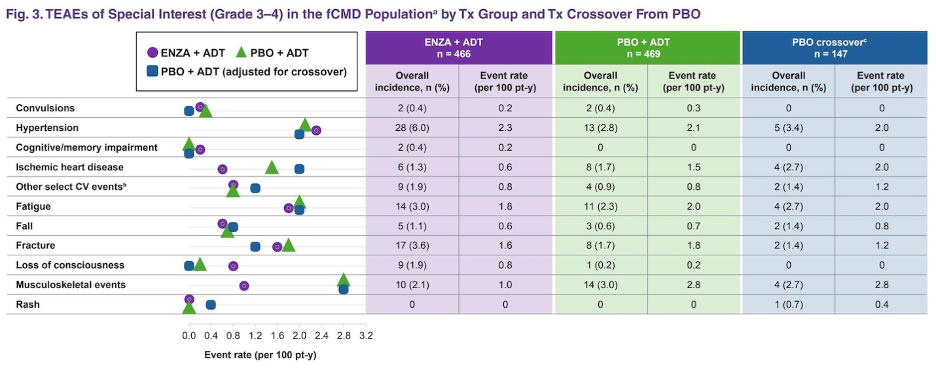
At the 2021 data cutoff, median treatment duration was substantially longer in the enzalutamide arm compared with placebo (41 months versus 14 months). Importantly, treatment-emergent adverse event rates per 100 patient-years were comparable between enzalutamide and placebo (313.8 versus 468.0, respectively).
Rates of adverse events of special interest with enzalutamide versus placebo included fatigue (14.4 versus 18.0 per 100 patient-years), falls (6.2 versus 2.6), fractures (7.3 versus 5.4), select cardiovascular events (2.5 versus 1.6), and convulsions (0.2 versus 0.5). No new safety signals were identified.
Dr. Stenzl concluded his presentation with the following key messages:
- Over 80% of patients enrolled in ARCHES had cardiometabolic comorbidities or were receiving CMD-related medications, highlighting the importance of considering comorbid conditions during treatment decision-making in prostate cancer
- ENZA + ADT remained efficacious and tolerable in patients with mHSPC and cardiometabolic comorbidities, with outcomes consistent with those observed in the overall ARCHES population
- The findings support ENZA + ADT as a standard-of-care option for patients with mHSPC who have CMDs or require CMD-related medications
- Dr. Stenzl emphasized that additional studies evaluating distinct mHSPC subgroups and comorbidity profiles remain important moving forward
Presented by: Arnulf Stenzl, MD, University Hospital Tubingen, Tubingen, Germany
Written by: Julian Chavarriaga, MD, Clinical Assistant Professor, Urologic Oncologist, Department of Urology at Penn State Health @chavarriagaj on X during the American Society of Clinical Oncology Genitourinary (ASCO) Annual Meeting held in Chicago, IL between May 29th and June 1st, 2026
References: