

(UroToday.com) The 2026 ASCO annual meeting featured a urothelial carcinoma trials in progress session and a presentation by Dr. Elena Sevillano discussing the SASAN-SPARING trial assessing selective bladder-sparing with sasanlimab as maintenance treatment based on clinical response to neoadjuvant treatment in molecularly categorized muscle invasive bladder cancer patients. Muscle invasive bladder cancer is an aggressive disease with a high risk of progression, for which radical cystectomy remains the standard of care. Adaptive bladder-sparing strategies based on post-neoadjuvant clinical restaging are increasingly explored to maintain oncologic control while preserving quality of life. SASAN-SPARING evaluates sasanlimab, a PD-1 inhibitor, as maintenance therapy in patients achieving a clinical response after neoadjuvant cisplatin-based chemotherapy.
SASAN-SPARING (HM-8788561; NCT06623162) is an ongoing, single-arm, multicenter, phase II trial enrolling patients aged ≥18 years with treatment-naïve, localized muscle invasive bladder cancer (pT2–T4a, N0, M0) eligible for neoadjuvant chemotherapy. All patients receive four cycles of cisplatin (70 mg/m² on day 1) + gemcitabine (1,000 mg/m² on days 1 and 8) every 3 weeks, followed by comprehensive clinical restaging:
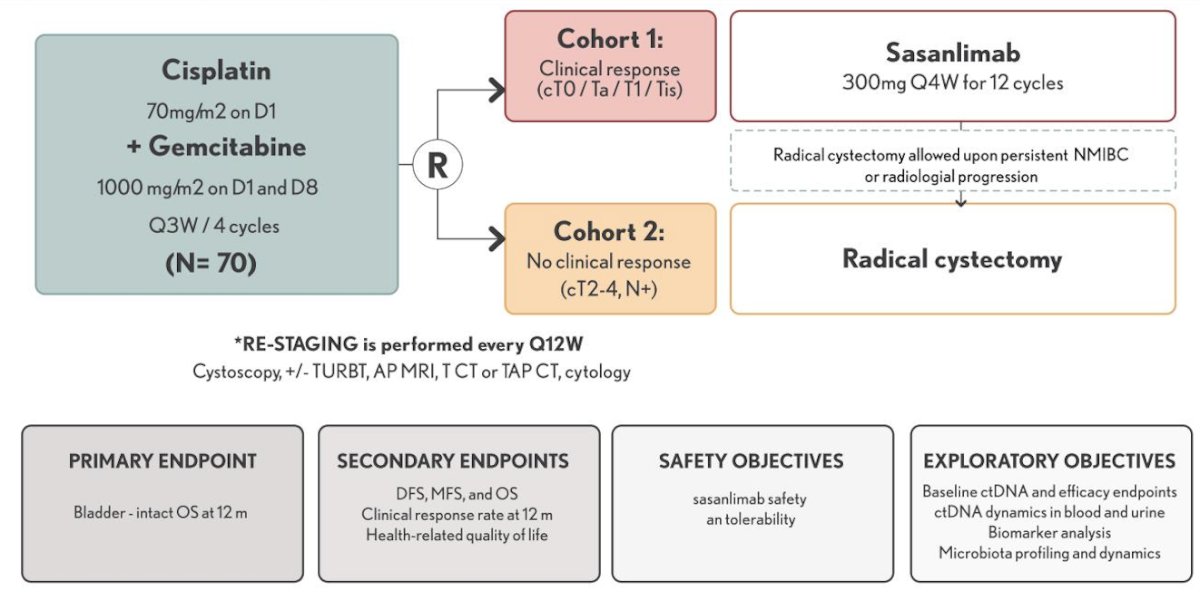
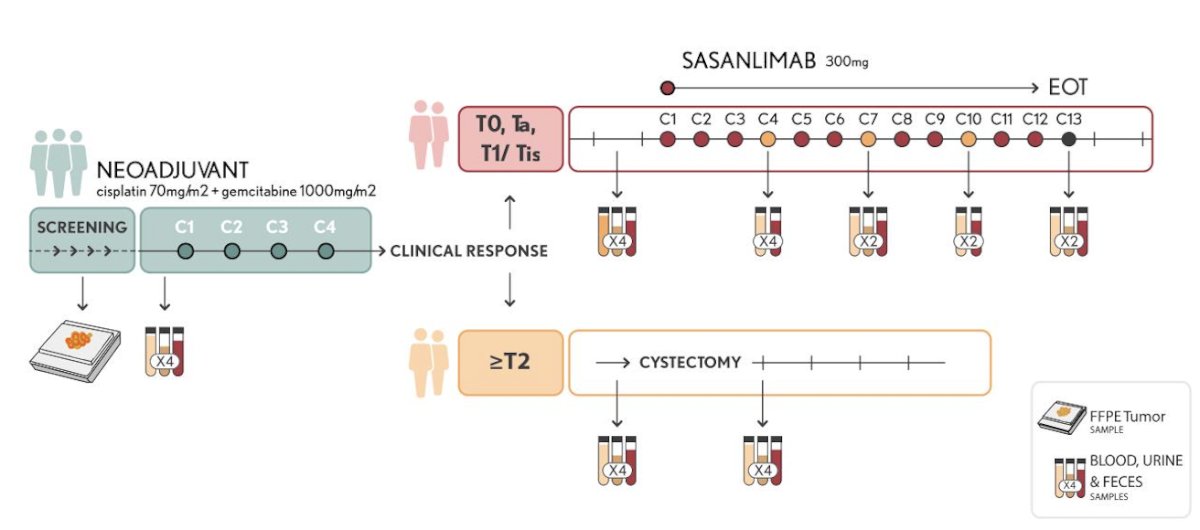
Patients achieving a clinical response (cT0/Ta/T1/Tis, negative cytology, and negative imaging) are eligible for bladder preservation with sasanlimab 300 mg administered subcutaneously every 4 weeks for up to 12 cycles. Non-responders (≥cT2) undergo radical cystectomy. During maintenance, restaging is performed every 12 weeks, and radical cystectomy may be considered upon loss of response or disease progression:
The primary endpoint is bladder-intact overall survival at 12 months after the first dose of sasanlimab. Secondary endpoints include disease free survival, metastasis free survival, overall survival, safety, and health-related quality of life.
The study incorporates an ambitious biomarker analysis, including whole-genome sequencing of tumor tissue and plasma, the use of ctDNA in plasma and urine for tumor assessment and molecular dynamics, and the study of the gut microbiome in stool. Biomarker-correlative studies will provide a valuable tool for personalized treatments and inform treatment decisions in adaptive strategies such as SASAN-SPARING. The expected sample size is 70 patients, assuming a 12-month bladder-intact overall survival of 81% (H0) and an increase with sasanlimab up to 93% (H1) (one-arm survival test; α = 0.05 β = 0.8).
Recruitment began in December 2024 and is now complete, with 70 patients enrolled across 10 centers. SASAN-SPARING explores an adaptive, biomarker-integrated bladder-sparing strategy which aims to generate prospective evidence to support organ-preservation strategies in muscle invasive bladder cancer.
Presented by: Elena Sevillano, MD, PhD, Centrol Integral Oncologico Clara Campal, Madrid, Spain
Written by: Zachary Klaassen, MD, MSc – Urologic Oncologist, Associate Professor of Urology, Georgia Cancer Center, Wellstar MCG Health, @zklaassen_md on Twitter during the American Society of Clinical Oncology Genitourinary (ASCO) Annual Meeting held in Chicago, IL between May 29th and June 1st, 2026