

(UroToday.com) The 2026 American Society of Clinical Oncology (ASCO) Annual Meeting was host to a kidney and bladder cancers poster session. Dr. Mohammad Moussa presented an analysis of ctDNA dynamics as an early biomarker of response to enfortumab vedotin + pembrolizumab (EV + pembro) in advanced urothelial carcinoma (aUC).
Radiographic assessment of treatment response in aUC carcinoma remains challenging, particularly in patients receiving immunotherapy-based combinations. ctDNA testing offers a sensitive and non-invasive approach for real-time monitoring of treatment response. Given the emergence of EV + pembro as a frontline standard of care, this study evaluated whether early ctDNA dynamics correlate with radiographic outcomes and survival endpoints.
The study investigators retrospectively analyzed an institutional cohort of 302 patients with aUC treated with EV + pembro at the MD Anderson Cancer Center. Among these, 79 patients with baseline and serial ctDNA testing using the tumor-informed Signatera assay between August 2023 and January 2026 were included in the analysis. ctDNA dynamics were evaluated using two complementary approaches:
- Early on-treatment ctDNA change (baseline versus first on-treatment ctDNA) and association with radiographic response
- Time-dependent Cox proportional hazards modeling evaluating ctDNA as a time-varying covariate for progression-free survival (PFS) and overall survival (OS), accounting for immortal-time bias
The baseline characteristics were as follows:
- Median age at advanced urothelial carcinoma diagnosis: 71 years
- Male sex: 70.9%
- Bladder primary tumors: 77.2%
- Upper tract primary tumors: 22.8%
- Visceral metastases: 43%
- Nodal-only metastases: 50.6%
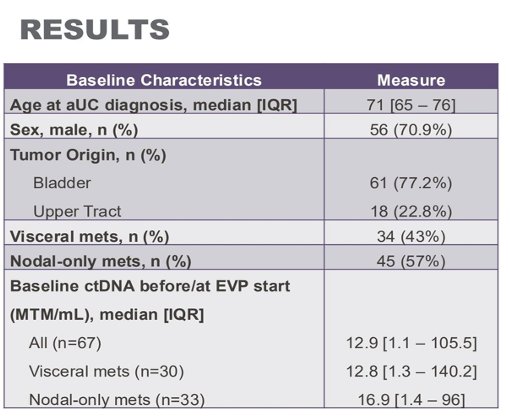
All patients underwent a median of 4 ctDNA assessments (range 1–9). Baseline ctDNA prior to or at EV + pembro initiation was available in 67 patients (84.8%). Among these patients:
- First ctDNA clearance occurred in 46.3%
- First ctDNA decrease occurred in 26.9%
- First ctDNA increase occurred in 19.4%
- Persistently undetectable ctDNA was observed in 6%
- 1.5% were lost to follow-up
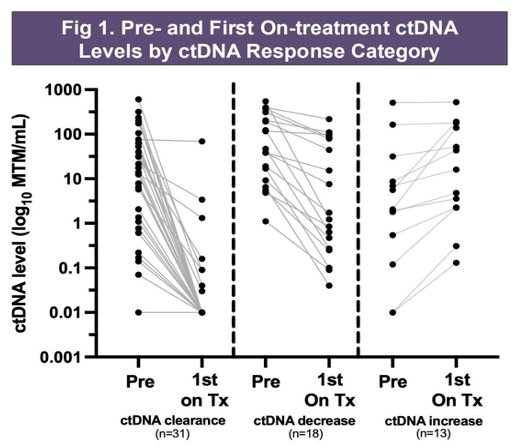
The median time to first ctDNA reduction, defined as clearance or decrease, was 48 days (IQR 40–86). Twelve patients (15.2%) without baseline ctDNA testing prior to EV + pembro initiation were considered non-evaluable.
The overall best response rate to EV + pembro was 67.1% (53/79), including:
- Complete response: 13.9%
- Partial response: 53.2%
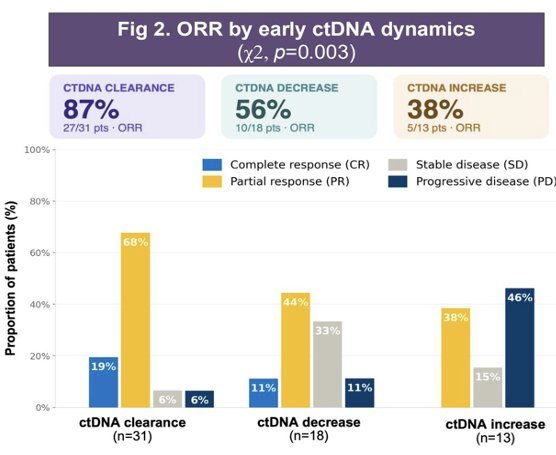
Importantly, radiographic responses strongly correlated with early ctDNA dynamics:
- First ctDNA clearance:
- Objective response rate: 87.1%
- First ctDNA decrease:
- Objective response rate: 55.6%
- First ctDNA increase:
- Objective response rate: 38.4%
- χ² test p=0.003
Survival outcomes in the overall cohort were as follows:
- Median PFS from EV + pembro initiation: 20.4 months (95% CI 8–NE)
- Median OS from EV + pembro initiation: 30.3 months (95% CI 26.3–34.3)
- Median follow-up: 12.1 months (95% CI 9.1–14.9)
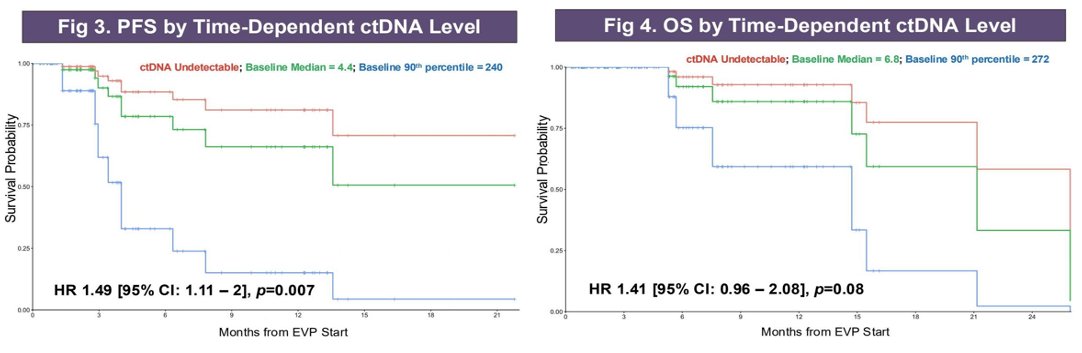
Time-dependent Cox proportional hazards analyses demonstrated that increasing ctDNA levels over time were associated with worse clinical outcomes:
- PFS: HR 1.49 (95% CI 1.11–2.0) ; p=0.007
- OS: HR 1.41 (95% CI 0.96–2.08); p=0.08
Dr. Moussa and colleagues concluded as follows:
- Early ctDNA dynamics represent a clinically meaningful biomarker of response to EV + pembro in advanced urothelial carcinoma and correlate closely with imaging outcomes.
- ctDNA clearance identified patients with deep and durable clinical benefit, whereas lack of clearance was associated with early resistance
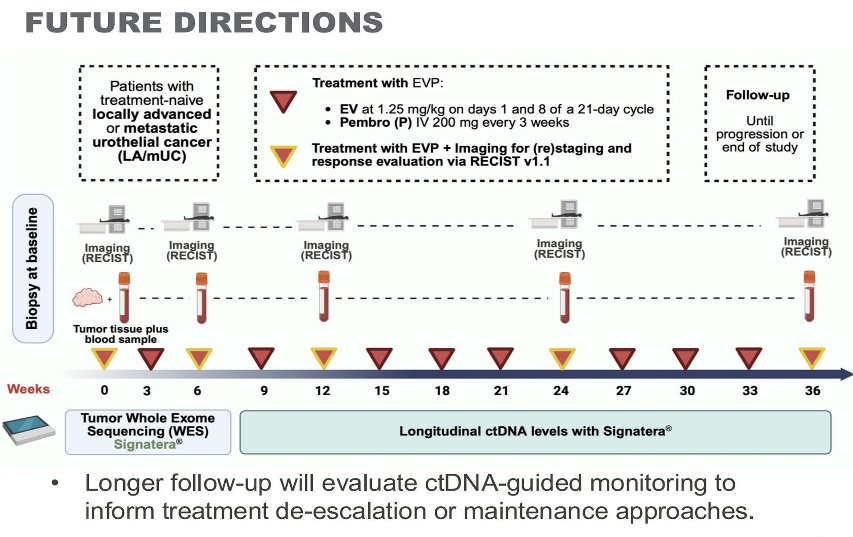
- These findings support the potential role of ctDNA-guided monitoring strategies during frontline EV + pembro therapy and may inform future approaches involving treatment de-escalation, maintenance strategies, and earlier identification of therapeutic resistance.
- Additional follow-up will be important to further validate the clinical utility of ctDNA-guided management approaches.
Presented by: Mohammad Jad Moussa, MD, MSc, Resident Physician, Department of Medicine, Baylor University Medical Center, Dallas, TX, USA
Written by: Rashid K. Sayyid, MD, MSc, Assistant Professor, Urologic Oncologist, Department of Urology at The University of Arizona and Banner University Medical Center, Tucson, AZ – @rksayyid on X during the American Society of Clinical Oncology Genitourinary (ASCO) Annual Meeting held in Chicago, IL between May 29th and June 1st, 2026