

(UroToday.com) The 2026 ASCO annual meeting featured a urothelial carcinoma session and a presentation by Dr. Andrea Necchi discussing the molecular characterization of residual disease post-neoadjuvant sacituzumab govitecan, pembrolizumab, or their combination in patients with muscle invasive bladder cancer. In patients with muscle invasive bladder cancer, Dr. Necchi and colleagues previously tested the activity of neoadjuvant sacituzumab govitecan (SURE-01), sacituzumab govitecan + pembrolizumab (SURE-02), and pembrolizumab alone (PURE-01),1 followed by surgery. In this analysis presented at ASCO 2026, Dr. Necchi and colleagues aimed to molecularly characterize the residual post-neoadjuvant therapy muscle invasive bladder cancer and its changes from baseline samples. This information could be important for informing future sequential therapeutic strategies and drug development.
Post-neoadjuvant therapy samples (ypT≥2) were available for transcriptome analyses from 12 patients in SURE-01, 24 in SURE-02, and 26 post-pembrolizumab alone. Decipher bladder genomic subtyping classifier expression profiling assay (Veracyte) was used to compare molecular subtyping distributions and genes/signatures expressions between matched pre-post neoadjuvant therapy samples, including 192 locked transcriptomic signatures in GRID (v3.1) and pre-specified therapeutic target genes (TROP2, TOP1, NECTIN4, HER2). FGFR3-active tumors were determined using a previously-developed long non-coding RNA-based classifier. The clinical primary endpoint was event free survival.
The following table highlights the patient baseline characteristics by study:

Post-neoadjuvant therapy molecular subtyping identified luminal vs non-luminal tumors in: 17% (2/12) versus 83% (10/12) (SURE-01), 21% (5/24) versus 79% (19/24) (SURE-02), and 8% (2/26) versus 92% (24/26) (PURE-01):

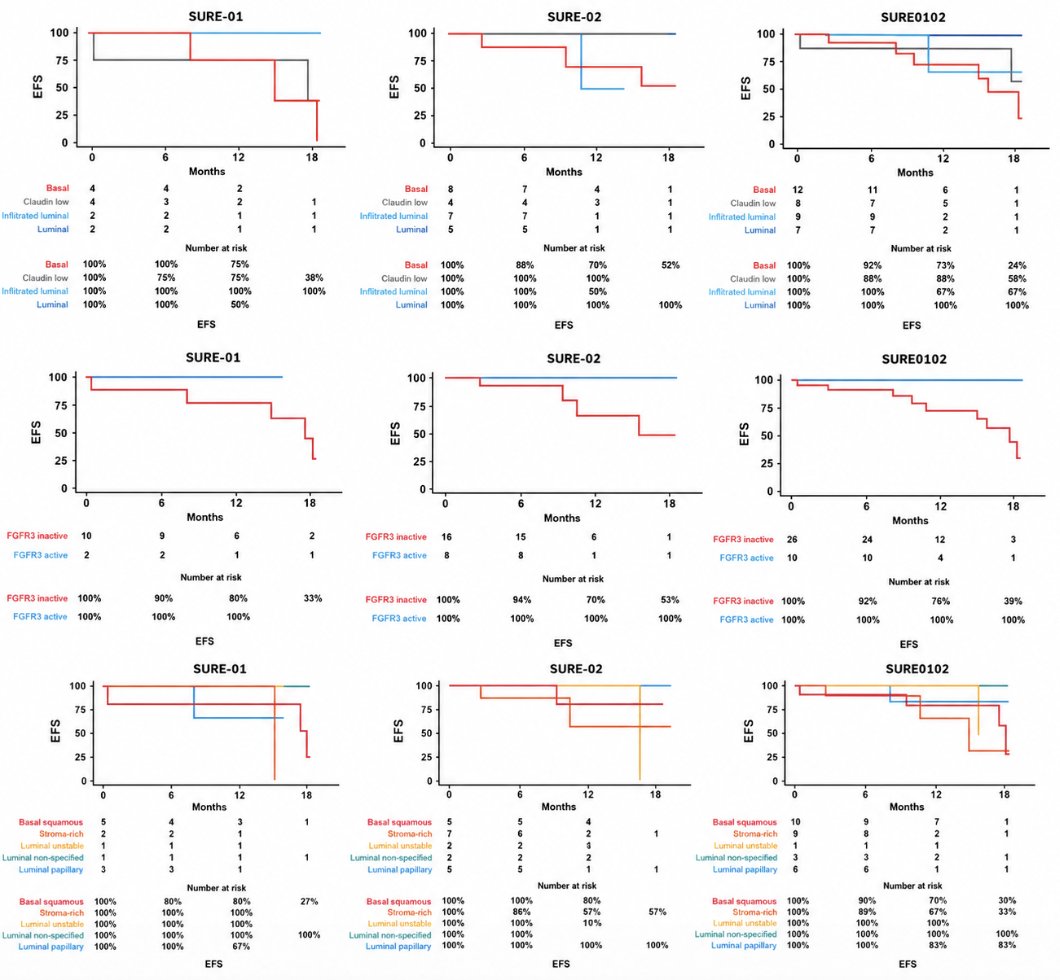
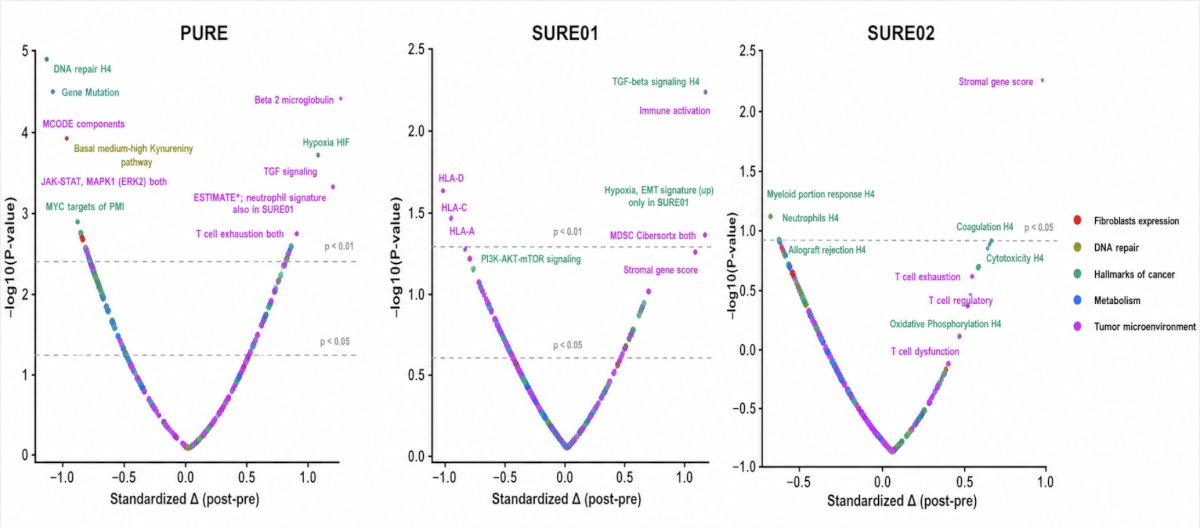
In total, 21 patients from SURE studies and 22 from PURE-01 had matched pre-post neoadjuvant therapy samples. Consensus molecular subtyping revealed a concordance in 86% (6/7) of patients in SURE-01, 57% (8/14) in SURE-02, and 36% (8/22) in PURE-01. After neoadjuvant therapy, the investigators found a decrease in luminal subtypes in SURE-01 (57% → 29%) and in SURE-02 (36% → 14%) versus an increase in stroma-rich (Consensus) subtype in SURE-02 (7% → 36%) and in PURE-01 (14% → 50%). Elevation of TGF-beta signaling hallmark (p = 0.02) and immune exclusion (p = 0.02) scores characterized post-neoadjuvant therapy samples in SURE-01, while in SURE-02 they found elevated stromal gene scores (p = 0.004) and lower DNA repair hallmark scores (p = 0.03) after neoadjuvant therapy. Comparing matched samples from SURE-01 and 02, Dr. Necchi found significantly decreased TROP2 expression scores (p = 0.03) and lower HER2 (p = 0.06) and NECTIN4 expression (p = 0.07). Application of the long non-coding RNA-based FGFR3-activity classifier revealed a total of 10/36 (28%) FGFR3-active tumors post-neoadjuvant therapy in SURE-01 and SURE-02, all without event free survival events during follow-up. For SURE-02, they found 4/24 (17%) patients harboring claudin-low tumors post-neoadjuvant therapy, who did not experience event free survival events following adjuvant pembrolizumab, similar to the low event free survival rate observed in PURE-01 (n = 7, 22%):
The following figure represents the standardized differences in transcriptomic signatures between matched pre- and post-treatment samples within PURE, SURE-01, and SURE-02:
Dr. Necchi concluded his presentation discussing the molecular characterization of residual disease post-neoadjuvant sacituzumab govitecan, pembrolizumab, or their combination in patients with muscle invasive bladder cancer with the following take home points:
- This study expands our knowledge on residual muscle invasive bladder cancer after various neoadjuvant therapy, displaying a noteworthy plasticity and significant changes post-neoadjuvant therapy
- These changes are important to reveal the biology of these tumors and highlights putative biomarkers for sequential therapies
Presented by: Andrea Necchi, MD, San Raffaele Hospital, Milan, Italy
Written by: Zachary Klaassen, MD, MSc – Urologic Oncologist, Associate Professor of Urology, Georgia Cancer Center, Wellstar MCG Health, @zklaassen_md on Twitter during the American Society of Clinical Oncology Genitourinary (ASCO) Annual Meeting held in Chicago, IL between May 29th and June 1st, 2026
References:
- Necchi A, Anichini A, Raggi D, et al. Pembrolizumab as Neoadjuvant Therapy Before Radical Cystectomy in Patients with Muscle-Invasive Urothelial Bladder Carcinoma (PURE-01): An Open-Label, Single-Arm, Phase II Study. J Clin Oncol 2018 Dec 1;36(34):3353-3360.