

(UroToday.com) The 2026 American Society of Clinical Oncology Genitourinary (ASCO) Annual Meeting held in Chicago, IL between May 29-June 2, 2026, was host to the Kidney and Bladder Cancer - Posters. Dr. Joaquim Bellmunt presented Abstract 4627: Patient-reported outcomes (PROs) from IMvigor011: A phase 3 study of ctDNA-guided adjuvant atezolizumab vs placebo in MIBC.
Dr. Bellmunt highlighted that the phase 3 IMvigor011 trial previously demonstrated that serial ctDNA-based molecular residual disease (MRD) monitoring could identify patients with MIBC at very high risk of recurrence who derive significant benefit from adjuvant atezolizumab, while patients who remained persistently ctDNA-negative had low recurrence and mortality risk without adjuvant treatment. (1) In this presentation, he focused on patient-reported outcomes (PROs) from the study, evaluating whether ctDNA-guided adjuvant atezolizumab impacted quality of life.
In IMvigor 011, Patients with MIBC and no radiographic evidence of disease after cystectomy underwent serial ctDNA monitoring for up to one year. Patients who tested ctDNA-positive and remained disease-free were randomized to atezolizumab or placebo every four weeks for up to 12 cycles or one year.1
The patient-reported outcome assessment schedule included secondary endpoints evaluating time to confirmed deterioration in physical functioning, role functioning, and global health status/quality of life using the EORTC QLQ-C30 instrument. Exploratory endpoints included symptom burden, functioning, global health status/quality of life, and treatment-related side-effect burden assessed through the EORTC Item Library 46. Symptoms specifically evaluated included appetite loss, constipation, diarrhea, dyspnea, fatigue, insomnia, nausea/vomiting, and pain. Adverse events were graded according to CTCAE version 5 criteria.
Among 250 ctDNA-positive patients randomized to atezolizumab (n=167) or placebo (n=83), questionnaire completion rates remained high throughout treatment and are reported in the table below: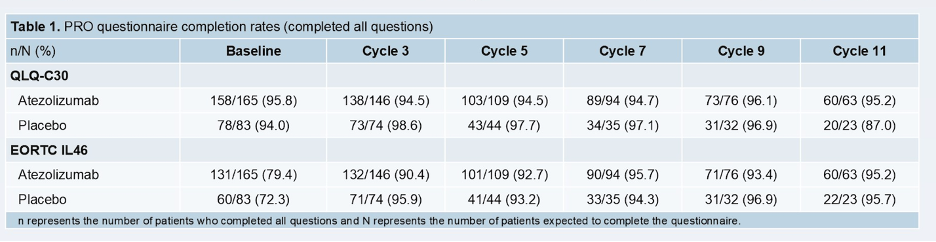
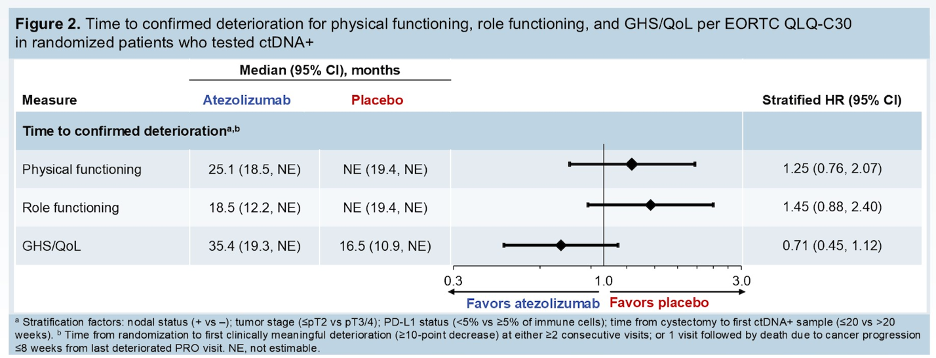
Time to confirmed deterioration (TTCD) analyses demonstrated no significant differences between arms for physical functioning, role functioning, or global health status/quality of life. Median TTCD for global health status/QoL was 35.4 months with atezolizumab versus 16.5 months with placebo (HR 0.71, 95% CI 0.45–1.12). Similarly, no clinically meaningful differences were observed in symptom burden or functional outcomes over time between treatment arms.
Among patients who persistently tested ctDNA-negative (n=357), EORTC QLQ-C30 completion rates exceeded 94% throughout surveillance weeks 6 to 48. Dr. Bellmunt highlighted that at baseline, patients in both treatment arms reported high levels of functioning and global health status/quality of life, along with low symptom burden. Mean functioning scores across physical, role, cognitive, emotional, and social domains ranged from 83.0 to 87.5 in the atezolizumab arm and 85.5 to 89.6 in the placebo arm. Baseline global health status/quality of life scores were similarly high in both groups, while symptom scores remained low overall.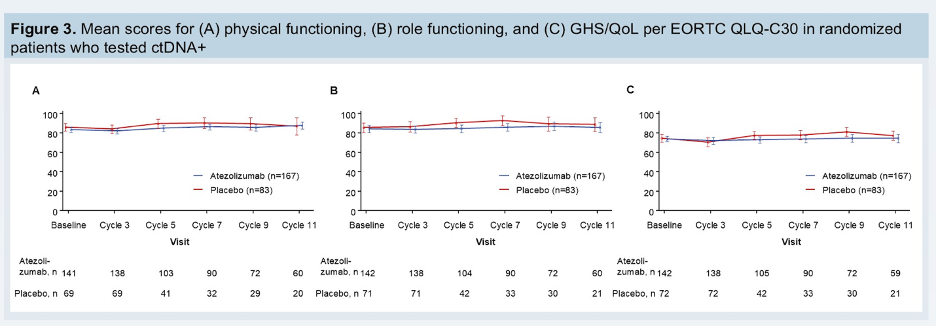
Dr. Bellmunt also highlighted that more than 90% of patients in both treatment arms reported little or no treatment-related side-effect burden from Cycle 1 Day 1 through Cycle 11 Day 1. At Cycle 11 Day 1, 98.3% of patients receiving atezolizumab reported “not at all/a little” treatment burden, with no patients reporting “very much” side-effect burden.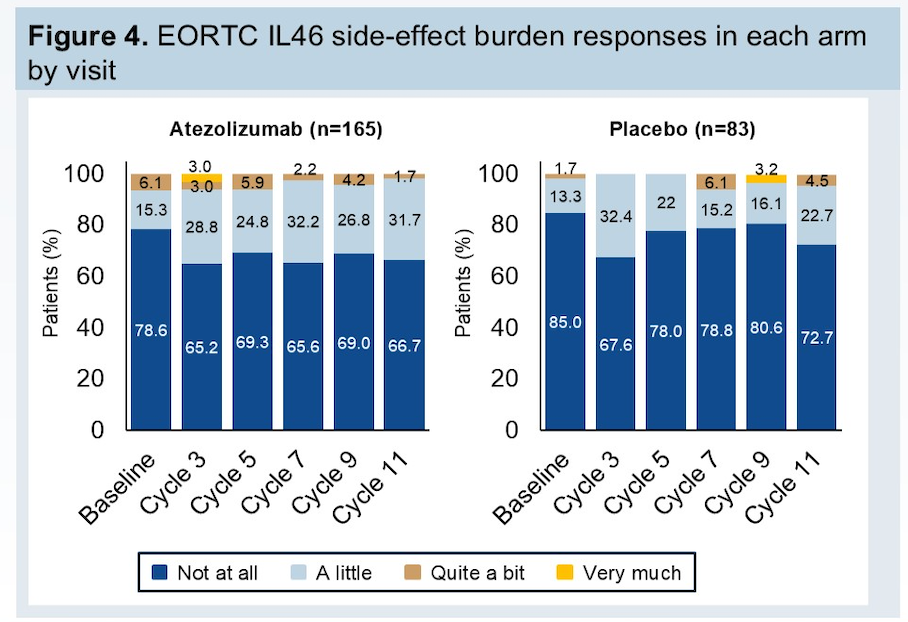
Dr. Bellmunt highlighted that atezolizumab demonstrated a tolerable safety profile in ctDNA-positive patients, comparable to placebo and consistent with EORTC IL46 treatment burden data. Patient-reported rates of constipation, diarrhea, and nausea were similar between the atezolizumab and placebo arms, and adverse events related to pain and fatigue were also comparable across treatment groups as illustrated in the table below: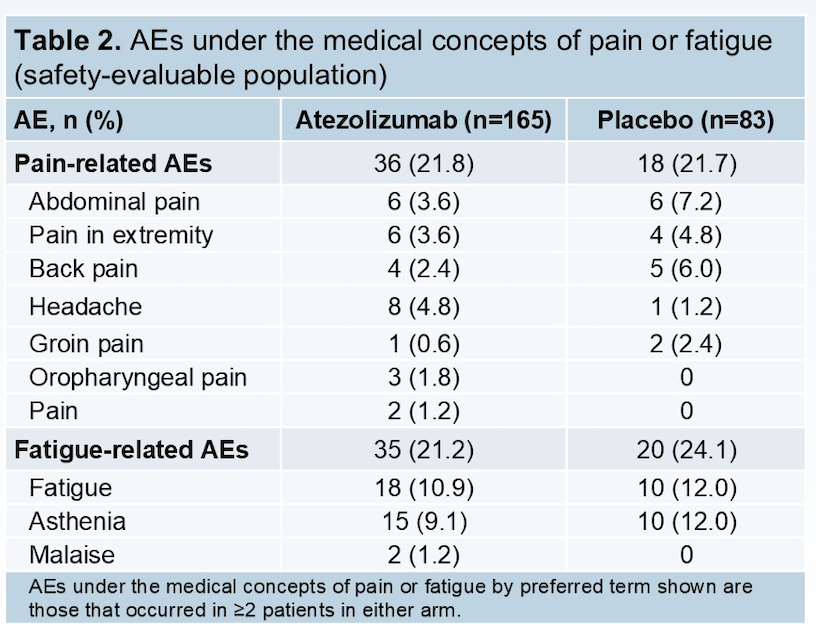
Lastly, Dr. Bellmunt noted that among patients who persistently tested ctDNA-negative, mean scores for physical functioning, role functioning, and global health status/quality of life showed no clinically meaningful differences between treatment arms throughout surveillance from Week 0 to Week 48, with all differences remaining below the predefined 10-point threshold.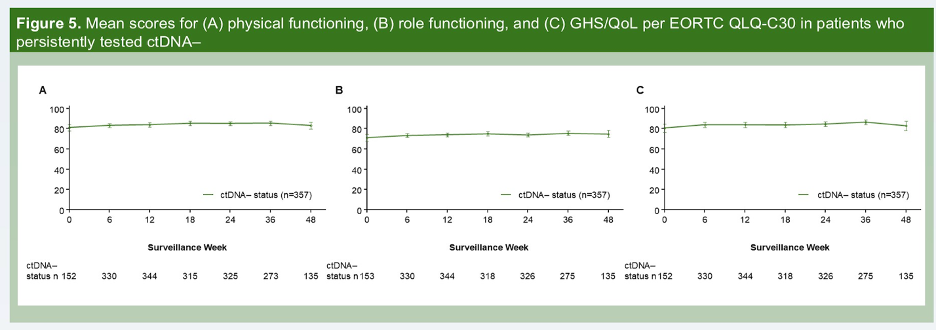
Dr. Bellmunt concluded his presentation with the following key messages:
- ctDNA-guided adjuvant atezolizumab provided clinically meaningful DFS and OS benefit in ctDNA-positive patients with MIBC
- Adjuvant atezolizumab did not negatively impact patient-reported quality of life compared with placebo
- Longitudinal PRO analyses demonstrated preserved physical functioning, role functioning, and global health status/QoL
- More than 90% of patients reported little or no treatment-related side-effect burden throughout treatment
- These findings further support a biomarker-driven perioperative strategy in MIBC using serial ctDNA monitoring
Presented by: Joaquim Bellmunt, MD, PhD, Medical Oncologist, Director, Bladder Cancer Center, Dana Farber Cancer Institute, Boston, MA
Written by: Julian Chavarriaga, MD, Clinical Assistant Professor, Urologic Oncologist, Department of Urology at Penn State Health @chavarriagaj on X during the American Society of Clinical Oncology Genitourinary (ASCO) Annual Meeting held in Chicago, IL between May 29th and June 1st, 2026
Reference: