

(UroToday.com) The 2026 American Society of Clinical Oncology Genitourinary (ASCO) Annual Meeting, held in Chicago, IL, hosted the Kidney and Bladder Cancer - Posters Session. Dr. Tianhang Lan presented Abstract 4592: Preliminary results of a single-arm, muti-center, prospective clinical study of disitamab vedotin combined with toripalimab and pelvic lymph node dissection for bladder preservation in patients with cT2-4aN0M0 bladder urothelial carcinoma and HER2 expression ≥ 2+ after maximal TURBT.
Although clinical complete response (cCR) rates in bladder cancer have improved across modern treatment eras, rates of lymph node metastasis remain concerningly high, particularly among patients with HER2 overexpression, representing a major limitation of bladder-sparing approaches.
This study enrolled patients with cT2-4aN0M0 MIBC and HER2 expression ≥2+. Following maximal TURBT, patients received toripalimab (3 mg/kg every 2 weeks) plus disitamab vedotin (2 mg/kg every 2 weeks) for six cycles, followed by repeat TURBT and PLND. Patients achieving cCR or partial response continued combination therapy for an additional six cycles, while those achieving cCR after 12 cycles subsequently received maintenance toripalimab for one year. Patients without cCR proceeded to comprehensive treatment or salvage radical cystectomy.
As of December 2025, 21 patients had been enrolled, with a median age of 66 years (range 37–82). The primary endpoint of 2-year bladder-intact disease-free survival had not yet been reached. Among 14 patients evaluable for efficacy at week 12, 10 achieved cCR, corresponding to a cCR rate of 85.8%, while one patient had stable disease and one experienced progressive disease.
Among the 10 patients who underwent TURBT plus PLND, pathological complete response (pT0N0M0) was achieved in 90%. Notably, one patient was found to have occult nodal disease and was staged postoperatively as pT0N1M0, highlighting the potential importance of PLND within bladder-preserving strategies for HER2-positive disease.
Regarding safety, all patients experienced treatment-related adverse events, although the majority were grade 1–2. The most common toxicities included pruritus (75.0%), paresthesia (68.75%), and ALT elevation (43.75%). Only one grade 3 adverse event was observed, consisting of severe urinary tract infection, and no grade ≥4 treatment-related adverse events were reported. 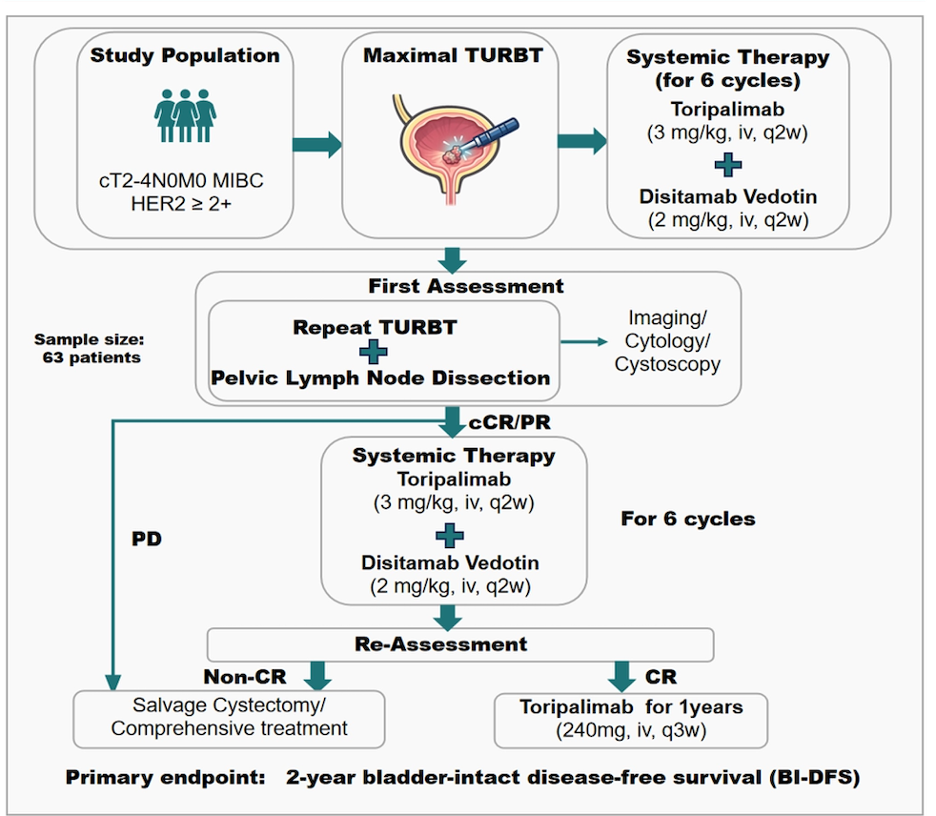
Key messages:
- A novel bladder-preserving strategy incorporating maximal TURBT, PLND, disitamab vedotin, and toripalimab demonstrated encouraging early efficacy in HER2-positive MIBC.
- An 85.8% cCR rate was observed at week 12, with pT0N0 achieved in 90% of patients undergoing TURBT plus PLND.
- Occult nodal disease was identified in one patient despite bladder pCR, supporting the potential value of PLND in bladder-preserving approaches for HER2-positive MIBC.
- Treatment was generally well tolerated, with predominantly grade 1–2 adverse events and no grade ≥4 toxicities observed.
- Longer follow-up is needed to determine the durability of bladder preservation and long-term oncologic outcomes.
Presented by: Tianhang Lan, MD, Department of Urology and Clinical Research Center at Sun Yat-sen Memorial Hospital / Sun Yat-sen University in Guangzhou, China
Written by: Julian Chavarriaga, MD, Clinical Assistant Professor, Urologic Oncologist, Department of Urology at Penn State Health @chavarriagaj on X during tthe American Society of Clinical Oncology Genitourinary (ASCO) Annual Meeting held in Chicago, IL between May 29th and June 1st, 2026