

(UroToday.com) The 2026 American Society of Clinical Oncology Genitourinary (ASCO) Annual Meeting held in Chicago, IL between May 29-June 2, 2026, was host to the Kidney and Bladder Cancer - Posters. Dr. Monika Joshi presented Abstract TPS4641: A phase III randomized trial of pembrolizumab in combination with sactizumab govitecan vs standard of care in anti-PD- (L)1-resistant aUC: ECOG ACRIN EA8231.
Dr. Joshi highlighted that patients with locally advanced or metastatic urothelial carcinoma who progress following anti–PD-(L)1 therapy and enfortumab vedotin currently face limited treatment options and poor outcomes. She noted that sacituzumab govitecan (SG), a TROP-2–directed antibody-drug conjugate, has previously demonstrated meaningful activity in heavily pretreated urothelial carcinoma, while the combination of SG plus pembrolizumab achieved encouraging response rates in platinum-refractory disease.
The phase III TROPHY-U-01 Cohort 4 trial failed to demonstrate a statistically significant overall survival improvement with sacituzumab govitecan compared with taxane or vinflunine chemotherapy, although sacituzumab govitecan continued to show notable activity in advanced urothelial carcinoma. She highlighted that several factors may have contributed to the lack of significant OS benefit.1
She further discussed findings from TROPHY-U-01 Cohort 3, where the combination of sacituzumab govitecan plus pembrolizumab demonstrated encouraging efficacy in a single-arm phase II setting, with an objective response rate of 41% and a complete response rate of 20% in platinum-refractory disease, alongside a manageable toxicity profile. (2)Additionally, she referenced post hoc analyses from KEYNOTE-045, KEYNOTE-052, and KEYNOTE-361 evaluating pembrolizumab retreatment after prior complete response or prolonged disease control, which demonstrated an objective response rate of 41% and a disease control rate of 82%.
Given the increasing use of both anti–PD-(L)1 therapy and enfortumab vedotin in earlier disease settings, the number of patients with CPI-refractory disease is expected to rise substantially, underscoring the need for prospective evaluation of novel combination strategies and immune checkpoint inhibitor rechallenge.
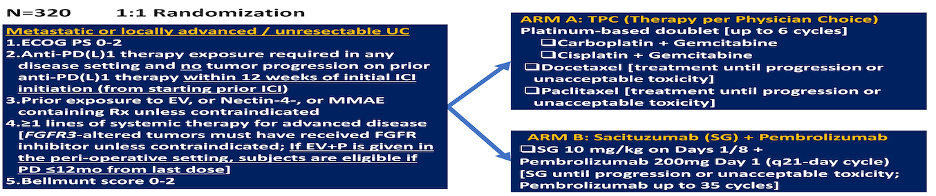
Dr. Joshi presented the design of EA8231, an ongoing open-label, multicenter, randomized phase III trial evaluating sacituzumab govitecan plus pembrolizumab versus standard chemotherapy in patients with previously treated unresectable locally advanced or metastatic urothelial carcinoma.
Eligible patients must have:
- ECOG performance status 0–2
- Prior anti–PD-(L)1 exposure in any disease setting
- No progression within 12 weeks of initiating prior anti–PD-(L)1 therapy
- Prior exposure to enfortumab vedotin unless contraindicated
- At least one prior systemic therapy for metastatic disease
- Prior FGFR inhibitor exposure for FGFR3-altered tumors unless contraindicated
- Bellmunt score 0–2
Patients previously treated with sacituzumab govitecan, other TROP-2–directed therapies, or topoisomerase I inhibitor–containing agents are excluded.
Patients are randomized 1:1 to:
- Standard-of-care chemotherapy consisting of platinum-gemcitabine or taxane-based therapy every 3 weeks
- Pembrolizumab 200 mg Day 1 plus sacituzumab govitecan 10 mg/kg on Days 1 and 8 of a 21-day cycle with G-CSF support
Randomization is stratified according to:
- Bellmunt score (0–1 vs 2)
- Number of prior therapy lines (≤2 vs >2)
- Prior platinum exposure and platinum eligibility
- Duration of prior anti–PD-(L)1 therapy (≤6 vs >6 months)
The primary endpoint is overall survival. Secondary endpoints include progression-free survival, objective response rate, clinical benefit rate, duration of response, safety, tolerability, and health-related quality-of-life measures utilizing NFBlSI-18, FACIT-Fatigue, and EQ-5D-5L instruments.
The study is powered to detect a 42.5% improvement in median overall survival, with a target hazard ratio of 0.70 and planned enrollment of 320 patients. The trial officially activated in October 2025, with enrollment ongoing across multiple participating sites.
Dr. Joshi concluded that EA8231 addresses a growing unmet need in patients with CPI-refractory metastatic urothelial carcinoma and may help define the role of sacituzumab govitecan plus pembrolizumab as a potential treatment strategy following prior anti–PD-(L)1 therapy and enfortumab vedotin exposure.
Presented by: Monika Joshi, MD, MRCP, Professor of Medicine, Endowed Professorship in Cancer Clinical Care, Division of Hematology-Oncology, Penn State Cancer Institute, State College, PA
Written by: Julian Chavarriaga, MD, Clinical Assistant Professor, Urologic Oncologist, Department of Urology at Penn State Health @chavarriagaj on X during the American Society of Clinical Oncology Genitourinary (ASCO) Annual Meeting held in Chicago, IL between May 29th and June 1st, 2026
References:
- Loriot Y, Petrylak DP, Rezazadeh Kalebasty A, Fléchon A, Jain RK, Gupta S, Bupathi M, Beuzeboc P, Palmbos P, Balar AV, Kyriakopoulos CE, Pouessel D, Sternberg CN, Tonelli J, Sierecki M, Zhou H, Grivas P, Barthélémy P, Tagawa ST. TROPHY-U-01, a phase II open-label study of sacituzumab govitecan in patients with metastatic urothelial carcinoma progressing after platinum-based chemotherapy and checkpoint inhibitors: updated safety and efficacy outcomes. Ann Oncol. 2024 Apr;35(4):392-401. doi: 10.1016/j.annonc.2024.01.002. Epub 2024 Jan 18. PMID: 38244927.
- Powles T, Tagawa S, Vulsteke C, Gross-Goupil M, Park SH, Necchi A, De Santis M, Duran I, Morales-Barrera R, Guo J, Sternberg CN, Bellmunt J, Goebell PJ, Kovalenko M, Boateng F, Sierecki M, Wang L, Sima CS, Waldes J, Loriot Y, Grivas P. Sacituzumab govitecan in advanced urothelial carcinoma: TROPiCS-04, a phase III randomized trial. Ann Oncol. 2025 May;36(5):561-571. doi: 10.1016/j.annonc.2025.01.011. Epub 2025 Feb 11. PMID: 39934055.