

(UroToday.com) The 2025 American Society of Clinical Oncology (ASCO) Annual Meeting held in Chicago, IL between May 30th and June 3rd, 2025, was host to a prostate, testicular, and penile cancers poster session. Dr. Alison Yan Zhang presented the 8-year outcomes of the ENZAMET (ANZUP 1304) trial of enzalutamide versus a non-steroidal anti-androgen for metastatic, hormone-sensitive prostate cancer (mHSPC)
ENZAMET demonstrated that enzalutamide plus testosterone suppression (TS) improved overall survival (OS) for mHSPC, compared to non-steroidal anti-androgen (NSAA) plus TS.1
In this report, Dr. Zhang and colleagues presented the updated outcomes after a median follow-up of 98 months (>8 years).
In ENZAMET, 1125 participants with mHSPC were randomly assigned (1:1) to enzalutamide (160 mg/day) or NSAA, plus TS. The primary endpoint was OS, analyzed using the Kaplan-Meier method, stratified log-rank test, and stratified Cox regression modeling. The key secondary endpoint for this analysis was deaths secondary to prostate cancer versus other causes analyzed using Fine and Gray regression modeling with subdistribution hazard ratios to account for competing risks.
The baseline patient characteristics are summarized in the table below. The median patient age was 69 years. 61% of patients had synchronous metastases (i.e., de novo disease). Visceral metastases were presented in 13% of patients. 45% of patients were planned for early docetaxel use. 54% of patients had CHAARTED high volume disease.

At the data cut-off date of June 30, 2024, and after a median follow-up of 8.1 years (IQR: 7.7–8.9), 185/563 (33%) remained on enzalutamide and 79/562 (14%) on NSAA. Of those on enzalutamide, 88% remained on the full 160 mg dose.
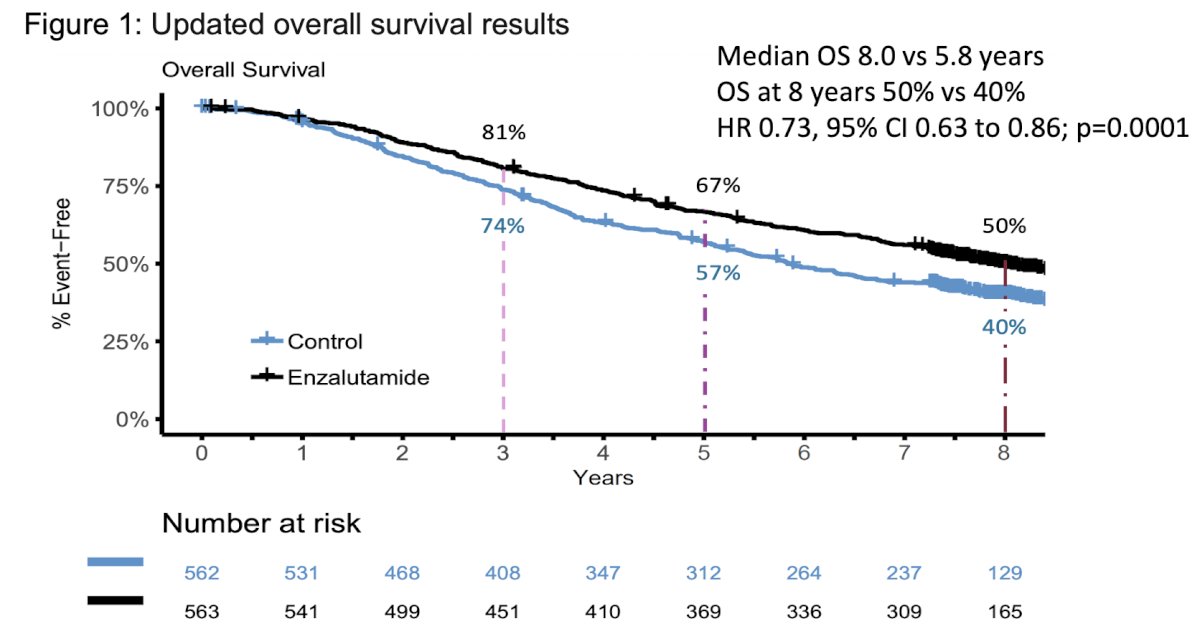
Death was reported in 285/563 (51%) patients assigned to enzalutamide versus 337/562 (60%) of those assigned to NSAA. The median overall survival was 8 versus 5.8 years (8-year overall survival: 50% versus 40%; HR: 0.73, 95% CI: 0.63–0.86, p=0.0001).
Clinical progression-free survival continued to favor the enzalutamide arm (HR: 0.49, 95% CI: 0.42–0.57, p<0.0001).
The median baseline PSA was 8 ng/mL (IQR: 2–33) in both treatment arms. A PSA ≤0.2 ng/ml was achieved by 73% of patients, with a median time to PSA nadir of 5.4 months. The median time to a PSA ≤0.2 was 3 and 5.6 months in the enzalutamide and NSAA arms, respectively. At 7 months, a PSA ≤0.2 ng/ml was achieved by 67% and 48% of patients, respectively. Compared to those with a PSA >0.2 ng/ml at 7 months, those who achieved a PSA ≤0.2 ng/ml had significantly improved survival outcomes (8-year survival: 55% versus 23%, p<0.001).

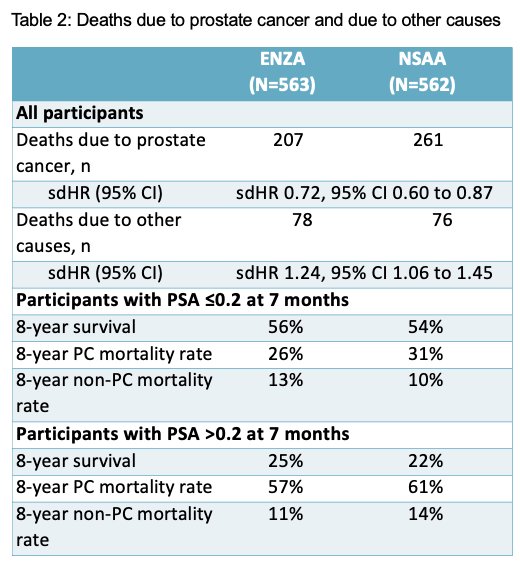
How did the rates of death due to prostate cancer versus other causes differ by PSA response at 7 months? Among patients who achieved a PSA ≤0.2 ng/ml at 7 months, deaths due to prostate cancer were observed in 29% versus 13% due to other causes (32% of all deaths observed). Conversely among those who did not achieve a PSA ≤0.2 ng/ml at 7 months, deaths due to prostate cancer were observed in 60%. Conversely, deaths from other causes were observed in 13% of these patients (18% of all deaths observed).

Dr. Zhang concluded this updated report of the ENZAMET trial as follows:
- After a median of follow-up of >8 years, overall survival remains statistically significant and clinically relevant for patients assigned enzalutamide plus testosterone suppression, compared to non-steroidal anti-androgen plus testosterone suppression
- Deaths due to prostate cancer were less frequent in those assigned enzalutamide; deaths due to other causes occurred with the same frequency
- Enzalutamide use was associated with a higher proportion of patients achieving PSA nadir ≤0.2 ng/mL at 7 months of therapy, compared with non-steroidal anti-androgens
- Consistent with other datasets, PSA nadir at 7 months was a significant predictive factor of overall survival in mHSPC patients, irrespective of treatment arm
Presented by: Alison Yan Zhang, MBBS, FRACP, PhD, MMed, Medical Oncologist, NHMRC Clinical Trials Centre, University of Sydney, Sydney, Australia
Written by: Rashid K. Sayyid, MD, MSc – Robotic Urologic Oncology Fellow at The University of Southern California, @rksayyid on Twitter during the American Society of Clinical Oncology (ASCO) 2025 Annual Meeting, Chicago, IL, Fri, May 30 – Tues, Jun 3, 2025.
References:- Davis ID, Martin AJ, Stockler MR, et al. Enzalutamide with Standard First-Line Therapy in Metastatic Prostate Cancer. N Engl J Med. 2019; 381(2): 121-131.
- Sweeney CJ, Martin AJ, Stockler MR, et al. Testosterone suppression plus enzalutamide versus testosterone suppression plus standard antiandrogen therapy for metastatic hormone-sensitive prostate cancer (ENZAMET): An international, open-label, randomized, phase 3 trial. Lancet Oncol. 2023; 24(4): 323-334.