

(UroToday.com) The 2025 ASCO annual meeting featured a prostate cancer trials in progress session and a presentation by Dr. Adrien Holzgreve discussing FLEX-MRT, a randomized phase 2 trial of flexible and extended dosing of 177Lu-PSMA-617 molecular radioligand therapy in metastatic castration-resistant prostate cancer (mCRPC). The U.S. FDA approved 177Lu-PSMA-617 radiopharmaceutical therapy for patients with mCRPC with a fixed dosing schedule: Six cycles of 7.4 GBq administered in six-week intervals.1 However, a patient-tailored, more flexible and extended dosing schedule of 177Lu-PSMA radiopharmaceutical therapy may increase treatment efficacy. In this randomized trial in men with mCRPC, Dr. Holzgreve and colleagues aimed to determine the efficacy of a response-based flexible dosing schedule of 177Lu-PSMA-617 radiopharmaceutical therapy administered up to 12 treatment cycles compared to the current standard of care.
This is an investigator-initiated prospective phase 2, open-label, randomized, controlled, parallel group, single-center trial. The aim is to assess the 2-year survival rate in mCRPC patients treated with a flexible dosing schedule of 177Lu-PSMA radiopharmaceutical therapy up to 12 cycles in comparison to the fixed dosing schedule of 6 cycles. Patients with progressive mCRPC post-androgen receptor pathway inhibitor and post taxane-based chemotherapy are eligible by PSMA PET VISION trial criteria. Exclusion criteria include prior radiopharmaceutical therapy and less than 6 weeks since the last myelosuppressive therapy. The overview of the study design is as follows:
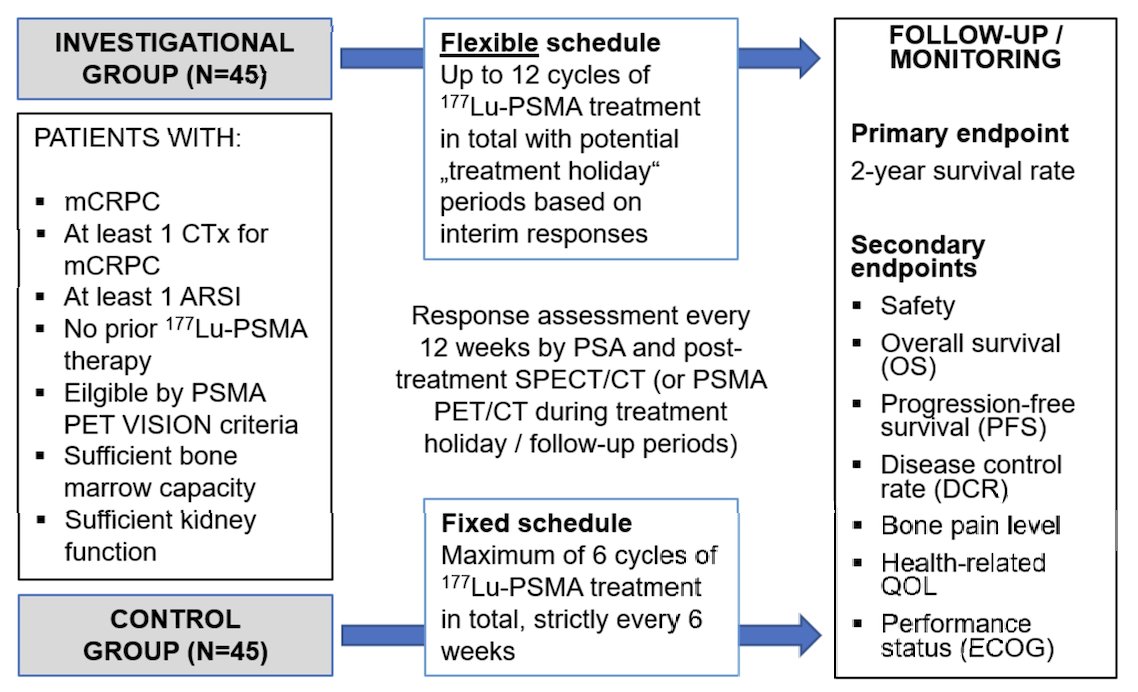
The investigators hypothesized 2-year survival rates of 55% in the investigational group and 30% in the control group. A two-sided log rank test with an overall sample size of 90 subjects (45 treatment group, 45 control group) achieves 80.3% power at a 0.05 significance level to detect a hazard ratio of 0.050. Patients will be randomized in a 1:1 ratio: The investigational arm is treated with up to 12 cycles, including potential “treatment holidays” depending on the treatment response (n = 45) versus the control arm receiving 6 cycles administered in six-week intervals (n = 45).
Imaging response to radiopharmaceutical therapy is assessed using 177Lu-PSMA-617 SPECT/CT after each cycle and PSMA PET/CT during treatment holidays (every 12 weeks), respectively. In the investigational arm, radiopharmaceutical therapy will be restarted after a treatment holiday if the patient experiences a ≥25% PSA progression and an imaging progression according to the RECIP:

The primary endpoint is the 2-year survival rate calculated from the date of the first cycle of radiopharmaceutical therapy. Secondary endpoints include safety by CTCAE and dosimetry, and determination of overall and progression-free survival (evidence of progression as defined by either radiographic, PSA, or clinical progression, or death from any cause).
The FLEX-MRT trial has been approved by the FDA and the UCLA IRB, and the trial is registered on ClinicalTrials.gov (NCT06216249). The FLEX-MRT trial is currently recruiting, with the start of enrollment in August 2024. As of January 27th, 2025, 19 patients have been enrolled.
Presented by: Adrien Holzgreve, MD, UCLA, Los Angeles, CA
Written by: Zachary Klaassen, MD, MSc – Urologic Oncologist, Associate Professor of Urology, Georgia Cancer Center, Wellstar MCG Health, @zklaassen_md on Twitter during the American Society of Clinical Oncology (ASCO) 2025 Annual Meeting, Chicago, IL, Fri, May 30 – Tues, Jun 3, 2025.
Related content: Personalizing Lutetium-177 Dosing: The FLEX-MRT Trial Approach - Adrien Holzgreve
References: