

(UroToday.com) The 2025 ASCO annual meeting featured a prostate cancer session and a presentation by Dr. Sumrah Khan discussing survival and hospitalizations with Lu-177 vipivotide tetraxetan in veterans with underlying genomic alterations. 177Lu-PSMA-617 is a radioligand therapy used to treat metastatic castration resistant prostate cancer (mCRPC) with limited real-world survival data outside of large academic centers. Emerging data suggests outcomes are associated with somatic tumor genomic profiles, such as status of tumor suppressor gene alterations, including TP53, PTEN, or RB1. Dr. Khan and colleagues utilized a nationwide retrospective cohort within the Veterans Health Affairs (VHA) to evaluate overall survival of patients treated with 177Lu-PSMA-617 and considered tumor suppressor gene alteration status, which could serve as a biomarker for personalized treatment.
Veterans with mCRPC treated in the VHA who received at least one dose of 177Lu-PSMA-617 from March 2022 to November 2024 were included. The National Precision Oncology Program (NPOP) was used to identify patients who underwent tumor sequencing and had tumor suppressor gene alterations. Age, Charlson comorbidity index, and number of hospitalizations were collected. The Kaplan-Meier method was used to estimate overall survival, logistic regression for risk of hospitalization, and Cox proportional hazards models to estimate mortality.
A total of 228 Veterans who had received at least one dose of 177Lu-PSMA-617 were identified. The mean age was 76.5 years (SD 7.6) with median Charlson comorbidity index of 2 (IQR 1-4). Median overall survival was 11.4 months (95% CI 8.6-14.2) in the entire cohort and 29.8% of Veterans (68/228) were hospitalized in the year after first dose. Age was not associated with mortality or hospitalization, however Charlson comorbidity index was associated with mortality (HR 1.12, 95% CI 1.01-1.24) and any hospitalization (OR 1.21, 95% CI 1.05-1.41). There were no differences in overall survival based on receipt of NPOP testing (HR 0.97, 95% CI 0.62-1.5). In 108 patients with NPOP testing, 44% (48/108) were found to have at least one tumor suppressor gene alteration. The median overall survival was shorter in patients with tumor suppressor gene alterations (5.8 versus 18.0 months, p = 0.001, HR 2.8, 95% CI 1.5-5.3) compared to patients without tumor suppressor gene alterations:
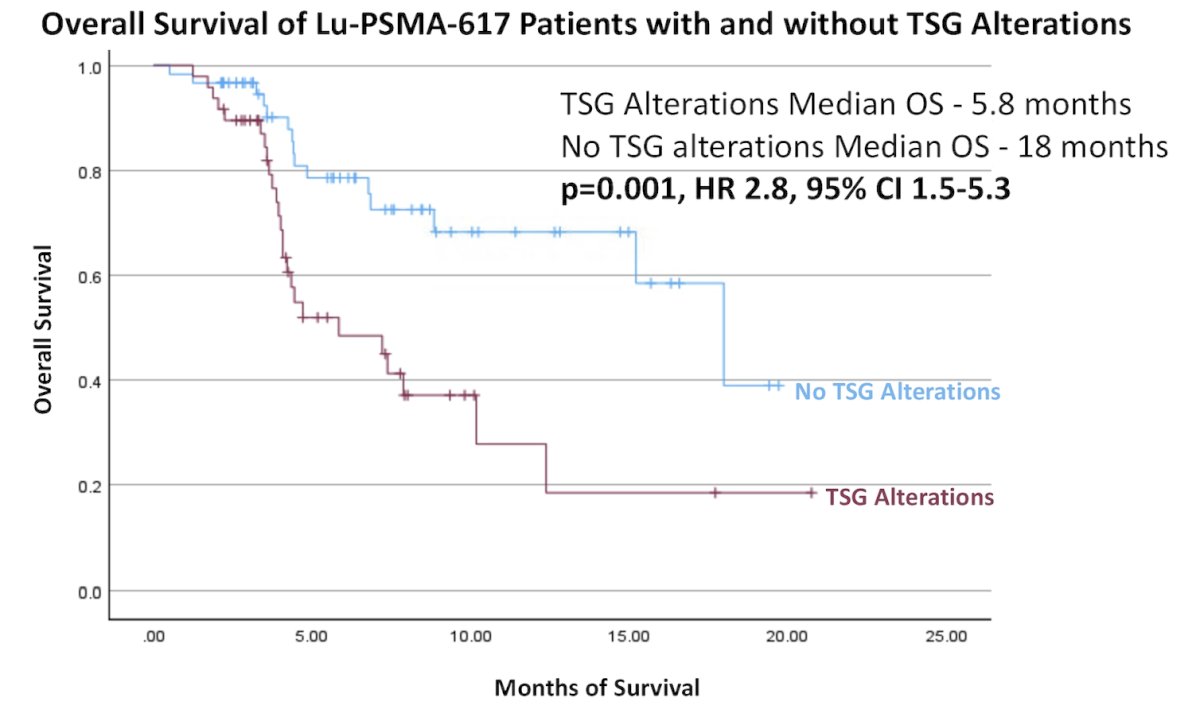
When accounting for age and Charlson comorbidity index, risk of death was increased in Veterans with tumor suppressor gene alterations (adjusted HR 3.0, 95% CI 1.6-5.9).
Dr. Khan concluded her presentation discussing survival and hospitalizations with Lu-177 vipivotide tetraxetan in veterans with underlying genomic alterations with the following take home points:
- In US Veterans treated with 177Lu-PSMA-617, median overall survival was 11.4 months, shorter than observed in other cohorts, although the mean age was higher
- Comorbidities were prognostic for mortality and hospitalization while age was not
- Veterans who had tumor suppressor gene alterations had significantly shorter overall survival in unadjusted and adjusted analyses, suggesting that patients with tumor suppressor gene alterations are less likely to benefit from 177Lu-PSMA-617 and could consider different treatment modalities
- Prospective studies are needed to identify additional clinical outcomes over time
Presented by: Sumrah Khan, DO, Saint Louis University School of Medicine, St. Louis, MO
Written by: Zachary Klaassen, MD, MSc – Urologic Oncologist, Associate Professor of Urology, Georgia Cancer Center, Wellstar MCG Health, @zklaassen_md on Twitter during the American Society of Clinical Oncology (ASCO) 2025 Annual Meeting, Chicago, IL, Fri, May 30 – Tues, Jun 3, 2025.