

(UroToday.com) The 2025 American Society of Clinical Oncology (ASCO) Annual Meeting held in Chicago, IL between May 30th and June 3rd, 2025, was host to a kidney and bladder cancers poster session. Dr. Tian Zhang presented the ongoing STAR-EV study, a phase I/II trial of neoadjuvant stereotactic radiotherapy plus enfortumab vedotin for localized, cisplatin ineligible, muscle invasive bladder cancer (MIBC).
Additional treatment options are needed for MIBC patients, given that up to 50% of MIBC patients cannot receive cisplatin-based chemotherapy. The current standard of care for MIBC is neoadjuvant chemotherapy followed by radical cystectomy or trimodality therapy (TMT) with maximal resection followed by chemo-radiation therapy (XRT).1
Enfortumab vedotin (EV) is an antibody-drug conjugate targeting nectin-4 that delivers monomethyl auristatin A (MMAE) and is now considered a standard of care for metastatic urothelial cancer. In EV-103 cohort H, patients with localized, cisplatin-ineligible MIBC receiving EV had a pathologic complete response (pCR) of 36% at time of radical cystectomy.2
A retrospective series of 60 patients treated with EV and XRT demonstrated a similar side effect profile to that of EV, with rashes and neuropathy as the most common adverse events (EV discontinued in 10% of patients).3 Based on these results, the study investigators designed the STAR-EV trial of EV + XRT followed by cystectomy aimed at improving pCR rates.
The study design is summarized below. STAR-EV is an open label phase I/II trial that will include cisplatin ineligible cT2-4a MIBC patients planned for radical cystectomy who will receive neoadjuvant EV (1.25 mg/kg intravenously on Days 1 and 8 of 21-day cycles for 3 cycles) and sequential/concurrent stereotactic radiation as illustrated below:
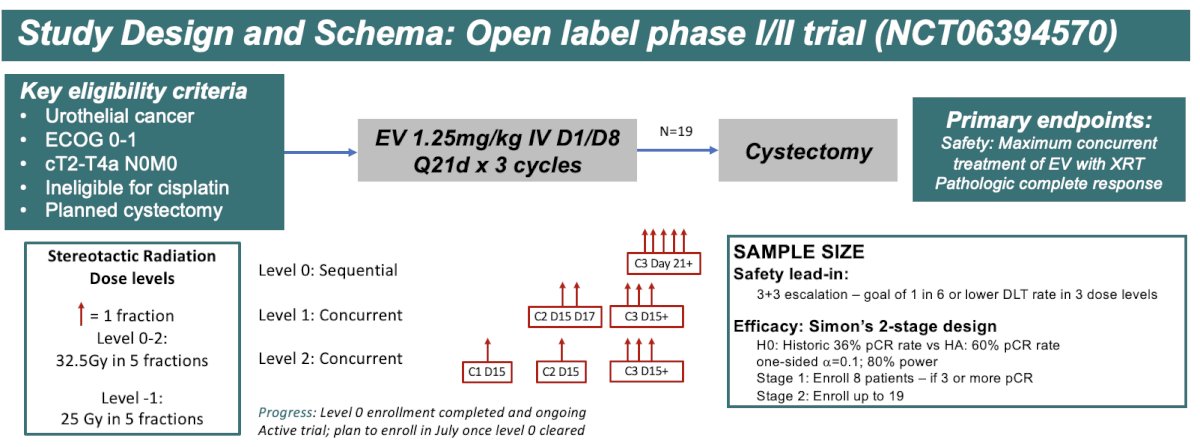
This trial will include a:
- Safety lead-in cohort:
- 3+3 escalation – goal of 1 in 6 or lower dose-limiting toxicity (DLT) rate in the 3 dose levels
- Efficacy cohort:
- Null hypothesis: 36% pCR rate
- Alternate hypothesis: 60% pCR rate
- Stage 1: Enroll 8 patients – if ≥3 pCR
- Stage 2: Enroll up to 19
The co-primary endpoints are:
- Safety: maximum concurrent treatment of EV with XRT
- pCR
The secondary endpoints are:
- Safety: adverse events based on CTCAE v5.0
- Rate of pathologic downstaging (ypT0, Tis, Ta, T1)
- Quality of life – EORTC QLQ-C30
- Urine UroAmp molecular features
- Frequency rate of patients undergoing cystectomy
- ctDNA before, during and after EV and radiation
- Rate of any >8-week delays from end of neoadjuvant therapy to surgery
- Time between TURBT until disease recurrence or death (disease-free survival)
The key inclusion/exclusion criteria are summarized below: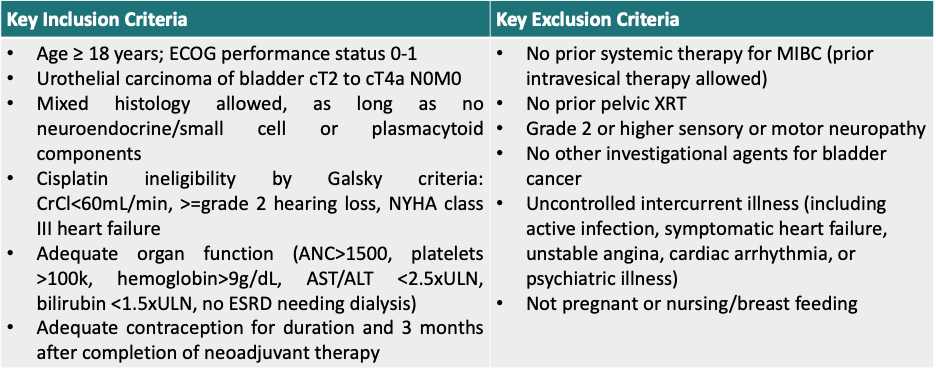
Dr. Zhang concluded with the following thoughts on the potential impact of this trial for clinical practice:
- As enfortumab vedotin improves outcomes in metastatic urothelial cancer, there is an opportunity to improve localized disease treatments for muscle invasive bladder cancer
- Improving pathologic complete response rates with EV and radiation will be hypothesis generating for future trials in localized bladder cancer
Presented by: Tian Zhang, MD, MHS, Associate Professor, Department of Internal Medicine, UT Southwestern Medical Center, Dallas, TX
Written by: Rashid K. Sayyid, MD, MSc – Robotic Urologic Oncology Fellow at The University of Southern California, @rksayyid on Twitter during the American Society of Clinical Oncology (ASCO) 2025 Annual Meeting, Chicago, IL, Fri, May 30 – Tues, Jun 3, 2025.
References:- Witjes JA, Bruins HM, Cathomas R, et al. Updated 2024 EAU guidelines on non–muscle-invasive bladder cancer. Eur Urol. 2024. PMID: 37858453.
- O’Donnell PH, Bajorin DF, Bochner BH, et al. Adjuvant nivolumab versus placebo in high-risk muscle-invasive urothelial carcinoma: 36-month follow-up from CheckMate 274. J Clin Oncol. 2023. PMID: 37369081.
- Soni YS, Nguyen DP, Shah JB, et al. Real-world outcomes of bladder-sparing approaches in muscle-invasive bladder cancer: An institutional cohort. Presented at: ASTRO Annual Meeting; 2024.