

(UroToday.com) The 2025 ASCO annual meeting featured a urothelial carcinoma session and a presentation by Dr. Shilpa Gupta discussing FGFR3 alteration status and outcomes with immune checkpoint inhibitors in patients with metastatic urothelial carcinoma. The use of immune checkpoint inhibitors has expanded in the treatment of metastatic urothelial carcinoma but response rates are variable, highlighting the need for predictive biomarkers. Tumor mutational burden has been previously shown to predict response to immune checkpoint inhibitors, but FGFR3 alterations are common drivers in metastatic urothelial carcinoma, and there is preclinical and anecdotal evidence that they may predict less favorable outcomes to immune checkpoint inhibitors, similar to ALK and ROS1 fusions in lung cancer. As such, Dr. Gupta and colleagues sought to explore the effect of FGFR3 alterations alone and with tumor mutational burden on response to immune checkpoint inhibitors in metastatic urothelial carcinoma.
Overall, 1,416 metastatic urothelial carcinoma patients who received hybrid-capture NGS-based genomic profiling were evaluated for their response to immune checkpoint inhibitors and chemotherapy treatment based on the presence of FGFR3 alterations (activating point mutations, insertions and deletions, rearrangements) and tumor mutational burden. The nationwide, US-based, de-identified Flatiron Health-Foundation Medicine metastatic urothelial carcinoma clinico-genomic database of NGS results linked to de-identified electronic health record-derived clinical data originating from approximately 280 US cancer clinics (~800 sites of care) was used to assess treatment patterns and real-world overall survival and real-world progression free survival. Propensity analysis was used to match clinical characteristics between patients receiving first-line immune checkpoint inhibitors and chemotherapy, and included age, disease grade, ECOG, and erdafitinib receipt as features.
The following table highlights the clinical characteristics of 1,416 metastatic urothelial carcinoma patients in the database:

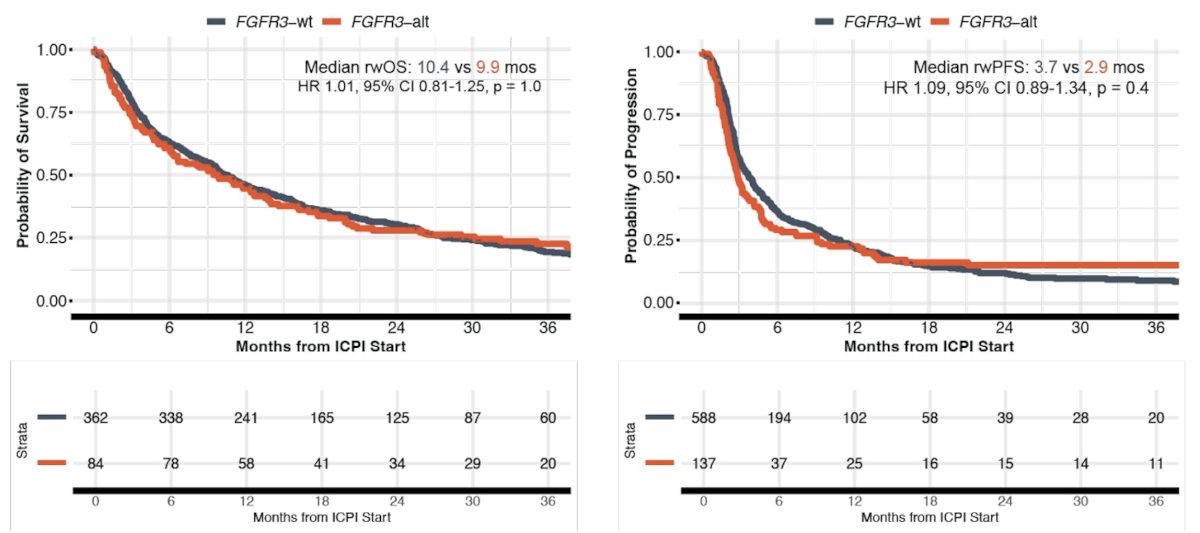
Among 819 patients with metastatic urothelial carcinoma who received immune checkpoint inhibitors, there were no significant differences in real-world overall survival or real-world progression free survival between FGFR3-altered (n = 161) and wildtype (n = 658) patients:
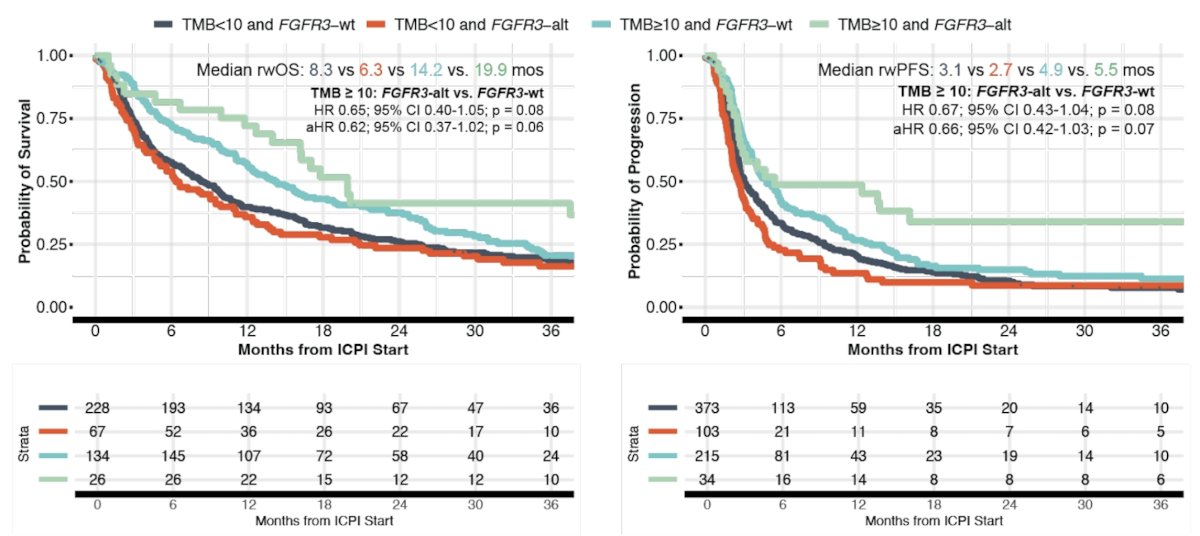
However, among patients with tumor mutational burden ≥10 mutation/Mb, FGFR3-altered patients (n = 39) trended towards longer real-world overall survival (20 versus 14 months, adjusted HR 0.62, 95% CI 0.37-1.02, p = 0.06) and real-world progression free survival (5.5 versus 4.9 months, adjusted HR 0.66, 95% CI 0.42-1.03, p = 0.07) than FGFR3-wt patients (n = 244):
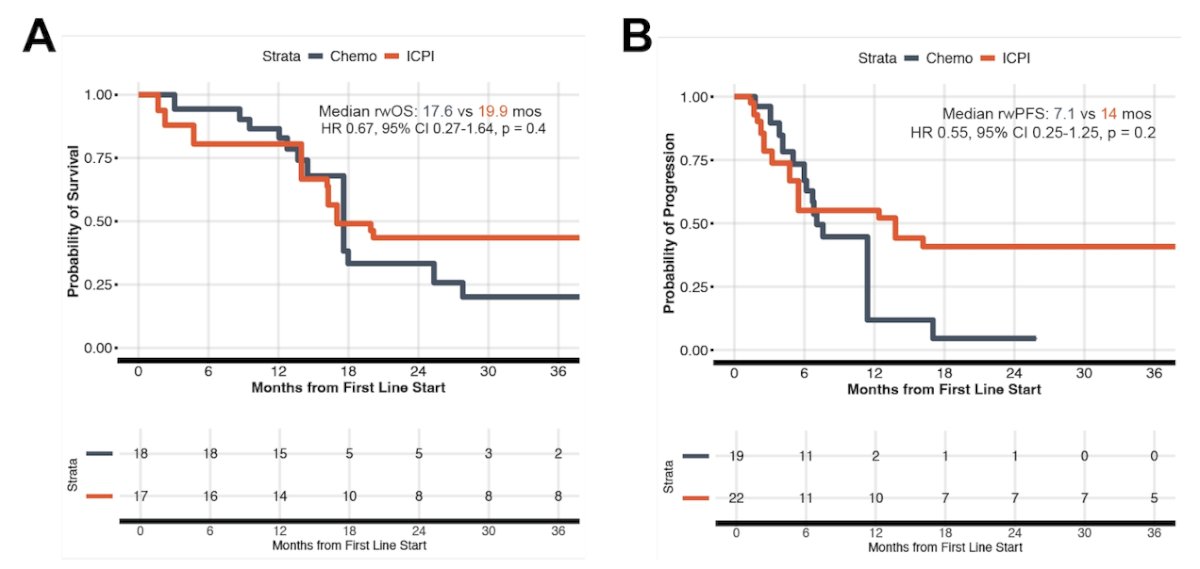
Comparing first-line immune checkpoint inhibitors versus chemotherapy and adjusting for imbalances, patients with tumor mutational burden ≥10 and FGFR3-alterations who received immune checkpoint inhibitors (n = 21) also trended towards longer real-world progression free survival than patients who received chemotherapy (n = 18) (14 versus 7.1 months, HR 0.55, 95% CI 0.25-1.25, p = 0.2), although no significant difference in real-world overall survival was observed:
Dr. Gupta concluded her presentation discussing FGFR3 alteration status and outcomes with immune checkpoint inhibitors in patients with metastatic urothelial carcinoma with the following take home points:
- While FGFR3 status alone is not predictive of response to immune checkpoint inhibitors, FGFR3 combined with tumor mutational burden emerged as a biomarker that may be predictive for response to immune checkpoint inhibitors in metastatic urothelial carcinoma and may have the potential to reconcile differences in previous observations regarding FGFR3 and immune checkpoint inhibitors response
- Further studies performed with larger patient populations to confirm these findings are warranted
Presented by: Shilpa Gupta, MD, Cleveland Clinic Taussig Cancer Institute, Cleveland, OH
Written by: Zachary Klaassen, MD, MSc – Urologic Oncologist, Associate Professor of Urology, Georgia Cancer Center, Wellstar MCG Health, @zklaassen_md on Twitter during the American Society of Clinical Oncology (ASCO) 2025 Annual Meeting, Chicago, IL, Fri, May 30 – Tues, Jun 3, 2025.