

(UroToday.com) The 2025 ASCO annual meeting featured a urothelial carcinoma session and a presentation by Dr. Martin Kurian discussing real-world enfortumab vedotin +/- pembrolizumab–based treatment toxicity, treatment discontinuation, and associations with survival in advanced urothelial carcinoma. Enfortumab vedotin-based therapy is central to the standard of care for advanced urothelial carcinoma, increasingly in combination with pembrolizumab. However, the current understanding of enfortumab vedotin-related toxicity is limited to clinical trial data. Prior studies finding positive associations between enfortumab vedotin related toxicities (namely skin reactions and neuropathy) and survival may be prone to immortal time bias, which occurs in cohort studies when a period of follow-up time during which the outcome (survival) cannot occur is incorrectly included in the analysis, potentially leading to artificial associations (increased survival). At the 2025 ASCO annual meeting, Dr. Kurian presented results of real-world data to characterize the frequency of enfortumab vedotin-based treatment-toxicity, -discontinuation, and associations with survival.
The investigators performed a post-marketing retrospective cohort study of enfortumab vedotin +/- pembrolizumab initiators at the University of Pennsylvania (January 2020 to May 2024). The frequency of any of five toxicities (skin reaction, neuropathy, ocular disorder, hyperglycemia, and pneumonitis) and associated treatment-interruptions (hold or discontinuation), -reduction, or -hospitalization were summarized. To account for immortal time bias, toxicities in this analysis were only included if occurring within 3 months of treatment initiation, and patients with overall survival < 3 months were also excluded. Survival was calculated from landmark time point at 3 months.
Among 123 enfortumab vedotin/enfortumab vedotin + pembrolizumab treated patients, the median age was 68 years, 72% were male, 74% were white, 68% had bladder primary, and 71% treated with enfortumab vedotin alone. Frequency of toxicity, time to toxicity, and proportions requiring dose interruption, reduction, and hospitalization are shown in the following table:
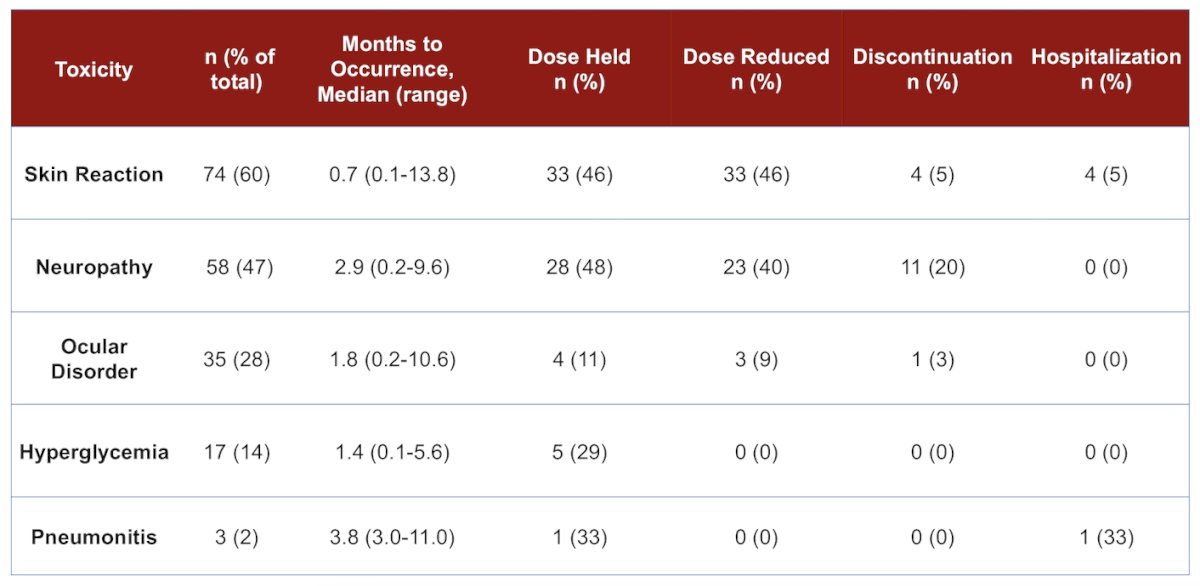
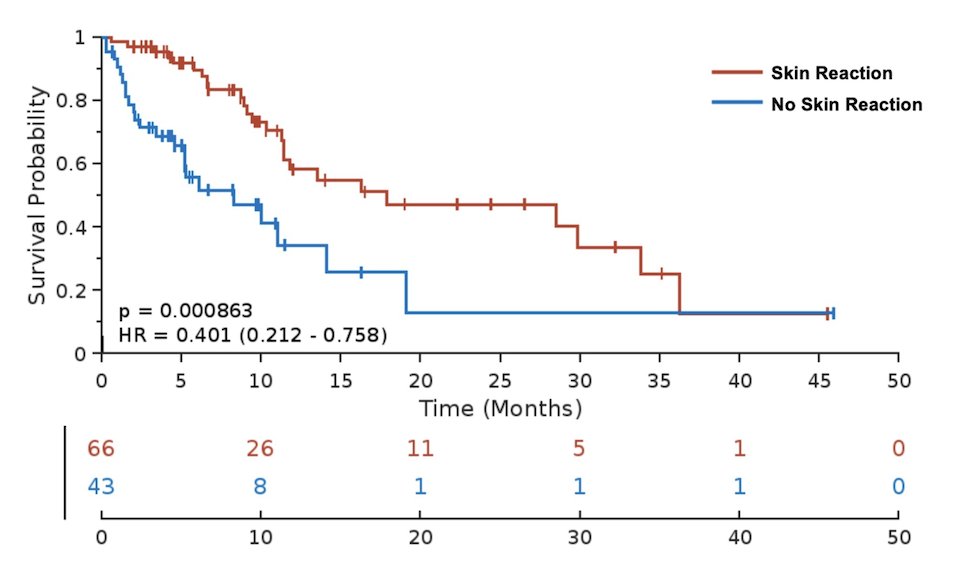
Overall, 60% of patients had skin reaction, 47% neuropathy, 28% ocular disorder, 14% hyperglycemia, and 2% pneumonitis. Treatment discontinuation occurred among 20% of patients with neuropathy, 5% of those with skin reaction, 3% of those with ocular disorders, and 0% of those with hyperglycemia or pneumonitis. Among 109 patients with at least 3 months of follow-up (survival) (68% enfortumab vedotin monotherapy), patients with a skin reaction had improved overall survival (HR 0.401, 95% CI 0.212-0.758):
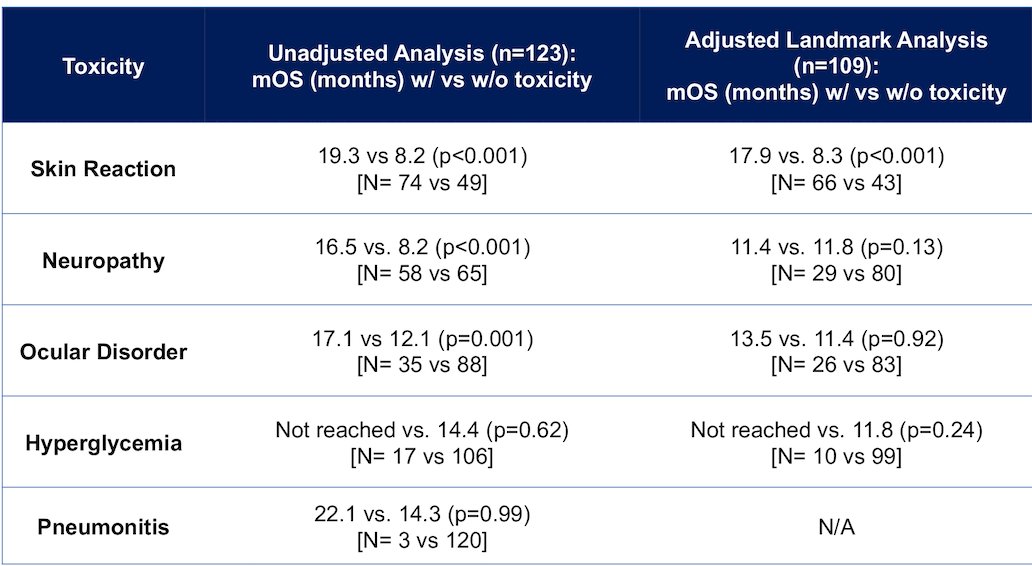
However, previously observed associations between other toxicities and survival were no longer present once adjusting for immortal time bias:
Dr. Kurian concluded his presentation discussing real-world enfortumab vedotin +/- pembrolizumab–based treatment toxicity, treatment discontinuation, and associations with survival in advanced urothelial carcinoma with the following take home points:
- Enfortumab vedotin +/- pembrolizumab treatment toxicity occurred in a majority of patients, but treatment discontinuation was infrequent
- Presence of skin toxicity was significantly associated with improved survival
- Associations between enfortumab vedotin toxicities and survival are prone to immortal time bias and should be accounted for in study design to avoid artefactual relationships
Presented by: Martin Kurian, MD, Hospital of the University of Pennsylvania, Philadelphia, PA
Written by: Zachary Klaassen, MD, MSc – Urologic Oncologist, Associate Professor of Urology, Georgia Cancer Center, Wellstar MCG Health, @zklaassen_md on Twitter during the American Society of Clinical Oncology (ASCO) 2025 Annual Meeting, Chicago, IL, Fri, May 30 – Tues, Jun 3, 2025.
Related content: Real-World Analysis Confirms Enfortumab Skin Toxicity Predicts Better Survival in Bladder Cancer - Martin Kurian