

(UroToday.com) The 2023 ASCO annual meeting included a bladder cancer session, featuring a presentation by Dr. Anumita Chakraborty discussing survival outcomes in patients with muscle-invasive bladder cancer (MIBC) receiving neoadjuvant chemotherapy stratified by number of cycles. Indeed, neoadjuvant cisplatin-based chemotherapy prior to radical cystectomy is the standard of care for patients MIBC. Three or more cycles of neoadjuvant chemotherapy are commonly administered based on outcomes in prior prospective trials, however many patients are intolerant of 3 cycles of neoadjuvant chemotherapy due to toxicity. Thus, the prognosis of patients receiving fewer than 3 cycles of neoadjuvant chemotherapy has yet been evaluated.
This study was a retrospective single-center study to quantify pathologic response, recurrence-free survival (RFS), and overall survival (OS) from time of first neoadjuvant chemotherapy in patients treated with < 3 cycles of neoadjuvant chemotherapy compared to patients treated with ≥3 cycles of neoadjuvant chemotherapy. Inclusion criteria included diagnosis of MIBC between 2004-2017, ≥5 years of follow up, and deceased or had recurrence prior to 5 years follow up but with adequate follow-up data. Patients were excluded from the study if they were found to have metastatic disease prior to initiation of neoadjuvant chemotherapy, lost to follow up prior to 5 years with no evidence of recurrence or death, or had progression of disease during neoadjuvant chemotherapy. The primary objective of this study was to determine RFS and OS in patients stratified by cycles of neoadjuvant chemotherapy.
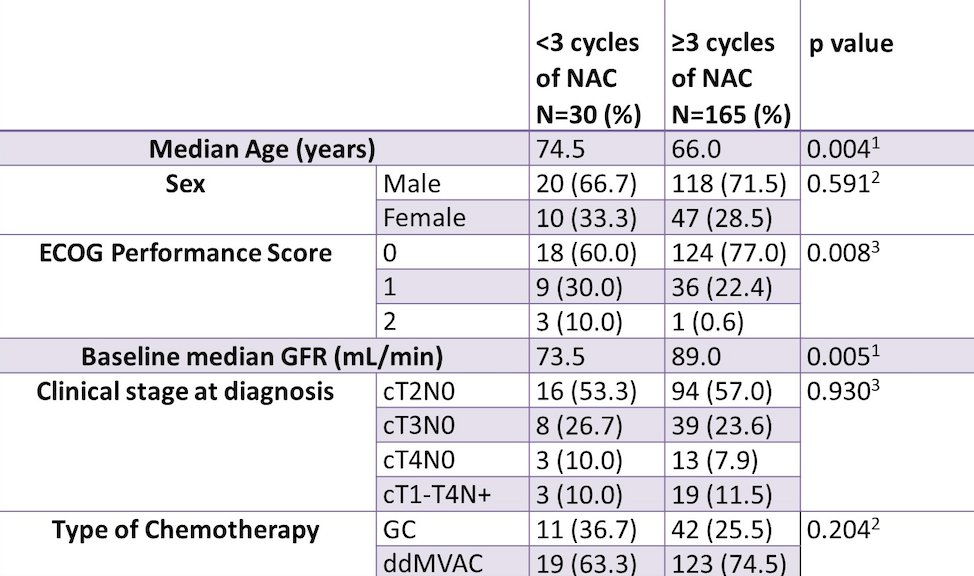
There were 195 patients treated with neoadjuvant chemotherapy for MIBC, of which 30 (15.3%) patients received < 3 cycles and 165 (84.6%) patients received ≥3 cycles of neoadjuvant chemotherapy. This included 53 patients receiving gemcitabine and cisplatin and 142 patients received methotrexate, vinblastine, doxorubicin, and cisplatin (MVAC). The demographic information stratified by number of neoadjuvant chemotherapy cycles is as follows:
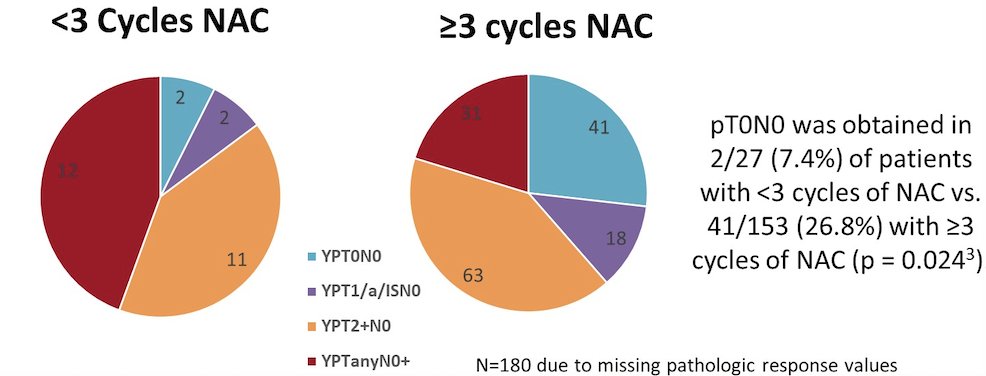
Complete pathologic response (ypT0N0) was observed in 7.4% of patients receiving < 3 cycles and in 26.8% of patient receiving ≥3 cycles of neoadjuvant chemotherapy (p = 0.024):
Significant pathologic response (< ypT2) was obtained in 22.2% of patients receiving < 3 cycles of neoadjuvant chemotherapy and in 41.8% of patients receiving ≥3 cycles (p > 0.05). Additionally, median RFS in patients with < 3 cycles of neoadjuvant chemotherapy was 8.8 months (95% CI 6.51, 13.4) and 54.5 months with ≥3 cycles of neoadjuvant chemotherapy (95% CI 29.8, 111.9). Based on a log-rank test there is a statistically significant difference in unadjusted RFS between the two groups (p < 0.001):
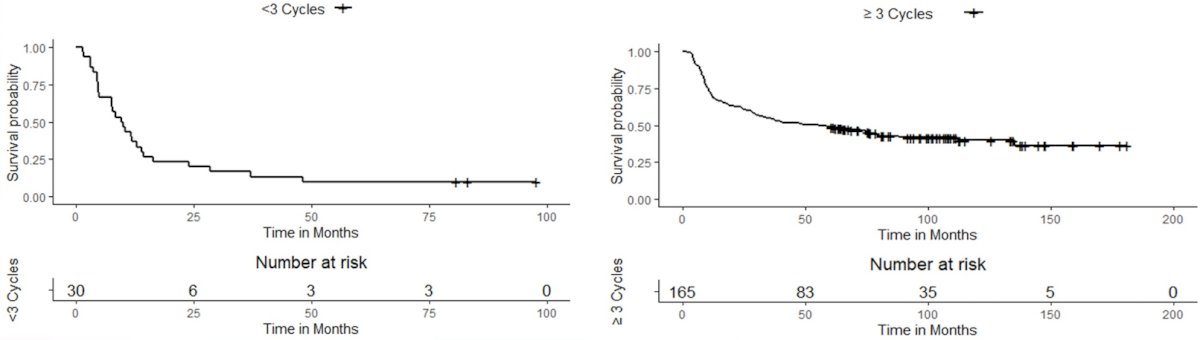
The 5-year OS in patients receiving < 3 cycles of neoadjuvant chemotherapy was 13.3%, and the 5-year OS in those receiving ≥3 cycles was 53.3%. This was a retrospective study and thus there may be confounding factors not measured within the study. Causation cannot be assessed, and all results are by association.
Dr. Chakraborty concluded this presentation discussing survival outcomes in patients with muscle-invasive bladder cancer receiving neoadjuvant chemotherapy stratified by number of cycles with the following take-home messages:
- The majority of patients ended neoadjuvant chemotherapy early due to toxicity, and a significantly higher rate of patients who received <3 cycles of neoadjuvant chemotherapy experienced Grade 3 adverse events
- Clinicians should prioritize administering at least 3 cycles of cisplatin-based chemotherapy when feasible to optimize outcomes, in particular RFS
- Shorter 5-year OS is associated with <3 cycles of neoadjuvant chemotherapy, however cause of death was not assessed. As such, it is not possible to differentiate whether death is associated with progression of disease, chemotoxicity, or other comorbidities
Presented by: Anumita Chakraborty, MD. Temple University Health System, Philadelphia, PA
Written by: Zachary Klaassen, MD, MSc – Urologic Oncologist, Associate Professor of Urology, Georgia Cancer Center, Augusta University/Medical College of Georgia, @zklaassen_md on Twitter during the 2023 American Society of Clinical Oncology (ASCO) Annual Meeting, Chicago, IL, Fri, June 2 – Tues, June 6, 2023.