

(UroToday.com) The 2022 ASCO annual meeting featured a session on prostate cancer, including a presentation by Dr. Howard Sandler discussing patient population and radiation therapy type in the ATLAS trial assessing apalutamide + ADT in high-risk localized or locally advanced prostate cancer. Current management of high-risk localized or locally advanced prostate cancer includes long-term ADT with primary radiotherapy. Despite definitive primary treatment, these patients have a high risk of metastasis and death. The phase 3 ATLAS study (NCT02531516) is investigating whether treatment intensification with the addition of apalutamide to neoadjuvant and adjuvant treatment with gonadotropin-releasing hormone agonist (GnRHa) and external beam radiation therapy will improve metastasis-free survival (MFS) in high-risk patients. At ASCO 2022, Dr. Sandler and colleagues describe (1) the distribution of baseline characteristics in this high-risk patient population and (2) the application of different radiotherapy regimens reflecting recent international guidelines and clinical practice changes for patients with high-risk localized or locally advanced prostate cancer.
Eligible high-risk localized or locally advanced prostate cancer patients (Gleason score ≥ 8 or 7 and PSA ≥ 20 ng/mL and stage ≥ cT2c), with ECOG PS 0/1 and Charlson Comorbidity Index (CCI) ≤ 3 were stratified by Gleason score, pelvic nodal status, use of brachytherapy boost, and region. Patients were randomized 1:1 to apalutamide or placebo plus GnRHa for 30 (28 days) treatment cycles. Study treatment was applied as neoadjuvant/concurrent to radiotherapy with apalutamide 240 mg/d versus bicalutamide 50 mg/d for 4 cycles; another 26 cycles are completed adjuvantly after radiotherapy with apalutamide 240 mg/day vs placebo. The ATLAS study design is as follows:

The primary end point was MFS (time from randomization to first distant metastasis on CT/MRI/bone scan by independent central review blinded to treatment or death from any cause). Imaging was conducted at baseline and every 6 months from biochemical failure until MFS. The protocol has been amended to include PET imaging (PSMA, fluciclovine, or choline).
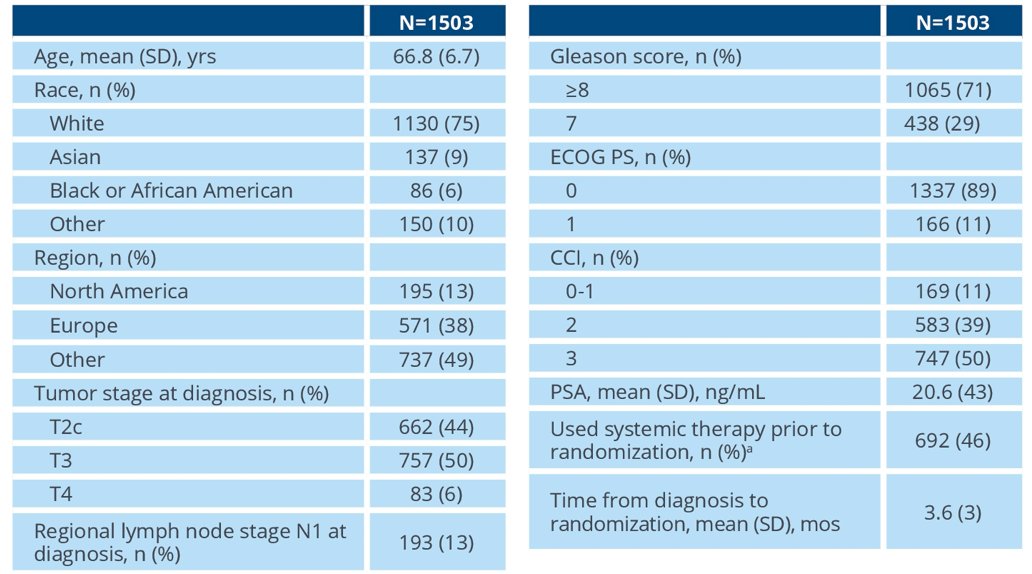
There were 1,503 patients randomized at 266 sites in 24 countries in North America, Latin America, Europe, and Asia. The study is fully enrolled, but ongoing. The median age was 67 years of age, ECOG performance status of 0 was 89%, 66% of patients were high-risk and 34% were very high–risk, median PSA was 6.3 ng/mL, 44% of patients were cT2, 50% were cT3, and 13% were cN1. Complete baseline characteristics are as follows:
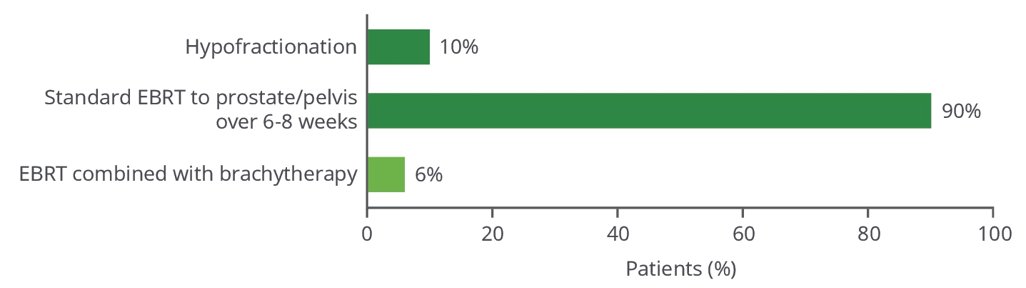
In 90% of ATLAS patients, radiotherapy used was standard external beam radiation therapy to prostate/pelvis over 6-8 weeks (cumulative 78-81 Gy), and in 10% recent hypofractionation schedules (per CHHiP or NRG/RTOG 0415) were applied (20x3 Gy/day or 28x2.5 Gy/day). There was 6% of patients that had external beam radiation therapy combined with brachytherapy (per ASCENDE-RT):
Dr. Sandler concluded his presentation by discussing patient population and radiation therapy type in the ATLAS trial assessing apalutamide + ADT in high-risk localized or locally advanced prostate cancer with the following summary points:
- Baseline characteristics of the ATLAS study population are reflective of patients with high- and very high–risk features and pelvic nodal involvement undergoing primary radiotherapy in clinical practice
- The radiotherapy schedules applied reflect recent evidence and guideline changes for the use of hypofractionation in this patient population
- ATLAS is an example of how radiotherapy can be included in phase 3 trials of high-risk localized or locally advanced prostate cancer, in combination with next-generation androgen receptor inhibitors (eg, apalutamide)
Presented by: Howard M. Sandler, MD, Cedars-Sinai Medical Center, Los Angeles, CA
Written by: Zachary Klaassen, MD, MSc – Urologic Oncologist, Assistant Professor of Urology, Georgia Cancer Center, Augusta University/Medical College of Georgia, @zklaassen_md on Twitter during the 2022 American Society of Clinical Oncology (ASCO) Annual Meeting, Chicago, IL, Fri, June 3 – Mon, June 7, 2022.