

(UroToday.com) At the 2022 American Society of Clinical Oncology Annual Meeting held in Chicago and virtually, the poster session focused on Prostate, Testicular, and Penile cancers on Monday afternoon included a presentation from Dr. Michael J. Morris describing the rationale, design, and protocol of a phase I trial of 69086420, an actinium-225-labeled antibody targeting human kallikrein-2, for advanced prostate cancer.
There has been significant interest recently in the field of theranostics for prostate cancer. The phase II TheraP and phase III VISION trials demonstrated the benefit of 177Lu-PSMA-617 in patients with heavily pre-treated metastatic castration-resistant prostate cancer (mCRPC) with evidence that PSMA prolongs survival and improves the quality of life. These agents are premised on targeting of the transmembrane protein prostate-specific membrane antigen. However, there is hope that further targeted therapies and more powerful radio payloads will result in improved outcomes. One such target is human kallikrein-related peptidase 2 (hK2), a tumor-associated member of the kallikrein family that shares significant homology to prostate-specific antigen and is minimally expressed in normal non-prostate tissues. JNJ-69086420 (JNJ-420; 225Ac-DOTA-h11B6 [1,4,7,10-tetraazacyclododecane-1,4,7,10-tetraacetic acid]), is a first-in-class radioimmunotherapy targeted to hK2 antigen.
In a phase 0 study of [111In]-DOTA-h11B6, patients with mCRPC who had progressed on standard therapies, treatment with a single dose of [111In]-DOTA-h11B6 (2 mg) with or without 8 mg h11B6, demonstrated safety, good tumor localization, and nominal normal-organ uptake. Thus, the authors designed a first-in-human study to assess the safety, pharmacokinetics (PK), pharmacodynamic (PD), and clinical activity of Ac-225 radiolabeled JNJ-420, to determine its recommended phase 2 dose (RP2D) in adults with advanced PC.
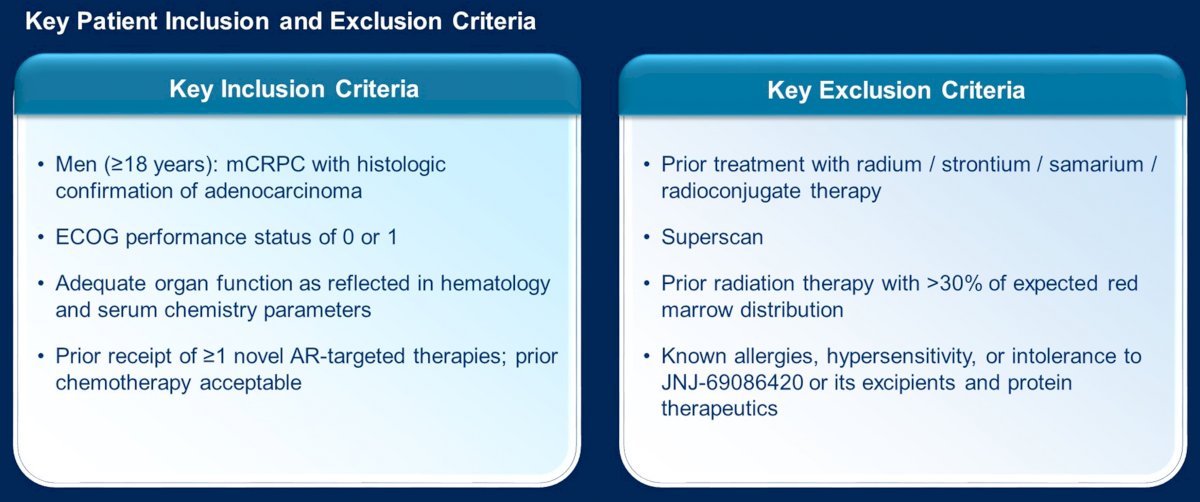
To do so, they will recruit approximately 50 men to this open-label, multicenter, phase 1 study (NCT04644770). Eligible men will be aged ≥18 years with mCRPC with histologic confirmation of adenocarcinoma, Eastern Cooperative Oncology Group (ECOG) performance status of 0 or 1, adequate organ function based on hematology and serum chemistry, and 1 or more prior novel androgen receptor-targeted therapies (prior chemotherapy acceptable). Notably, men will be excluded if they have prior treatment with radium/strontium/samarium/radioconjugate therapy, superscan findings as protocol defined, or active central nervous system metastases.
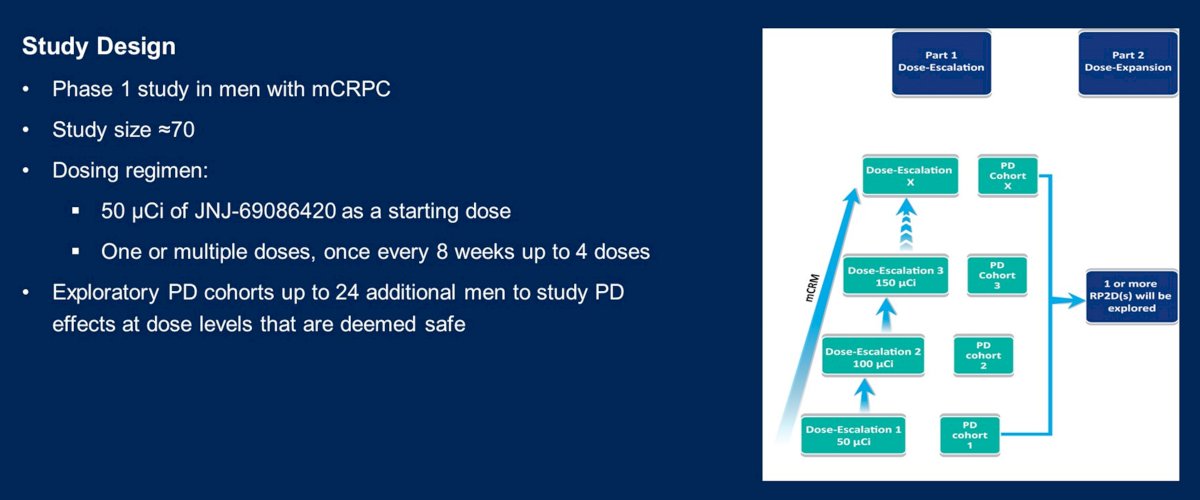
The study will include two parts: dose escalation (Part 1) and expansion (Part 2) parts. In Part 1, men will receive intravenous (IV) injection of 50 μCi/ 2 mg JNJ-420 (once every 8 weeks) with one or multiple doses; escalation of dose levels to be based on dose limiting toxicities (DLTs) evaluation, until RP2D identification. In Part 2, JNJ-420 is to be given at one of the RP2D(s) determined in Part 1.
The primary endpoint of this phase I trial is safety (incidence and severity [grading per NCI-CTCAE V5.0] of AEs including DLTs). Secondary endpoints include prostate-specific antigen response rate, overall response rate (PCWG3 modified RECIST 1.1 criteria), PK, PD, immunogenicity, and biomarker analyses.
This trial began enrollment in December 2020 and, as of May 15 2022, 4 sites have been initiated and 73 patients enrolled. Currently, the dose-escalation phase is ongoing.
Presented by: Michael J. Morris, MD., is the Clinical Director, Genitourinary Medical Oncology Service & Prostate Cancer Section Head, Division of Solid Tumor Oncology, Memorial Sloan Kettering Cancer Center, New York