

(UroToday.com) The 2022 ASCO annual meeting featured a session on prostate cancer, including a presentation by Dr. Neeraj Agarwal discussing genomic aberrations associated with overall survival in mCSPC treated with apalutamide or placebo + ADT in the TITAN trial.1 TITAN, a phase 3 placebo-controlled study in patients with mCSPC, showed apalutamide + ADT improved radiographic progression-free survival and OS vs placebo + ADT. In this exploratory analysis presented at ASCO 2022, Dr. Agarwal and colleagues reported the relationships between biomarkers and OS in TITAN.
The TITAN biomarker population included a subset of patients who consented to exploratory biomarker analysis and provided >=1 sample at baseline and/or end of study treatment:
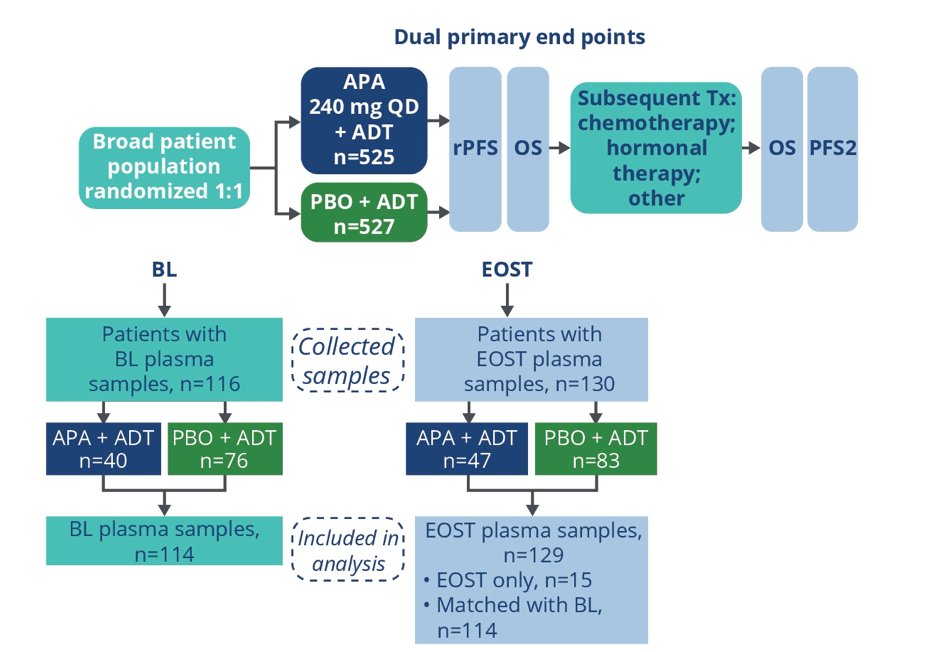
Circulating tumor (ct)DNA and genomic aberrations in 17 prostate cancer-related genes, including the androgen receptor, were assessed at baseline (114 patients) and end of study treatment (129 patients) using next-generation sequencing. ctDNA was assessed qualitatively and genomic aberrations were assessed within ctDNA-positive samples as inactivation (heterozygous/homozygous deletion or single nucleotide variant) or activation (amplification or single nucleotide variant). Associations of detected ctDNA/aberrations at baseline or end of study treatment with OS, and biomarkers at end of study treatment with OS on subsequent therapies, were evaluated using univariate or multivariate analyses and Cox proportional hazards model, with results were stratified by treatment arm.
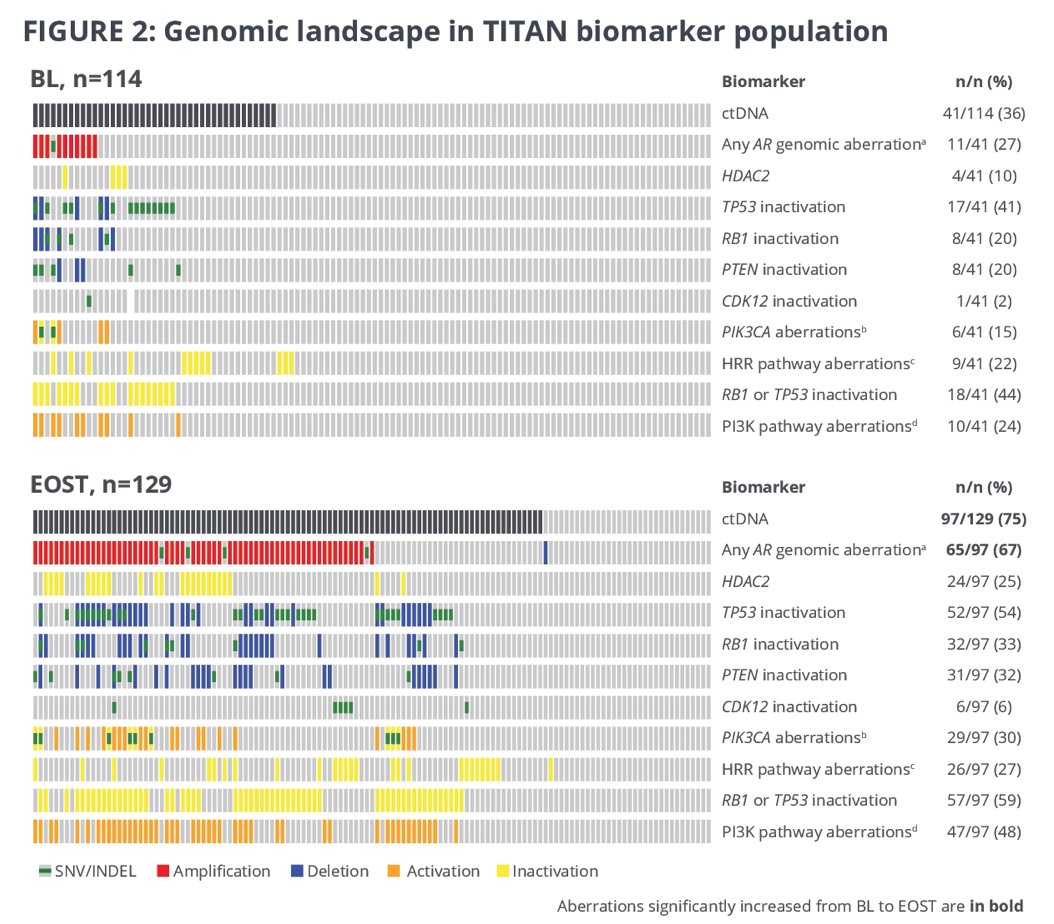
Among patients from both treatment groups, 36% had detectable ctDNA, of which 27% had any genomic AR aberration and 24% had AR gene amplification at baseline; prevalence of these biomarkers increased significantly from baseline to end of study treatment. The most prevalent non-androgen receptor aberrations at baseline (TP53, homologous recombination repair pathway, PTEN, RB1, and PIK3CA genes) increased at end of study treatment but not significantly:
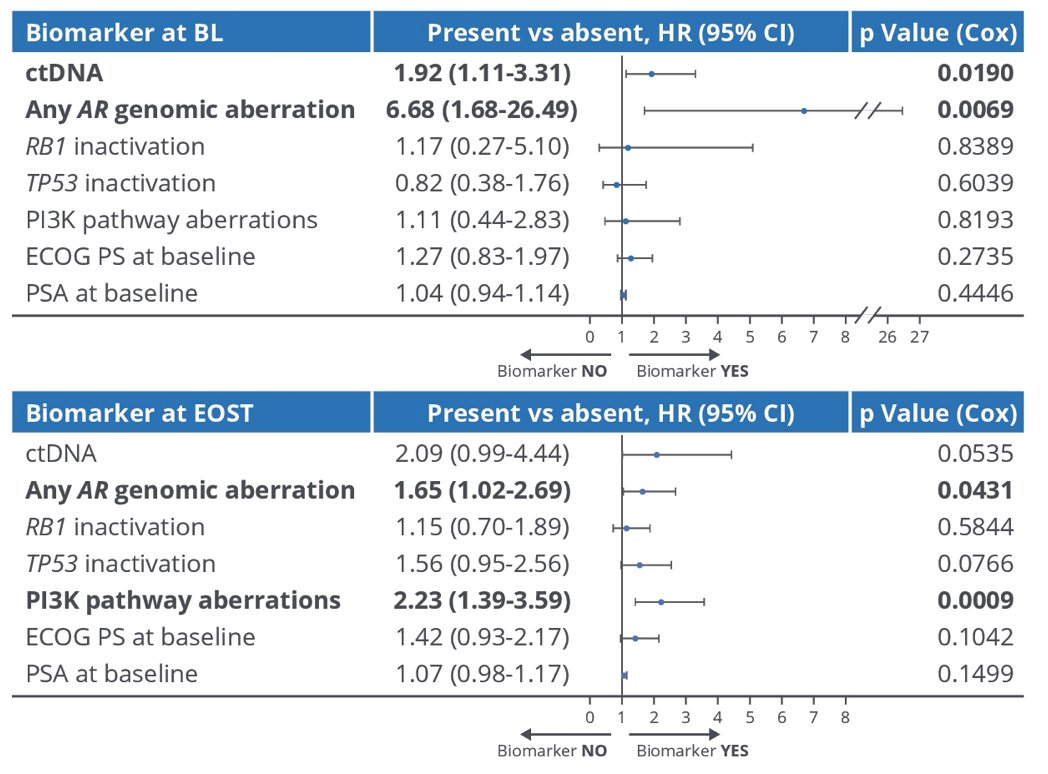
Among assessed aberrations, presence of ctDNA or any AR genomic aberrations at baseline (HR, 1.9 or 6.7; all p < 0.05) and any AR genomic aberrations or PI3K pathway activation at end of study treatment (1.7, p < 0.05 or 2.2, p < 0.001) was significantly associated with poor OS in multivariate analyses from both treatment groups:
In univariate analyses of patients who received subsequent therapy (chemotherapy: 106; hormonal therapy: 161), worse OS was associated only with PIK3CA activation, PI3K pathway activation, or TP53 inactivation at end of study treatment (3.7, p < 0.05; 2.4, p < 0.05; 3.0, p < 0.01, respectively) in chemotherapy-treated patients.
Dr. Agarwal concluded his presentation discussing genomic aberrations associated with overall survival in mCSPC treated with apalutamide or placebo + ADT in the TITAN trial with the following concluding statements:
- These hypothesis-generating data from TITAN show that presence of ctDNA or select androgen receptor and non-androgen receptor biomarkers at baseline or end of study treatment were associated with poor OS
- The predictive value of these biomarkers for survival in mCSPC needs further confirmation
Presented by: Neeraj Agarwal, MD, Huntsman Cancer Institute, University of Utah, Salt Lake City, UT
Written by: Zachary Klaassen, MD, MSc – Urologic Oncologist, Assistant Professor of Urology, Georgia Cancer Center, Augusta University/Medical College of Georgia, @zklaassen_md on Twitter during the 2022 American Society of Clinical Oncology (ASCO) Annual Meeting, Chicago, IL, Fri, June 3 – Mon, June 7, 2022.
References: