

(UroToday.com) The 2022 ASCO annual meeting featured an oral abstract session on kidney and bladder cancer, including a presentation by Dr. Thomas Flaig discussing cell-free DNA methylation as a predictive biomarker of response to neoadjuvant chemotherapy for patients with muscle-invasive bladder cancer in SWOG S1314. Neoadjuvant chemotherapy is the standard of care in muscle-invasive bladder cancer patients. However, treatment is intense, the overall benefit is small, and there is no established marker to identify patients who benefit most. Many factors are potentially associated with response or resistance to platinum chemotherapy, such as p53-like molecular subtype, ERCC2 mutation, an ERBB2 mutation. The aim of the current study presented by Dr. Flaig was to characterize cell-free DNA methylation from patients receiving neoadjuvant chemotherapy in SWOG S1314, a prospective cooperative group trial, and to correlate the methylation signatures with pathologic response.
The SWOG S1314 trial schema is as follows:

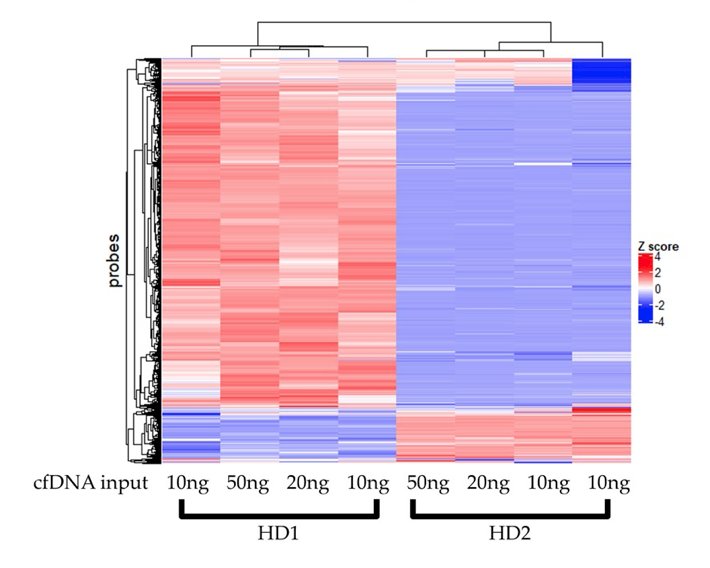
Blood samples were collected prospectively from 72 patients before and during standard neoadjuvant chemotherapy. At radical cystectomy, pathologic response was documented, and plasma cell-free DNA was profiled using Infinium MethylationEPIC BeadChip array. This platform is cost effective, commercially available, and is a standard established analysis tool. However, although it has been used extensively for tissue profiling, it has not been previously tested for cfDNA (lower DNA content):
Differential methylation between pathologic responders (≤pT1N0M0) and non-responders was analyzed, and a Random Forest model was used to generate a classifier predictive of treatment response.
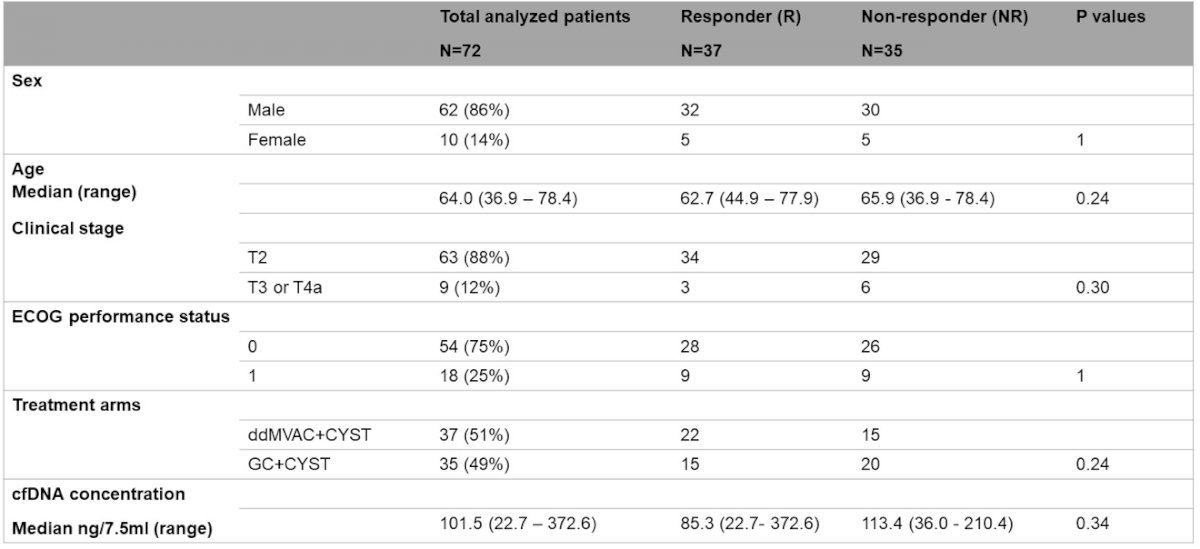
Patient characteristics were well-balanced between responders and non-responders:
There was no single methylation locus statistically correlated with response after adjustment for multiple comparisons (>850K probes in Infinium chip). However, on tSNE mapping, responders and non-responders clustered separately based on the 500 most differentially methylated DNA loci. Thus, Dr. Flaig and colleagues applied Random Forest machine learning and leave-one-out cross validation to all 850K loci to create the methylation-based response score (mR-score). By using pre-chemotherapy plasma cell-free DNA, they developed a mR-score predictive of pathologic response:

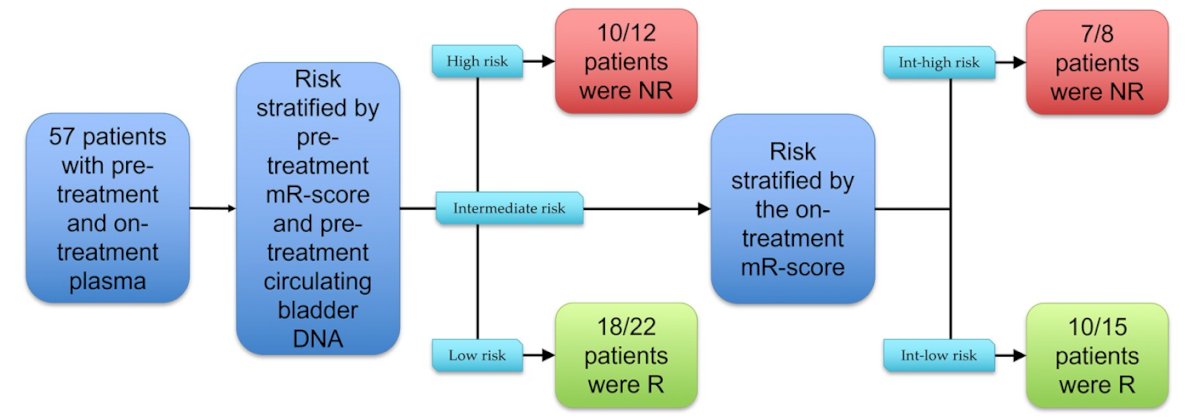
The mR-score also could be calculated using plasma samples collected after the first cycle of neoadjuvant chemotherapy, resulting in a similar predictive ability. Furthermore, Dr. Flaig and colleagues used cell-free DNA methylation data to calculate the circulating bladder DNA fraction, which had a modest but independent predictive ability for treatment response. When combining the mR-score and circulating bladder DNA fraction, they successfully predicted pathologic response outcomes in 79% of patients based on their plasma collected before chemotherapy and after 1 cycle of chemotherapy:
Dr. Flaig concluded this presentation discussing cell-free DNA methylation as a predictive biomarker of response to neoadjuvant chemotherapy for patients with muscle-invasive bladder cancer in SWOG S1314 with the following take-home points:
- Infinium MethylationEPIC BeadChip can be used to profile plasma cfDNA methylation
- Machine-learning can be applied to cfDNA methylomes to generate biomarker signatures predictive of response to therapy
- In this pilot study, mR-score was not correlated with circulating bladder DNA fraction, thus these two independent biomarkers may be used in conjunction to predict chemotherapy response
- Plasma cfDNA methylation at baseline and after one cycle of neoadjuvant chemotherapy correctly predicted response in nearly 80% of patients, an approach that may aid in treatment selection if further validated in this setting
Presented by: Thomas W. Flaig, MD, University of Colorado Cancer Center, Aurora, CO
Written by: Zachary Klaassen, MD, MSc – Urologic Oncologist, Assistant Professor of Urology, Georgia Cancer Center, Augusta University/Medical College of Georgia, @zklaassen_md on Twitter during the 2022 American Society of Clinical Oncology (ASCO) Annual Meeting, Chicago, IL, Fri, June 3 – Mon, June 7, 2022.