

(UroToday.com) The Advanced Prostate Cancer Consensus Conference (APCCC) Diagnostics 2025 held in Lugano, Switzerland was host to a session addressing the contemporary management of biochemically recurrent prostate cancer patients. Dr. Ganesh Palapattu discussed what should be done for biochemically recurrent patients with negative imaging findings.
He began by noting that:
- PSA recurrences precede the development of metastases, which in turn precedes prostate cancer-related morbidity and mortality
- Not all PSA recurrences will lead to patient harm
- Salvage radiation treatment works best at lower PSA levels
- Salvage radiation treatment is associated with adverse effects
- The detection rate of next generation molecular imaging is inferior at lower PSA levels
What PSA defines a biochemical recurrence, and, in turn, what imaging should be performed? The definition of a PSA recurrence depends on the primary treatment modality. Following a radical prostatectomy, biochemical recurrence is defined by a serum PSA level ≥0.2 ng/ml, with a confirmatory value of >0.2 ng/ml. Following pelvic radiotherapy, biochemical recurrence is defined by a PSA >2 ng/ml above nadir (Phoenix criteria).1
With regards to imaging, the following options are available:
- Bone scan and CT abdomen/pelvis
- Choline PET/CT
- F-NaF PET/CT
- Whole body axial MRI and/or pelvic MRI
- 18F-fluciclovine PET/CT
- 68Ga-PSMA PET/CT
What should we do in cases of biochemical recurrence with negative imaging? Dr. Palapattu noted that the 1st step should be to risk stratify patients using either the AUA or EAU risk stratification systems:
- AUA risk stratification, with high risk defined by any of the following:
- Pathologic Grade Group 4–5 disease
- pT3b–4
- Positive surgical margins
- Lymph node-positive disease
- Short PSA doubling time
- Short interval from primary therapy to PSA recurrence
- Higher post-radical prostatectomy PSA level
- High-risk genomic classifier score
- EAU risk stratification:
- Post-radical prostatectomy
- PSA doubling time ≤1 year OR
- Pathologic Grade Group 4–5 disease
- Post-radiotherapy
- Interval to biochemical recurrence ≤18 months OR
- Biopsy Grade Group 4–5 disease
- Post-radical prostatectomy
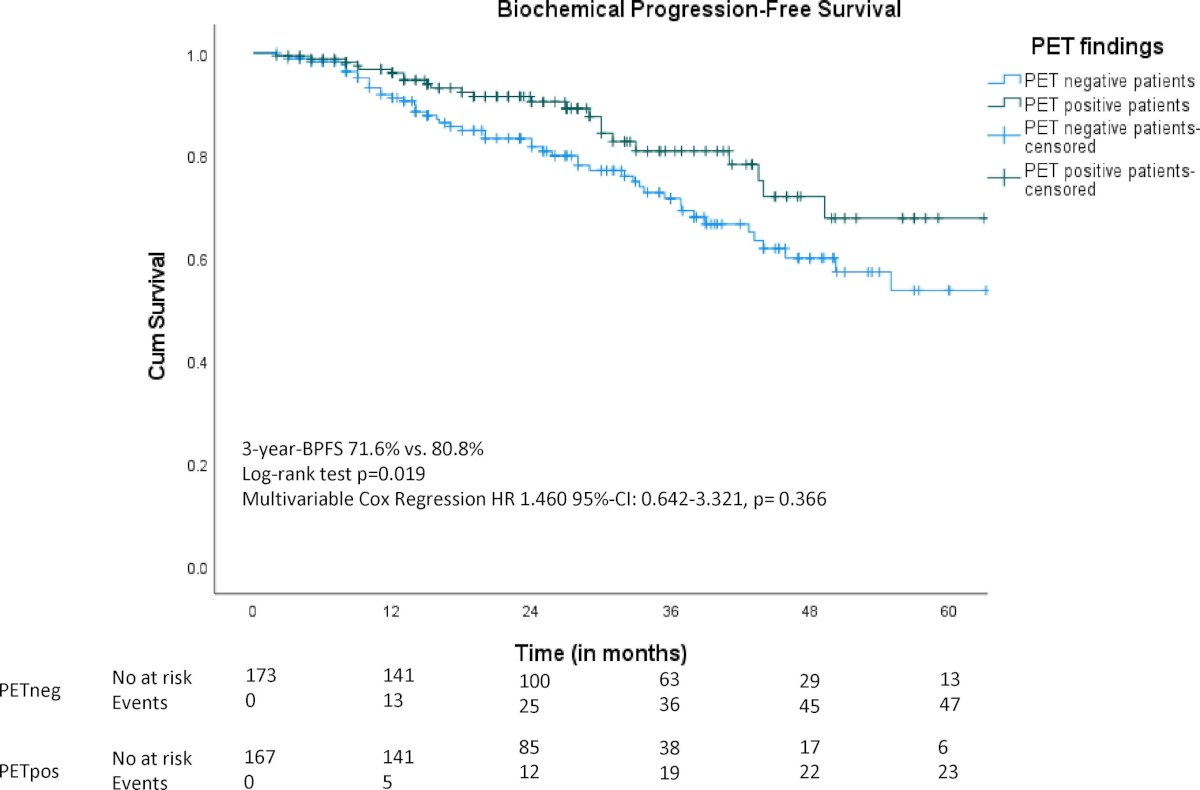
What does the current evidence show in this space? Should patients with negative findings on PSMA PET receive salvage radiotherapy to the pelvis? In a 2023 retrospective study of 341 patients who received salvage radiotherapy,2 including 173 with negative PSMA PET results and 168 with local disease-positive PSMA PET findings, the 3-year biochemical progression-frees survival rates were:
- PSMA PET negative: 71.6%
- PSMA PET positive for local recurrence: 80.8%
On multivariable analysis, there were no significant differences in biochemical progression-free survival rates between the two groups. Significant predictors of biochemical progression-free survival were:
- PET-negative group:
- Age
- PSA doubling time
- PET-positive group:
- ISUP Grade Group
- Radiation dose to the pelvic fossa
Dr. Palapattu argued that these findings support the recommendation to initiate salvage radiotherapy in a ‘timely manner’ after the development of biochemical recurrence, even in patients with PSMA PET scans that are negative for local disease recurrence.
What should clinicians do in clinical practice? Firstly, risk stratify patient using the available risk stratification systems (AUA or EAU), with high-risk patients recommended for early salvage therapy, whereas low-risk risk patients may be considered for PSA surveillance with interval repeat imaging. Ultimately, clinicians and patients should weigh the risks and benefits, with shared decision-making key in this setting.
Several open questions remain in this space:
- What is the optimal dose and radiation field in the salvage setting?
- Is biochemical progression-free survival an appropriate endpoint to base decisions in this context?
- What is the role of biochemical biomarkers?
- How will we manage PSA recurrences following focal ablative therapy?
Presented by: Ganesh Palapattu, MD, FACS, George F. and Sandy G. Valassis Professor of Urology, Department Chair, Urology, University of Michigan, Ann Arbor, MI
Written by: Rashid K. Sayyid, MD, MSc – Robotic Urologic Oncology Fellow at The University of Southern California, @rksayyid on Twitter during the Advanced Prostate Cancer Consensus Conference (APCCC) Diagnostics 2025 Annual Meeting, Virtual and Lugano, Switzerland, Thurs, Feb 27 – Fri, Feb 28, 2025.
References:
- Roach M3rd, Hanks G, Thames HJr, et al. Defining biochemical failure following radiotherapy with or without hormonal therapy in men with clinically localized prostate cancer: recommendations of the RTOG-ASTRO Phoenix Consensus Conference. Int J Radiat Oncol Biol Phys. 2006; 65: 965–974.
- Scharl S, Zamboglou C, Strouthos I, et al. Salvage radiotherapy is effective in patients with PSMA-PET-negative biochemical recurrence- results of a retrospective study. Radiother Oncol. 2023; 109678.