

(UroToday.com) The 2025 APCCC Diagnostics annual meeting featured a session on how to monitor metastatic prostate cancer and a presentation by Dr. Michael Morris discussing PCWG4 and SPARC, including how to define progression on PSMA PET imaging. The domains of SPARC and PCWG4 are as follows:
- SPARC: a consensus on how PSMA PET should be reported, used for primary staging, biochemical recurrence, and response (EAU oral presentation, March 21, 2025)
- PCWG4: a clinical trials design framework with a focus on drug and biomarker development (manuscript written, pending submission)
These two entities are coming together to answer the following PSMA PET questions:
- Criteria for identifying and reporting localized disease?
- Criteria for identifying and reporting distant disease?
- Criteria for identifying and reporting progression?
- Criteria for identifying and reporting response?

A key question of SPARC is “can we arrive at a common lexicon for describing the domains of PSMA PET?” Additional goals of SPARC are:
- To improve efficiency of research
- To prioritize key issues
- To minimize field heterogeneity
- To minimize field confusion
- To unify what have previously been parallel but uncoordinated efforts
Currently, there are many reporting recommendations: PrimaryScore, PROMISE, ePROMISE, aPROMISE, PSMA-RADS, ePSMA, PPP (PSMA PET Progression criteria), RECIP, PCWG3 (PWG4), RECIST 1.1, and aPERCIST. The 30 experts in SPARC include:
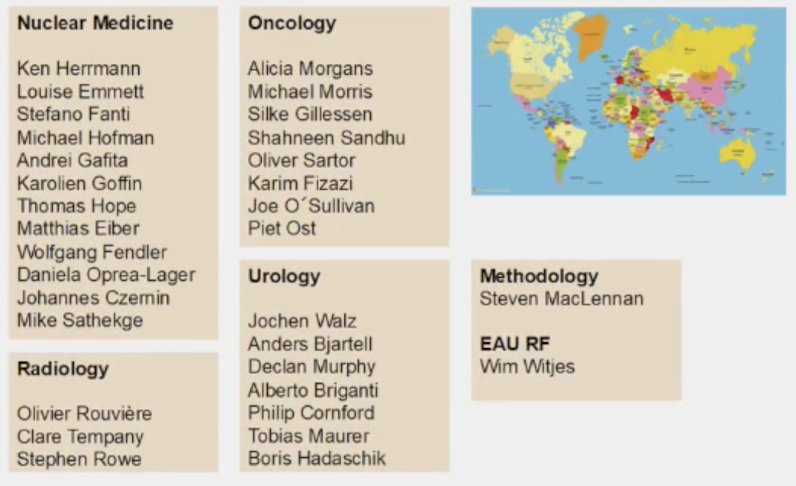
These experts were split into 5 thematic groups and each group reviewed relevant literature to generate agreement statements. Then, a preview and refinement process of all statements was completed by all 3 experts on the panel, with 91 final statements created. Dr. Morris notes that there are several common assumptions shared between SPARC and PCWG4:
- No validated response/progression criteria for SUV based changes
- The CT should be incorporated into the assessment
- RECIST will still apply despite PSMA PET
- New lesions will be defined on the basis of uptake, size, location, and pattern
- Early PSMA imaging can reflect changes in PSMA uptake rather than response or progression of disease
The PCWG4 contributing members are as follows:

There are several PCWG4 special considerations noted by Dr. Morris:
- Right now we are still “stuck” with bone scans as a standard for clinical trials – PSMA PET should be performed in studies at baseline, early response, and early progression
- Overall:
- Clinical trials are international, involving sites of various resources and sophistication
- Criteria need to be feasible on standard workstations
- Cannot involve proprietary software that only certain sites have
- Response: currently we cannot define an investigational endpoint. Data collection is needed so that we have answers for PCWG5
- Progression:
- SUV based criteria require validation
- New lesions do represent progressive disease
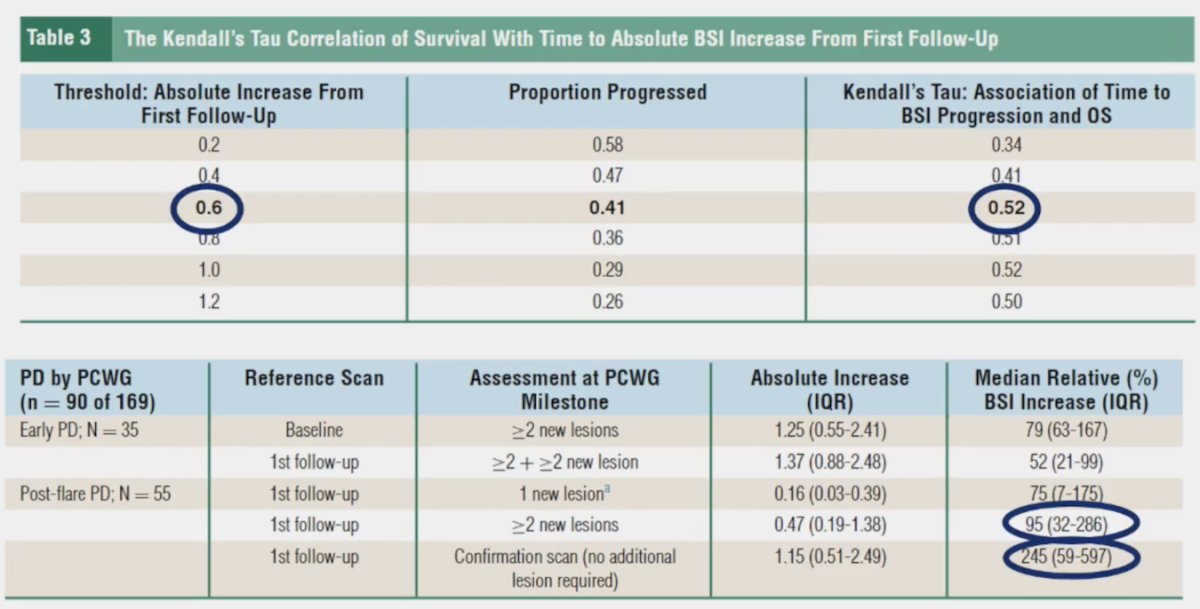
Eligibility for PCWG4 is the same as for PCWG3. For PSMA PET, changes in SUV based criteria are not ready to qualify as progression of disease for eligibility. New lesions will qualify if a prior PSMA PET is available for comparison. In work from Dr. Morris’ group1 assessing PCWG3, they noted that more disease over threshold does not confer a greater association between radiographic progression free survival and overall survival:
Dr. Morris concluded his presentation by discussing PCWG4 and SPARC, including how to define progression on PSMA PET imaging, with the following take-home points:
- It is important to distinguish oligometastatic from polymetastatic progression of disease
- When imaged with PSMA PET, polymetastatic progression of disease will not require a confirmatory scan
- Some visceral lesions, even if only evident on PET, are worthy of declaring progression of disease
Presented by: Michael J. Morris, MD, Memorial Sloan Kettering Cancer Center, New York, NY
Written by: Zachary Klaassen, MD, MSc – Urologic Oncologist, Associate Professor of Urology, Georgia Cancer Center, Wellstar MCG Health, @zklaassen_md on Twitter during the Advanced Prostate Cancer Consensus Conference (APCCC) Diagnostics 2025 Annual Meeting, Virtual and Lugano, Switzerland, Thurs, Feb 27 – Fri, Feb 28, 2025.
References: