

(UroToday.com) The 2025 APCCC Diagnostics annual meeting featured a session on how to stage and estimate risk for prostate cancer and a presentation by Dr. Daniela Oprea-Lager discussing that if a patient needs next generation imaging, it must be PSMA PET.
Dr. Oprea-Lager started her presentation by noting that ChatGPT does a very good job highlighting the benefits of PSMA PET. When entering “PSMA PET” AND “Imaging” AND “prostate cancer” into ChatGPT, it immediately highlights the key benefits of PSMA PET in prostate cancer:
- Accurate detection
- Early detection of recurrence
- Treatment planning
- Improved staging
- Assessment of treatment response
ChatGPT also highlights the advantages over other imaging methods, including higher sensitivity, fewer false negatives, and fewer false positives. For the remainder of her presentation, Dr. Oprea-Lager reviewed her ten scientific arguments for PSMA PET/CT as the standard of care.
1. PSMA is a useful theranostic target. PSMA is a type II transmembrane protein and is a promising and specific target for prostate cancer imaging. Further, PSMA is expressed by 90% of prostate cancer; expression correlates with unfavorable prognostic factors, and is an excellent target for diagnosis and therapy (thus has theranostic applicability).
2. PSMA is the first radiotracer with an indication for the initial staging of prostate cancer.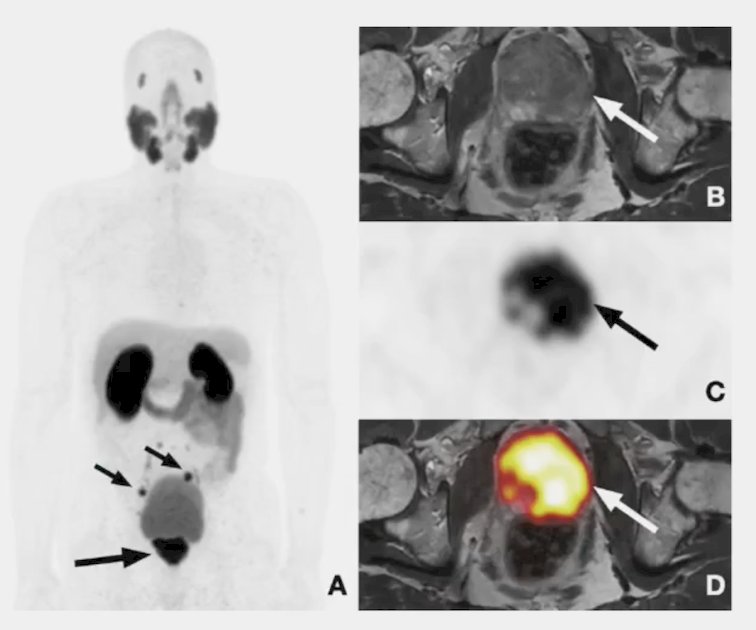
3. PSMA PET is able to detect lymph node metastasis.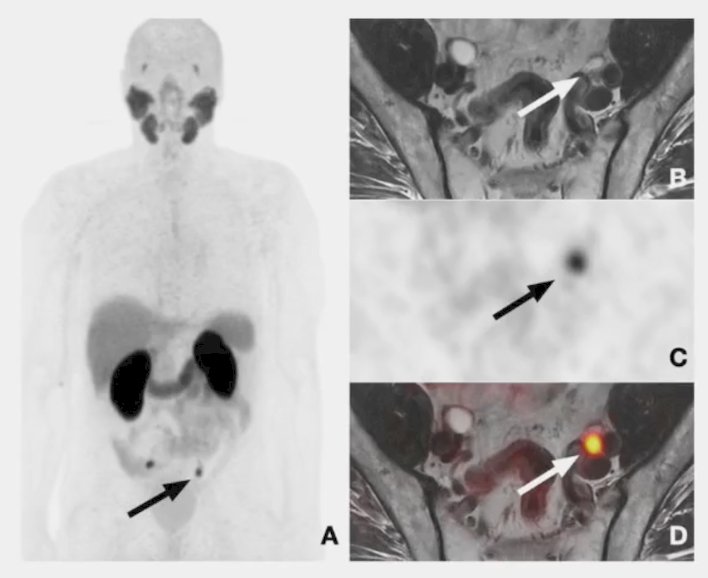
4. PSMA PET improves distant metastases detection:

5. PSMA PET improves detection in the initial staging setting. The following table represents the 68Ga-PSMA-11 test characteristics for composite 3 blinded reads and overall majority rule read:1

6. PSMA PET has a predictive ability for primary staging. A systematic review and meta-analysis published by Perera et al.2 in 2020 assessed 37 articles including 4,790 patients. For patients with biochemical recurrence, the percentage of positive scans were 33% for PSA 0-0.19 ng/mL, 45% for PSA 0.2-0.49, 59% for PSA 0.50-0.99, 75% for PSA 1-1.99, and 95% for PSA >= 2 ng/mL. Additionally, there were significant differences in positivity after biochemical recurrence in the prostate bed that were noted between radical prostatectomy (22%) and radiotherapy (52%) patients. On a per patient level, the sensitivity was 77% and the specificity was 97%; on a per lesion analysis, the sensitivity was 75%, and specificity was 99%.
7. PSMA PET has predictive value in pN1 disease. The following highlights the prognostic value of lymph node staging with PSMA PET/CT and extended pelvic lymph node dissection in patients with prostate cancer having N1 disease:3

8. PSMA PET outperforms conventional imaging. The proPSMA study4 found that PSMA PET-CT had a 27% greater accuracy than that of conventional imaging (92% versus 65%), with subgroup analyses also showing the superiority of PSMA PET/CT for patients with pelvic nodal metastasis (AUC 91% versus 59%) and for patients with distant metastases (AUC 95% versus 74%).
9. PSMA PET has diagnostic value in unfavorable intermediate risk prostate cancer:5
10. The EAU Guidelines support PSMA PET in the staging of prostate cancer.
- Any risk group staging: use pre-biopsy MRI for local staging information (Weak)
- Low-risk localized disease: do not use additional imaging for staging purposes (Strong)
- Intermediate risk disease: for patients with ISUP grade group 3 disease, perform PSMA PET/CT if available to increase accuracy or at least cross-sectional abdominopelvic imaging and a bone scan (Weak)
- High risk localized disease/locally advanced disease: perform metastatic screening using PSMA PET/CT if available or at least cross-sectional abdominopelvic imaging and a bone scan (Strong)
The summary of evidence (level 1b) for the staging of prostate cancer in the EAU guidelines states, “PSMA PET/CT is more accurate for staging than CT and bone scan for high-risk disease, but to date no outcome data exist to inform subsequent management.”
Dr. Oprea-Lager concluded her presentation discussing that if a patient needs next generation imaging, it must be PSMA PET with the following take-home points:
- PSMA PET is here to stay:
- Initial staging: unfavorable intermediate and high risk prostate cancer
- PSMA PET outperforms conventional imaging
- PSMA PET predicts oncological outcomes
- It is well positioned in the EAU guidelines
- Imaging doctors are here to stay:
Presented by: Daniela Oprea-Lager, MD, PhD, Department of Radiology and Nuclear Medicine, Amsterdam UMC Location Vrije Universiteit Amsterdam, Amsterdam, The Netherlands
Written by: Zachary Klaassen, MD, MSc – Urologic Oncologist, Associate Professor of Urology, Georgia Cancer Center, Wellstar MCG Health, @zklaassen_md on Twitter during the Advanced Prostate Cancer Consensus Conference (APCCC) Diagnostics 2025 Annual Meeting, Virtual and Lugano, Switzerland, Thurs, Feb 27 – Fri, Feb 28, 2025.
References:
- Hope TA, Eiber M, Armstrong WR, et al. Diagnostic accuracy of 68Ga-PSMA-11 PET for Pelvic Nodal Metastasis Detection Prior to Radical Prostatectomy and Pelvic Lymph Node Dissection: A Multicenter Prospective Phase 3 Imaging Trial. JAMA Oncol. 2021 Nov 1;7(11):1635-1642.
- Perera M, Papa N, Roberts M, et al. Gallium-68 Prostate-specific Membrane Antigen Positron Emission Tomography in Advanced Prostate Cancer-Updated Diagnostic Utility, Sensitivity, Specificity, and Distribution of Prostate-Specific Membrane Antigen-avid Lesions: A Systematic Review and Meta-Analysis. Eur Urol 2020 Apr;77(4):403-417.
- Meijer D, Ettema RH, van Leeuwen PJ, et al. The prognostic value of lymph node staging with prostate –specific membrane antigen (PSMA) positron emission tomography (PET/CT) and extended pelvic lymph node dissection in node-positive patients with prostate cancer. BJU Int. 2023 Mar;131(3):330-338.
- Hofman MS, Lawrentschuk N, Francis, RJ, et al. Prostate-specific membrane antigen PET-CT in patients with high-risk prostate cancer before curative-intent surgery or radiotherapy (proPSMA): A prospective, randomized, multicentre study. Lancet 2020 Apr 11;395(10231):1208-1216.
- Hagens MJ, Luining WI, Jager A, et al. The diagnostic value of PSMA PET/CT in men with newly diagnosed unfavorable intermediate risk prostate cancer. J Nucl Med. 2023 Aug;64(8):1238-1243.