

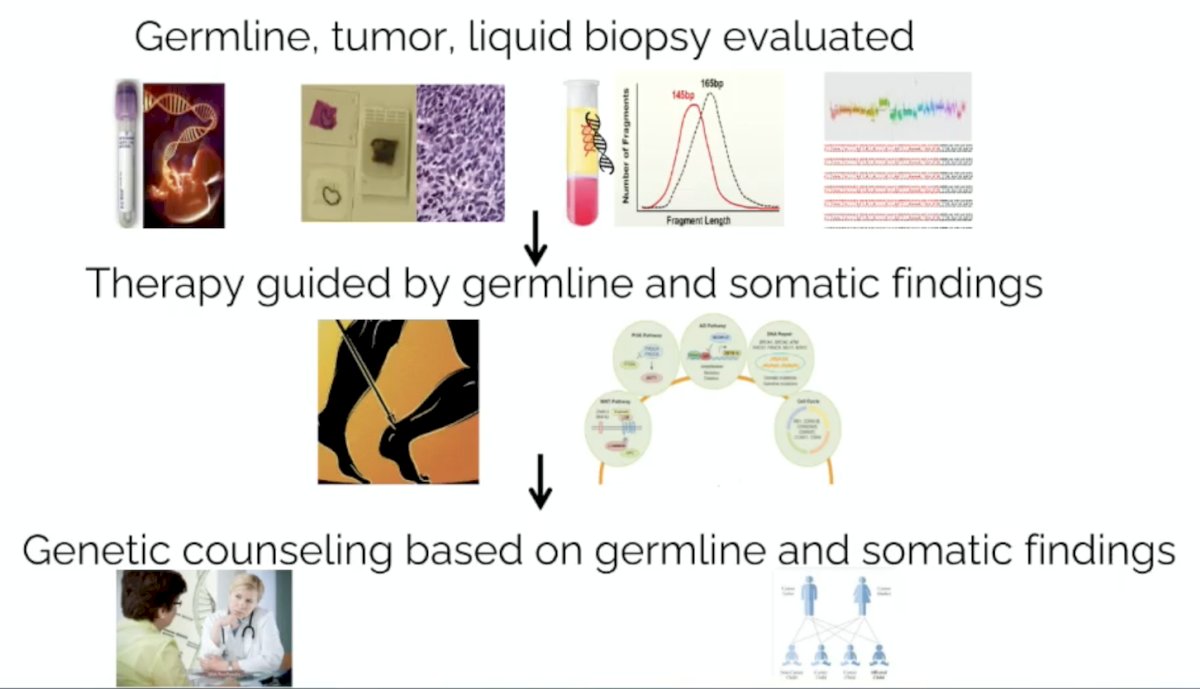
(UroToday.com) The 2026 Advanced Prostate Cancer Consensus Conference (APCCC) meeting featured a session discussing how we ensure everyone gets the best possible care in different contexts and a presentation by Dr. Colin Pritchard discussing whether there is a possibility to make NGS testing and results widely available. Dr. Pritchard notes that the ideal model for advanced prostate cancer would be to assess every patient’s germline, tumor, and liquid biopsy, followed by therapy guided by germline and somatic findings, followed by genetic counseling based on germline and somatic findings:
However, there are significant barriers (but with potential solutions) to the ideal model:
- Cost/coverage: solutions may be advocacy and guidelines
- Access/availability: a solution may be test innovation
- Oncology expertise: a solution would be education
- Pathology expertise: a solution would be updating diagnostic criteria and encouraging “in house” testing
- Test interpretation: a solution would be molecular tumor boards
- “Push” versus “Pull” workflow: a solution may be pathology directed testing
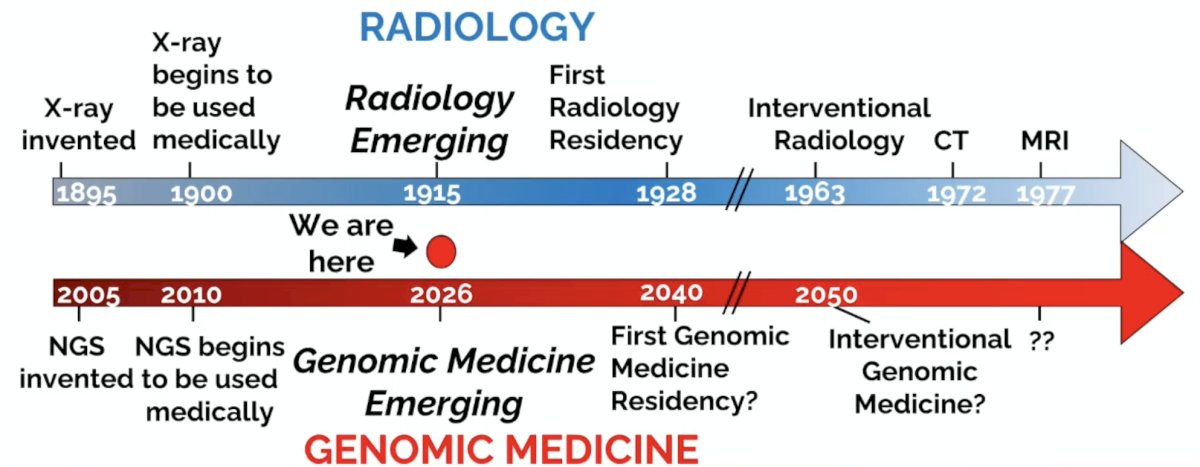
The problem with test interpretation is that there are too many uncertain findings and too much automation, resulting in inadequate care. Moreover, there are not enough next generation sequencing trained on-site pathologists, and reported data is not synthesized into a medical diagnosis (treated as a lab test rather than a diagnostic physician service). Looking ahead, Dr. Pritchard envisions parallel timelines of emerging diagnostic medical fields for genomic medicine, akin to what has occurred in the field of radiology:
Dr. Pritchard concluded his presentation discussing whether there is a possibility to make NGS testing and results widely available by highlighting what the APCCC community can do right now:
- Recognize that NGS testing is complex and requires support, opening the door for advocacy for test coverage and education
- Have APCCC Panel thought leaders work with their local pathologists to establish in-house standardized NGS workflows (“pull model”)
- Publish an international consensus on ideal NGS testing models in different settings and data sharing guidelines
Presented by: Colin C. Pritchard, MD, PhD, Fred Hutchinson Cancer Center, University of Washington, Seattle, WA
Written by: Zachary Klaassen, MD, MSc – Urologic Oncologist, Associate Professor of Urology, Georgia Cancer Center, Wellstar MCG Health, @zklaassen_md on Twitter during the 2026 Advanced Prostate Cancer Consensus Conference (APCCC), Lugano, Switzerland, Thurs, April 30 – Sat, May 2, 2026.