

(UroToday.com) The 2026 Advanced Prostate Cancer Consensus Conference (APCCC) meeting featured a management and prevention of frequent side effects and modifying the metabolism session, and a presentation by Dr. Daniela Oprea-Lager discussing the prevention and management of radioligand therapy-induced xerostomia. Xerostomia after radioligand therapy can have a substantial impact on quality of life, leading to issues with:
- Oral health: reduced saliva increases the risk of tooth decay, infection, and mucosal atrophy
- Functional issues: lead to difficulties in eating, tasting, and speaking
- Symptoms: patients may experience dry, sticky saliva and a sore or burning sensation
Dr. Oprea-Lager then discussed several key facts about xerostomia and radioligand therapy:
- Mechanism of action: PSMA agents (ie, 177Lu-PSMA) unintentionally accumulate in the salivary glands, causing radiation-induced damage
- Frequency: Occurs in approximately 33–39% of patients receiving 177Lu-PSMA therapy, mostly reported as mild (Grade 1 or 2)
- Onset: Rapid, with symptoms often appearing after just 1–2 treatment cycles
- Severity Factors: Higher energy alpha particle therapies (ie, 225Ac-PSMA) may cause a higher incidence and severity compared to beta particle therapies (ie, 177Lu-PSMA)
- Reversibility: While often temporary or manageable, it can be a dose-limiting factor if not properly managed
- Oral toxicity of PSMA-targeted radioligand therapy arises from PSMA-mediated salivary gland uptake and radionuclide retention, differing fundamentally from the nonspecific tissue damage mechanisms of traditional external beam radiotherapy
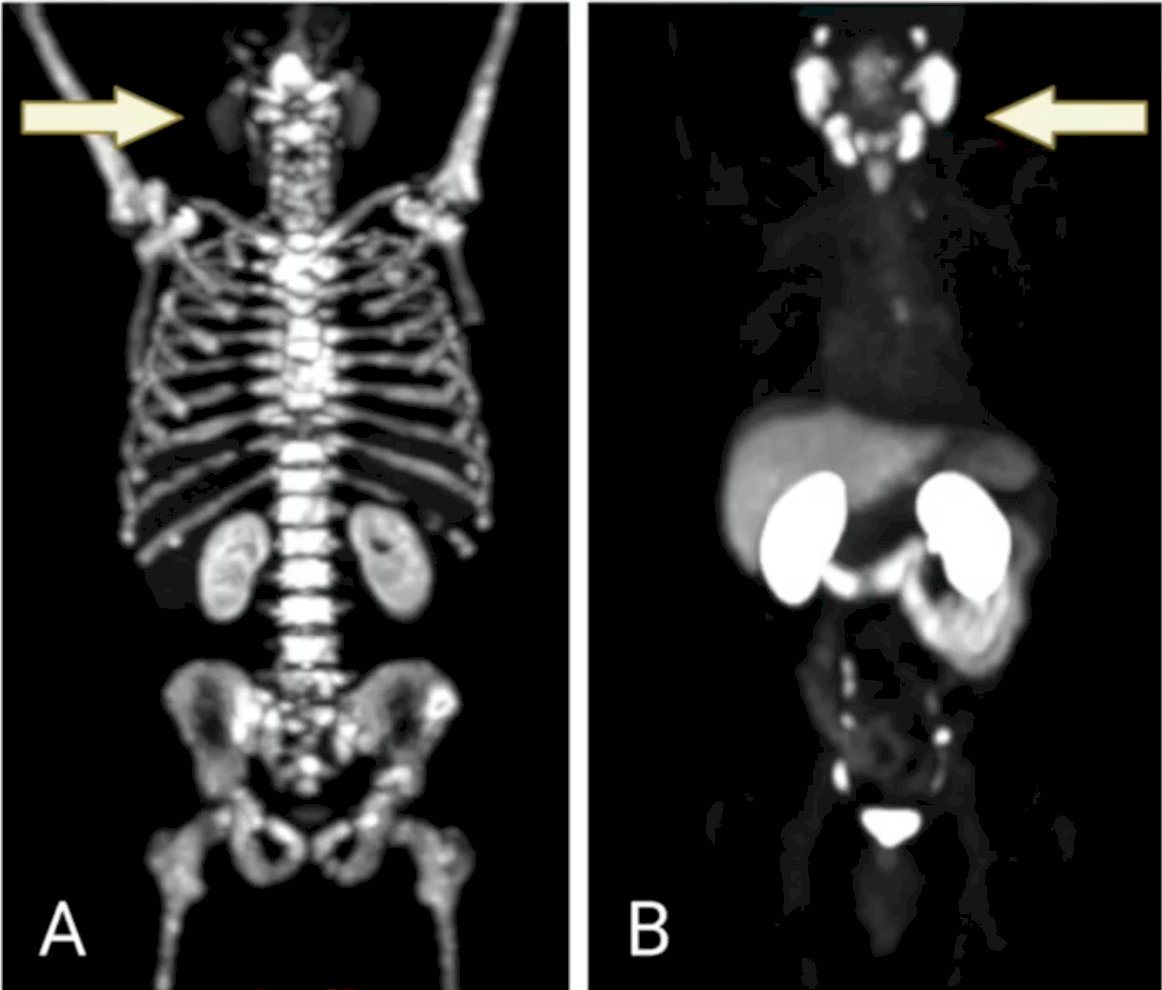
Dr. Oprea-Lager then provided case examples of patients to demonstrate the “tumor sink effect”. In panel A, this patient exhibits a very high tumor volume, with extensive PSMA-positive osseous metastases evident on 68Ga-PSMA PET/CT. The majority of the radioligand is sequestered in the numerous sites of disease, resulting in minimal uptake in the salivary glands (arrow). In panel B, this patient presents with a low volume of lymph node-only metastatic disease on baseline 68Ga-PSMA PET/CT. With a lower tumor burden, there is significantly greater radioligand uptake by the salivary glands (arrow), potentially leading to a higher degree of salivary toxicity:
There are several ways to decrease/treat xerostomia and its related complications, with the first being the prevention of radioligand uptake.1 This can be done by local cooling with icepacks, injection of botulinum toxin A, displacement with 2-PMPA + pro-drug JHU-245, folic polyglutamate tablets, or monosodium glutamate:

The second way is by administration of radioprotectors. Options for radioprotection include amifostine, tempol, or lidocaine hydrochloride:

The third way is by restoration of salivary gland function. This can be accomplished by gene transfer of human aquaporin-1, using artificial salivary glands, or stem cell transplantation:

Finally, stimulating salivary gland secretion may assist with decreasing/treating xerostomia. Options include drinking lemon juice or eating yogurt, injection of local anesthetics and histamines, or injection of short-acting sialogogues (pilocarpine, methacholine, and cemiveline):


Dr. Oprea-Lager concluded her presentation discussing prevention and management of radioligand therapy-induced xerostomia with the following take-home points:
- Xerostomia remains a debilitating and extremely uncomfortable side effect, hampering the usage of PSMA radioligand therapy in earlier treatment lines
- We need to develop efficient and effective strategies to either prevent, treat or alleviate symptoms of salivary gland toxicity
- Further research is needed to make radioligand therapy safer to use and to diminish xerostomia in patients treated with PSMA radioligand therapy
Presented by: Daniela Oprea-Lager, MD, PhD, Radboud University Medical Centre, Nijmegen, Netherlands
Written by: Zachary Klaassen, MD, MSc – Urologic Oncologist, Associate Professor of Urology, Georgia Cancer Center, Wellstar MCG Health, @zklaassen_md on Twitter during the 2026 Advanced Prostate Cancer Consensus Conference (APCCC), Lugano, Switzerland, Thurs, April 30 – Sat, May 2, 2026.
Reference:- Heynickx N, Herrmann K, Vermeulen K, et al. The salivary glands as a dose-limiting organ of PSMA-targeted radionuclide therapy: A review of the lessons learnt so far. Nucl Med Biol. 2021 Jul-Aug;98-99:30-39.